Outdoor signage performs differently from indoor display graphics. A flag that’s positioned outside is often exposed to moisture, wind, temperature changes, UV radiation, and repeated mechanical movement. Printed artwork doesn’t determine how well an outdoor banner flag performs. Instead, it's the dye penetration, fabric weight, base selection, pole construction, and the style of the attached flag.
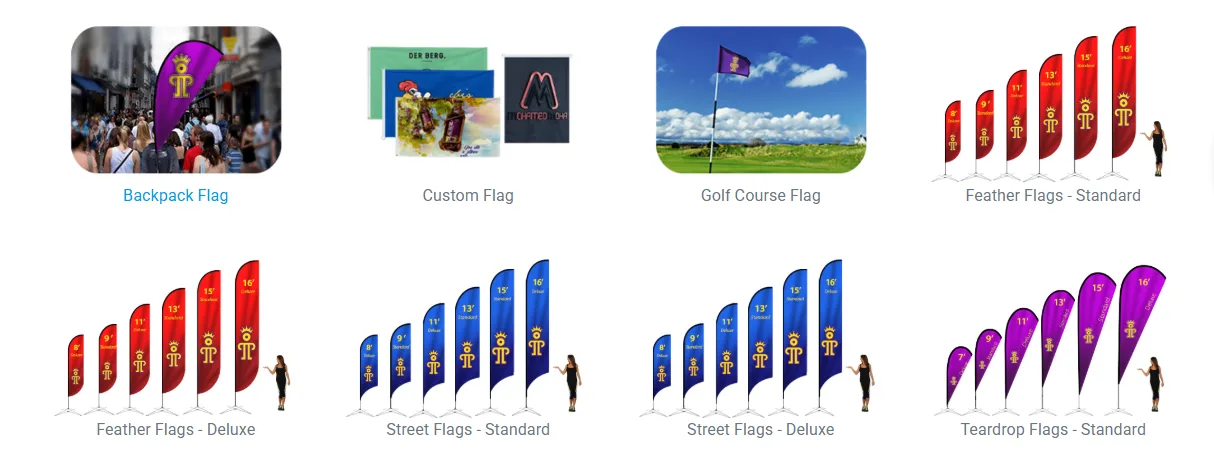
Modern fabric flags are designed as flexible display systems. The textile needs to be light enough to move easily with air currents while retaining print definition and dimensional stability. The supporting hardware should have enough structural support for the intended installation environment. At Paramount Promotions, there are different flag formats such as feather flags, street flags, custom flags, backpack flags, Mondo flags, and large-sized outdoor banner displays.
Why Does Paramount Promotions Use Dye-Sublimation Printing on Flag Fabric?
Dye sublimation is ideal for outdoor fabric graphics. The dye transfers into the textile fibers instead of depositing as a thick surface layer. Paramount Promotions’ full-color dye sublimation procedure supports:
- Gradients
- Full-color photographic artwork
- Complex logos
- Fine graphic details
- Repeating Patterns
- Large areas of solid color
As the textile moves and blends continuously, it integrates color into the fabric. It is technically different from the application of a rigid printed film to a solid substrate.
Which One to Choose: Single-Sided Vs. Double-Sided Flags?
The one technical aspect is whether the flag requires one printed layer or two.
For the feather flags, Paramount Promotions says the single-sided flags need dye sublimation with ink penetrating through the fabric. The front needs 100% ink coverage, making 70-90% of the image bleed through to the reverse as a mirrored image. The double-sided construction requires a blockout fabric layer between two printed flag layers. This helps prevent the artwork on one side from visually interfering with the other.
The option between single- and double-sided construction is a choice of material and optical decision, not just a question of any printing surface.
How Should Outdoor Flags Artwork Be Prepared?
Flag artwork requires to be prepared differently in comparison to the rigid signage. The textile can fold, move, and show a mirrored image on the other side. It is important for designers to focus on visual simplicity.
The technical artwork considerations are:
- Vector files for typography and logos
- Required high-resolution raster images
- Strong foreground/background contrast
- Avoid excess of thin lines
- Necessary information away from attachment areas
- How the design looks from the other side
- Design as per manufacturer’s artwork template
This way, short messages and large logos are easy to view on moving fabric.
Why Pole Construction Matters: Aluminium, Fiberglass & Carbon Composite
The pole is the structural backbone of the flag system, supporting fabric for controlled movement.
Depending on the flag model, Paramount Promotions provides different hardware configurations. The Standard Feather Flag Hardware uses fiberglass and aluminium poles, which include an iron spike base along with a 27-inch-wide cross base. On the other hand, the deluxe configuration requires steel spike bases, carbon composite poles, and a wider 33” cross base.
The below-mentioned materials have mechanical characteristics:
Aluminium - It provides a lightweight, rigid component.
Fiberglass - It gives controlled flexibility, useful in pole systems requiring accommodated repeated movement.
Carbon Composite - It provides a high strength-to-weight ratio that’s used in Paramount Promotions’ deluxe hardware configurations.
It is necessary to evaluate the flag size, installation conditions, and pole material together.
Technical Specifications for Outdoor Flag Systems:
Factor Key Consideration Base & Ground Choose spike bases for suitable soil and cross bases for hard surfaces or freestanding use. Wind Loading Consider flag size, wind speed, pole height, fabric, and base stability. Paramount’s Giant Outdoor Banner Display is rated for 18–23 mph winds. Flag Geometry Feather, teardrop, and street flags have different shapes, footprints, and mounting requirements. Edge Finishing Options include hot-knife cut or ½-inch double-folded stitched edges. Pole Pockets Available in top, bottom, or side configurations, with sizes from 1–6 inches. Grommets Corner or side grommet placement provides an alternative attachment method. System Selection Match the base, pole, flag shape, and attachment method to the installation surface and environmental conditions.
A Final Checklist Before Ordering Outdoor Banner Flags!
It is essential to follow the technical checklist, which is as follows:
- Construction and fabric weight
- Single-or double-sided printing
- Dye-sublimation needs
- Final flag dimensions
- Base type
- Pole material
- Edge treatment
- Surface conditions
- Grommet configurations
- Artwork dimensions
The outdoor flags are usually lightweight. Their performance is dependent on the interaction between printing, geometry, pole mechanics, base stability, and attachment points. It is necessary to choose components carefully, as there needs to be a complete system. Explore the wide range of flag options at Paramount Promotions.
Q1. What material is used by Paramount Promotions for custom flags?
Ans. Paramount Promotions uses 115 g/m² for the custom flag product.
Q2. What makes single-sided flags different from double-sided flags?
Ans. Single-sided flags have one printed fabric layer and are lighter. Double-sided flags come with two printed layers with a blockout fabric between them, which makes the same image visible on both sides but adds weight.
Q3. What bases are required to be used outdoors?
Ans. Depending on the flag system, there are options including cross bases and spike bases. The appropriate choice is dependent on the installation conditions and supporting surface.
Q4. What are the edge-finishing options?
Ans. For the custom flags, there are hot-knife cut edges as well as ½ - inch double-folded stitched edges.