Verification remains one of the most important steps in full-arch implant dentistry. Regardless of whether a workflow is digital or conventional, clinicians must confirm that implant position records accurately represent the patient's clinical situation before final prosthetic fabrication begins.
Traditionally, implant verification has been performed using resin-based verification jigs and physical models. However, as digital workflows become more common, technologies such as OptiSplint® are being adopted to support a more streamlined and digital-first approach to implant verification.
Understanding the differences between OptiSplint® dental workflows and traditional verification methods can help clinicians determine which approach best aligns with their restorative objectives and digital workflow goals.
Why Verification Is Important in Full-Arch Implant Cases
Full-arch restorations involve multiple implants supporting a single prosthetic framework. Because every implant must align accurately, even small discrepancies can affect the fit of the final restoration.
Without proper verification, clinicians may encounter:
- Passive fit issues
- Prosthetic screw complications
- Framework stress
- Additional chairside adjustments
- Laboratory remakes
- Delayed restoration delivery
Verification helps identify inaccuracies before final fabrication, improving overall restorative predictability.
Organizations such as the American Academy of Implant Dentistry (AAID) continue emphasizing restorative accuracy as a critical factor in successful implant treatment.
What Are Traditional Verification Jigs?
Traditional verification jigs are commonly fabricated using resin materials that connect impression copings or implant components together.
These jigs are used to verify that implant positions captured during the impression process accurately represent the patient's clinical situation.
A traditional workflow often includes:
- Conventional impressions
- Stone model fabrication
- Resin jig fabrication
- Sectioning and rejoining procedures
- Physical verification appointments
For many years, this approach has been considered a standard method for verifying implant positions in full-arch cases.
Challenges Associated With Traditional Verification Jigs
Although traditional verification methods remain widely used, they can involve several manual steps that may introduce variability.
Each stage of the process creates opportunities for minor inaccuracies to occur.
Common challenges include:
- Material shrinkage or distortion
- Additional laboratory procedures
- Multiple handling stages
- Increased appointment requirements
- Manual sectioning and rejoining techniques
- Longer overall workflow times
As implant workflows become increasingly digital, many clinicians are exploring alternatives that reduce dependence on analog procedures.
What Is OptiSplint®?
OptiSplint® is a digital scannable verification jig designed to support full-arch implant workflows.
Instead of relying on traditional resin-based verification methods, OptiSplint® creates a rigid verification structure that can be scanned digitally while preserving the spatial relationship between implants.
As part of the broader Digital Arches digital workflow ecosystem, the system is designed to integrate with modern implant treatment protocols that incorporate digital scanning, photogrammetry, and CAD/CAM manufacturing.
The primary objective is to support accurate implant position verification within a digital workflow environment.
How OptiSplint® Differs From Traditional Verification Jigs
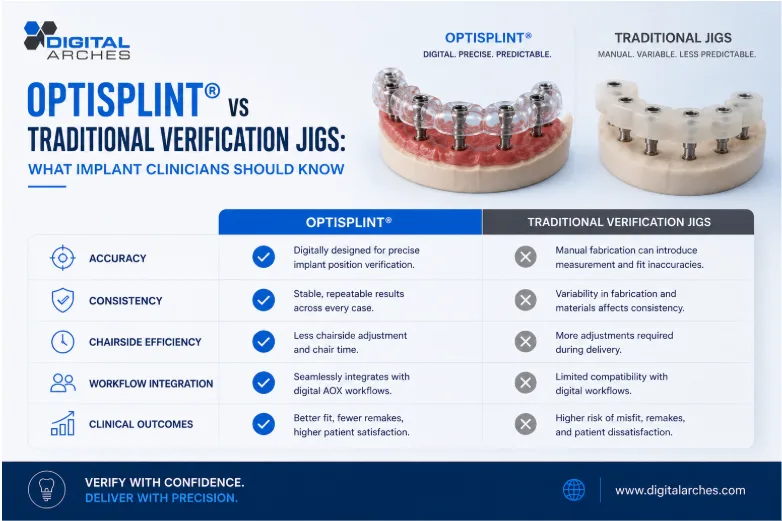
The most significant difference between OptiSplint® and traditional verification jigs is how implant position information is captured and transferred.
Traditional verification often relies on physical materials and multiple analog workflow stages. OptiSplint® is designed to support digital record acquisition and digital verification processes.
Key differences include:
Traditional Verification JigsOptiSplint® Digital VerificationPhysical resin-based workflowDigital scannable workflowMultiple manual fabrication stepsStreamlined digital processPotential material distortionRigid digital verification structureAdditional model handlingReduced dependence on physical modelsAnalog data transferDigital data integrationWhile both methods aim to verify implant positions, the workflows used to achieve that goal differ significantly.
Why More Clinicians Are Moving Toward Digital Verification
The adoption of digital implant workflows has accelerated in recent years.
Many clinicians are now combining:
- Digital treatment planning
- Guided surgery
- Intraoral scanning
- Photogrammetry
- Digital verification
- CAD/CAM prosthetic fabrication
As these technologies become more integrated, verification systems that align with digital workflows are becoming increasingly attractive.
Research published through the National Library of Medicine highlights the growing role of digital technologies in improving communication, restorative planning, and treatment workflow efficiency.
Potential Advantages of OptiSplint® Dental Workflows
Clinicians adopting digital verification workflows often cite workflow efficiency and consistency as important considerations.
Potential advantages associated with OptiSplint® include:
- Improved implant position stability
- Reduced scan body movement
- Better digital workflow integration
- More efficient data transfer
- Enhanced communication with laboratories
- Greater restorative predictability
Because implant positions are maintained within a unified verification structure, clinicians may achieve greater confidence in the records used for prosthetic fabrication.
How Verification Influences Passive Fit
Regardless of the verification method used, passive fit remains one of the most important restorative objectives.
A restoration that does not fit passively can create stress within the prosthetic framework and implant components.
Potential complications associated with poor passive fit include:
- Prosthetic screw loosening
- Framework strain
- Increased maintenance requirements
- Restorative instability
- Long-term prosthetic complications
Verification helps reduce the likelihood of these issues by ensuring that restorative records accurately represent implant positions before manufacturing begins.
OptiSplint® and Photogrammetry: Complementary Technologies
One common misconception is that digital verification replaces other digital technologies.
In reality, many modern workflows combine multiple systems to improve treatment accuracy.
For example, clinicians frequently integrate:
- Photogrammetry
- Digital verification
- CAD/CAM manufacturing
- Guided surgery
- Digital treatment planning
While photogrammetry systems help capture implant positions digitally, verification technologies help confirm that the information being used throughout the restorative workflow is accurate.
These technologies often work together rather than serving as direct replacements for one another.
Educational organizations such as the Academy of Osseointegration continue supporting research into digital workflow integration, restorative predictability, and implant accuracy.
Which Verification Approach Is Better?
There is no universal answer because workflow preferences vary among clinicians, laboratories, and treatment teams.
Traditional verification jigs remain a proven method and continue to be used successfully in many practices.
However, digital verification systems such as OptiSplint® are increasingly being adopted by clinicians who want to:
- Reduce analog workflow steps
- Improve digital integration
- Streamline communication
- Support modern AOX workflows
- Increase restorative predictability
The choice often depends on the practice's workflow goals, technology adoption level, and restorative preferences.
Frequently Asked Questions
What is the main difference between OptiSplint® and traditional verification jigs?
Traditional verification jigs rely on physical resin-based workflows, while OptiSplint® is designed to support digital implant verification through a scannable verification structure.
Can OptiSplint® replace traditional verification methods?
Many clinicians use OptiSplint® as part of a digital workflow, but the choice between verification methods depends on individual clinical preferences and workflow requirements.
Why are clinicians adopting digital verification systems?
Digital verification systems can improve workflow integration, reduce manual procedures, and support more efficient communication between clinics and laboratories.
Is passive fit still important in digital workflows?
Yes. Passive fit remains one of the most important objectives in full-arch implant restorations regardless of whether the workflow is digital or conventional.
Final Insight
Verification continues to play a critical role in full-arch implant dentistry. While traditional verification jigs have supported implant workflows for many years, the growing adoption of digital technologies is changing how clinicians approach restorative accuracy and workflow efficiency.
OptiSplint® represents part of this transition toward digital-first implant verification. By supporting digital integration, improving workflow consistency, and helping clinicians maintain accurate implant position records, it offers an alternative approach for practices seeking greater efficiency within modern AOX and full-arch implant workflows.