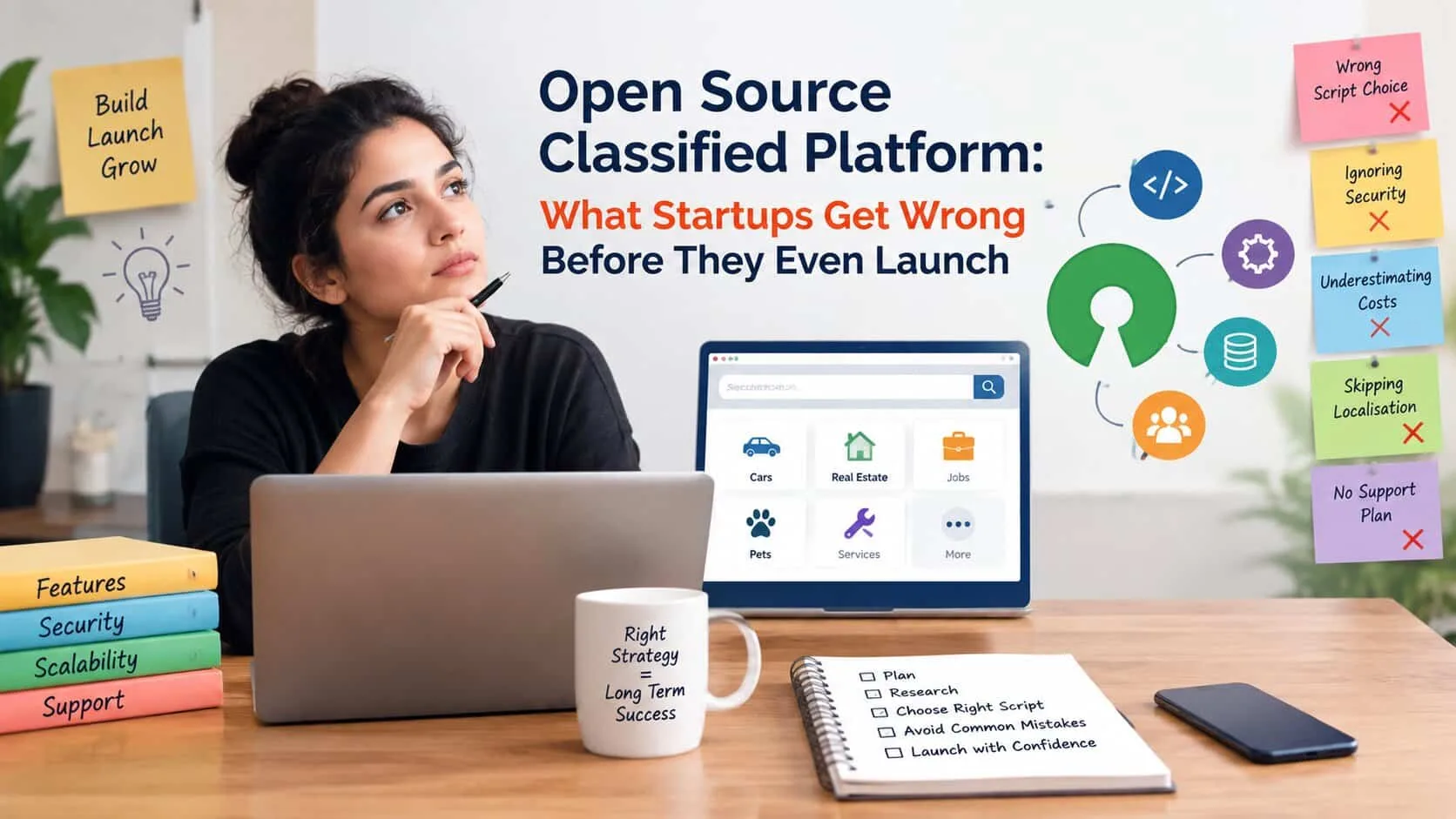
The classified marketplace space looks deceptively simple from the outside. Someone picks an open source classified platform, installs it, adds a few categories, and expects listings to follow. That plan fails more often than it succeeds.
According to a global market analysis published by SkyQuest, the online classified ad platform market was valued at over USD 19 billion in 2025 and is projected to reach nearly USD 31 billion by 2033. More founders are entering this space. Most are picking the wrong starting point.
The problem is rarely the idea. It is the tool selection and the assumptions that come with it.
Why Founders Default to Open Source Without Asking the Right Questions
Free has obvious appeal. An open source classified script can be downloaded, installed on a server, and technically live within a few hours. No licensing fees, no vendor dependency. That reasoning makes sense on paper.
But the real cost shows up later. Open source tools for classified websites (options like Osclass or LaraClassifier) require someone on the team to handle server configuration, plugin maintenance, security patching, and performance optimisation as the platform grows. A comparison published by DreamHost on open source versus proprietary software notes that cloud infrastructure waste often hits 27 percent when teams cannot tune their own stack. For a small startup without a dedicated DevOps person, that overhead compounds fast.
Still, the bigger issue is not technical. It is that many founders have not decided what kind of classified platform they actually want to build before they pick the software to build it on.
What Does an Open Source Classified Platform Actually Give You?
Open source classified software gives you a codebase. That is the beginning, not the end.
A base install typically includes core listing functionality, basic category structures, user accounts, and some form of admin panel. What it usually does not include, at least not in ready-to-use form, is a working payment gateway, mobile apps, a chat system between buyers and sellers, push notifications, or the SEO-specific URL structures that help listings rank in search results.
According to a detailed review of classified listing platforms published on Medium, founders choosing open source alternatives often end up purchasing commercial plugins or themes to fill the gaps, sometimes spending more in total than they would have on a ready-made solution. The "free" label is accurate only for the base code.
This is where the startup's skill profile matters. If the team includes an experienced PHP or Laravel developer who has launched web platforms before, an open source classified script can be shaped into something competitive. Without that, the learning curve is steep and the launch timeline stretches.
Is There a Meaningful Difference Between Open Source and a Ready-Made Classified Script?
Yes. And the difference is less about code and more about time.
An open source classified platform provides source code you control entirely. Modifications are possible at every layer, but every modification is yours to build, test, and maintain. A ready-made classified marketplace script, the kind built for commercial deployment, typically ships with more of the operational layer already assembled: integrated payment support, mobile-ready architecture, admin dashboards that non-technical operators can actually use, and ongoing update paths from the provider.
The research published by BlackHatWorld's classified script discussion thread reflects a recurring pattern: founders start with Osclass or HivePress because they are free, then migrate once the feature gaps and maintenance overhead become visible. That migration costs time and money that a better initial decision would have avoided.
For startups planning a general-purpose marketplace (something in the style of OLX or Dubizzle), a ready-made solution built on a commercial open source classified script often covers the feature gap while still giving founders access to the underlying codebase. The distinction between "open source" and "commercial" is not always a binary one.
What Features Actually Matter at Launch?
Founders tend to fixate on features that matter later. The features that determine whether a classified site survives the first six months are different.
The two things that define early retention are search and trust. Search is whether buyers can find what they are looking for quickly, with filters that match how they actually think about a category. A car buyer wants to filter by make, model, price range, and year. Not just by a broad "vehicles" category. Trust is whether both buyers and sellers feel confident the other party is real. Phone verification, profile completeness indicators, and report mechanisms all contribute here.
A technical piece on classified script features published by Dev.to outlines how real estate, car, and pet platforms each have vertical-specific filters that generic classified software rarely ships with by default. Building them from scratch on an open source base takes meaningful developer time. Platforms that build these verticals early tend to retain more users than those that launch with flat category structures.
Mobile matters, too. Market data cited by MarketReportsWorld shows that over 65 percent of classified ad traffic now comes from mobile devices. A platform that is not mobile-ready from day one will lose users before they even see what the site offers.
How Do You Choose the Right Classified Software for Your Market?
The answer depends on three things: your team's technical capacity, your launch timeline, and the vertical you are entering.
If you have developer resources and a niche-specific product vision that no existing script addresses well, building on open source foundations makes sense. You control every aspect of the product. You will spend more time before launch, but the output is custom.
If the goal is to validate a marketplace idea quickly, to prove that buyers and sellers will show up, a ready-made classified website script gets you there faster. You can focus energy on community building, local marketing, and figuring out which verticals gain traction, rather than on routing logic and server configuration.
There is also a middle path that more founders are choosing. Start with a commercial classified platform that offers source code access. Use the default build to launch and generate early data. Then extend it once you know what the market actually needs, not what you assumed it would need before launch.
A useful starting framework appears in this guide on how to create a classifieds site and ways to profit, which walks through the business decisions before the technical ones.
What Are the Most Reliable Ways to Monetise a Classified Platform?
Revenue is where many classified sites make a structural mistake early. They either leave monetisation for later or they front-load it in a way that pushes users away before the platform has listings density.
The three monetisation approaches that tend to work on classified platforms are featured listings, subscription tiers for power sellers, and banner or category sponsorship for local businesses.
Featured listings work because they are user-initiated. A seller pays to promote a specific ad to the top of a category page. The buyer still controls what they see, and the seller gets measurable visibility. It does not feel like advertising to either party.
Subscription tiers work once sellers are active enough to see the value. A basic tier allows a limited number of active listings; a premium tier removes that cap and adds analytics or promotion credits. A practical breakdown of classified monetisation approaches outlines how platforms sequence these revenue layers without disrupting early growth.
The mistake is trying to charge before the marketplace has supply. Sellers post elsewhere when there are no buyers. Buyers leave when there are no listings. Monetisation works once both sides have reason to stay.
The Launch Decision Most Founders Delay Too Long
Choosing a platform is not a permanent decision. The platforms that scale tend to start with one clear vertical, one geography, and one user type. They expand after they know what is working.
A marketplace that tries to be everything to everyone at launch ends up with thin listings across every category. That looks dead to new users and creates no reason to return. A piece on marketplace differentiation published on LinkedIn describes this pattern clearly: founders build for breadth when users actually need depth.
Pick the vertical where you understand buyer and seller behaviour. Pick the geography where you can seed initial supply yourself if needed. Build the feature set for that vertical specifically. Not for every classified category you hope to add later.
The platform choice flows from that decision, not the other way around.
Conclusion
Open source classified platforms are not a shortcut. They are a starting point that carries real technical responsibility. Understanding what that means before committing to one saves months of course-correction later.
The better question is not "which open source script should I use?" but "what do I need my classified platform to do in the first 90 days, and which tool gets me there with the least overhead?" For some teams, that answer is an open source codebase. For others, it is a commercial ready-made classified script that ships with the operational layer already built. The decision belongs to the founder, and it should come after the product decision, not before it.
---
**Author Bio:** Idea contributed by Asim Patra, Software Product Marketing Manager at Best Classified Script, a software solution specializing in Classified marketplace clone scripts and custom apps. With years of experience in building user-focused buying and selling platforms, Asim guides entrepreneurs in creating differentiated solutions like advanced Letgo clones and Dubizzle Clone.