

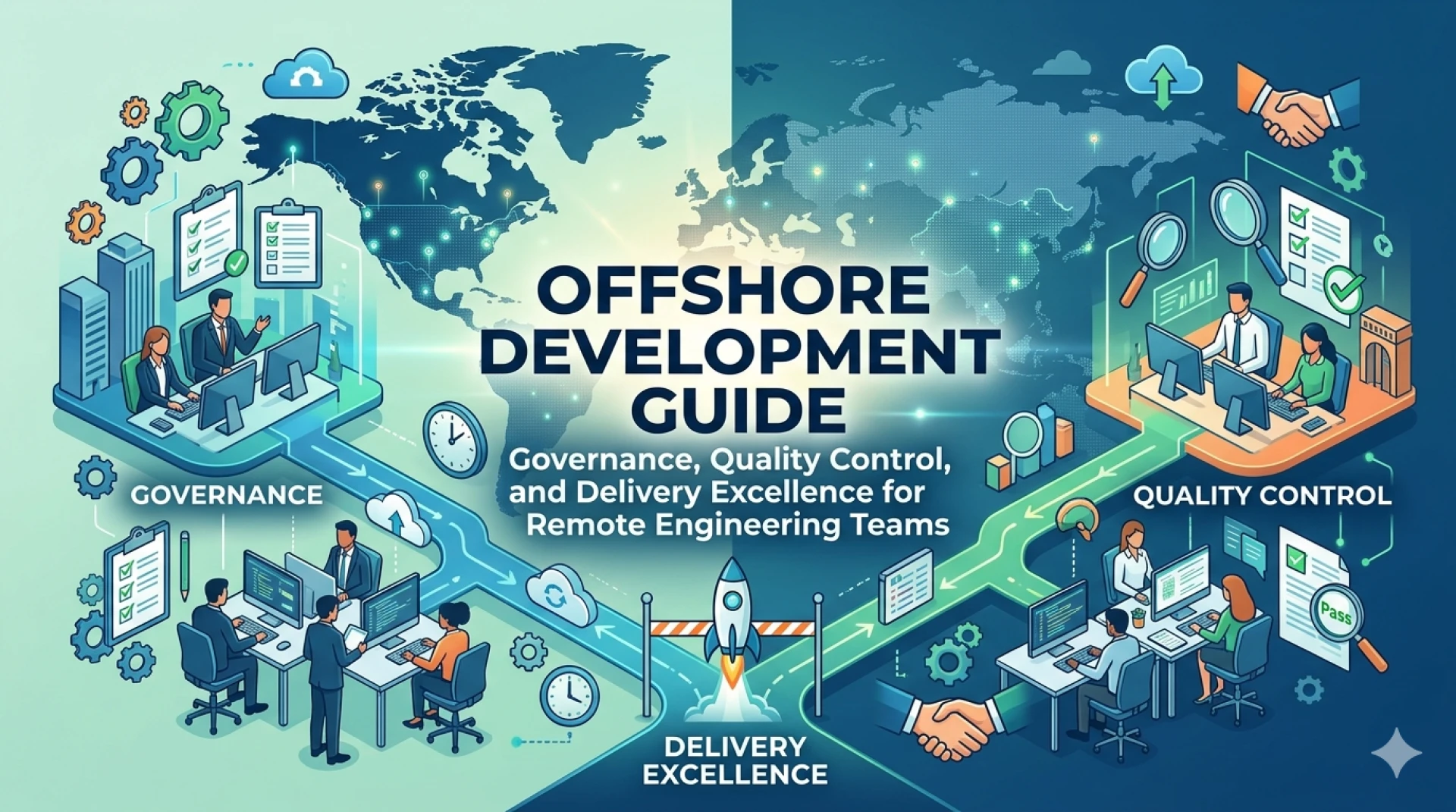
You already know offshore can save money.
You already know offshore can scale teams.
This offshore development guide is about the part most articles skip:
How to run offshore engineering with the same governance, quality, predictability, and control as an in-house team.
Because the real question founders ask after hiring offshore is not:
“Are they good developers?”
It becomes:
“Why does delivery feel harder to control than it should be?”
This guide answers that with frameworks you can apply immediately, whether you are building SaaS, modernizing legacy platforms, or launching mobile app development for startups initiatives.
1. Offshore Is Not a Hiring Decision. It Is an Operating Model.
Most companies treat offshore like recruitment.
Mature companies treat offshore like an operating system.
If you are engaging an offshore development company for custom software development services, you are not adding people. You are extending your engineering workflow across borders.
That requires:
- Delivery governance
- Quality checkpoints
- Communication architecture
- DevOps maturity
- Documentation discipline
Without these, even talented teams drift.
2. The Governance Layer Most Offshore Setups Miss
Governance is the invisible layer between planning and coding.
It defines:
- Who approves what
- How tasks move across stages
- When quality is measured
- How releases are validated
- What “done” truly means
For teams building SaaS product development services or web app development services, governance ensures predictability.
Create a simple governance map:
StageOwnerToolQuality GateRequirementProduct OwnerJiraAcceptance CriteriaDevelopmentOffshore TeamGitCode ReviewTestingQACI PipelineTest CoverageReleaseDevOpsCI/CDDeployment Checklist
This removes ambiguity that often hurts offshore projects.
3. Quality Control Framework for Offshore Teams
Quality is not about senior developers. It is about enforced standards.
Your offshore quality framework must include:
- Mandatory pull request reviews
- Defined branching strategy
- Static code analysis
- Automated testing
- Documentation per module
This is where DevOps consulting and DevOps professional services change the game. With CI/CD pipelines and automated quality checks, geography becomes irrelevant.
4. Communication Architecture Beats Communication Frequency
Daily calls do not guarantee clarity. Structure does.
Define:
- Where tasks live (Jira/ClickUp)
- Where discussions happen (Slack/Teams)
- Where documentation lives (Notion/Confluence)
- Where code lives (GitHub/GitLab)
For teams handling API integration services for e-commerce websites or complex backend systems, this clarity avoids repeated explanations.
5. The Offshore Documentation Rule: If It’s Not Written, It Doesn’t Exist
Offshore teams cannot rely on hallway conversations.
Document:
- Architecture decisions
- API contracts
- Deployment steps
- Error handling logic
- Database schema changes
This is especially critical for legacy system modernization services and software maintenance services for legacy systems where historical knowledge matters.
6. Defining “Done” for Offshore Delivery
Most offshore friction comes from different definitions of completion.
Define “done” as:
- Code written
- Code reviewed
- Tests passed
- Documentation updated
- Deployed to staging
This clarity is vital in SaaS product development services and long-running projects.
7. Security, Access, and IP Governance
Professional offshore setups include:
- Role-based repository access
- NDA and IP agreements
- Secure VPN or controlled access
- Audit logs for deployments
This matters greatly for domains like fintech and enterprise healthcare software.
8. Offshore Cost Optimization Without Quality Loss
The goal is not cheap developers. The goal is efficient engineering economics.
You save on:
- Hiring cycles
- Infrastructure
- Training overhead
- Idle time between releases
While still maintaining premium standards expected from a software development company near me.
9. Offshore for Different Use Cases
SaaS Platforms
Long-term dedicated teams work best.
Mobile App Development for Startups
Rapid MVP cycles with scalable backend support.
API Integration Services
Specialized engineers reduce integration time.
Legacy Modernization
Gradual, safe transformation of old systems.
Cloud Migration
Setting up cloud server for small business environments efficiently.
10. The Delivery Dashboard Every Founder Should Have
Track these weekly:
- Sprint velocity
- Bug rate
- Deployment frequency
- Code review turnaround time
- Test coverage
This makes offshore performance measurable, not emotional.
11. The First 30 Days Offshore Plan
Week 1: Setup tools, access, documentation
Week 2: Start with small tasks and reviews
Week 3: Introduce CI/CD and testing discipline
Week 4: Begin full sprint execution
Gradual onboarding prevents chaos.
12. Common Offshore Failure Patterns
- Vague requirements
- No product owner
- No DevOps pipeline
- No code review culture
- Choosing based on price alone
Offshore multiplies both strengths and weaknesses.
13. Turning Offshore Into a Long-Term Engineering Advantage
Once governance and quality are stable:
- Add more engineers
- Expand modules
- Increase release cycles
- Improve architecture
This is where offshore becomes a competitive advantage.
14. How API DOTS Implements Offshore Delivery Excellence
API DOTS operates as a technology consultant and product development software agency, not just an offshore vendor.
Their approach includes:
- Documentation-first development
- Strong DevOps practices
- Experience in custom software development services, SaaS, and healthcare
- Expertise in legacy system modernization services
- Dedicated teams aligned with client workflows
- Transparent reporting and communication
API DOTS ensures offshore teams feel like an internal engineering unit, delivering predictability and quality.
15. Offshore Development Is a System, Not a Shortcut
When structured properly, offshore development provides:
- Scalability
- Predictability
- Quality
- Cost efficiency
- Faster time to market
This offshore development guide is about building that system.
With the right governance, tools, and partner like API DOTS, offshore development becomes one of the most powerful ways to scale engineering without losing control.


