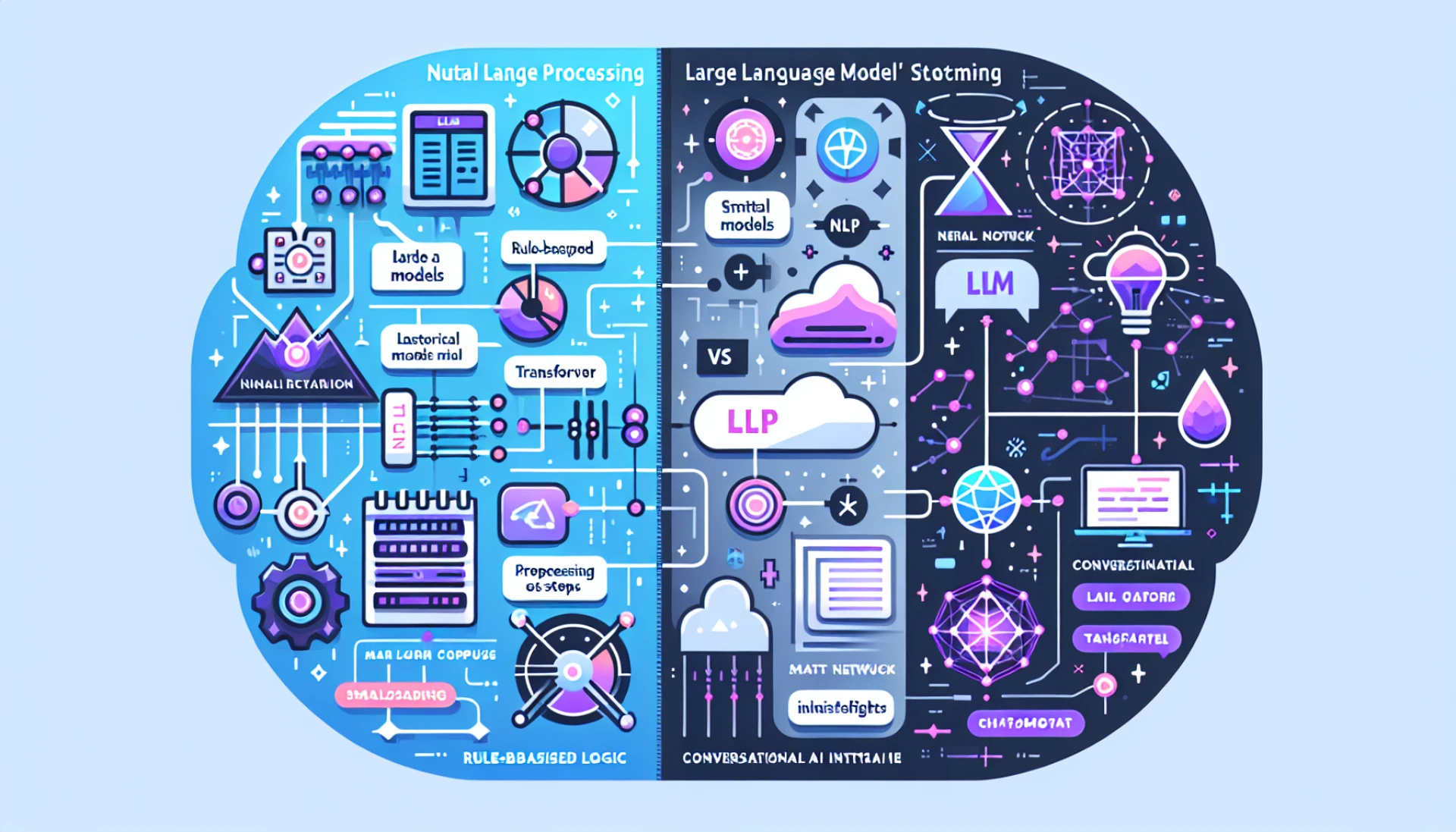
Artificial intelligence has dramatically improved how machines understand and communicate in human language. Two important technologies behind this advancement are Natural Language Processing (NLP) and Large Language Models (LLMs).
While both deal with language, they differ in capability, scale, and application. Understanding NLP vs LLM is essential for choosing the right AI solution in 2026 and beyond.
Understanding Natural Language Processing (NLP)
Natural Language Processing is a field of AI focused on enabling computers to interpret, analyze, and process human language in a structured way.
NLP systems are commonly used for specific, predefined language tasks.
Main Capabilities of NLP
- Detecting sentiment in text
- Categorizing documents
- Extracting keywords
- Identifying entities (names, locations, brands)
- Translating languages
- Recognizing speech
NLP models typically rely on linguistic rules, statistical models, or machine learning algorithms designed for specific tasks.
Understanding Large Language Models (LLMs)
Large Language Models are advanced AI systems trained on massive text datasets to recognize patterns and context in language.
Unlike traditional NLP systems, LLMs can generate new text rather than just analyze existing content.
Main Capabilities of LLMs
- Writing articles and blogs
- Generating marketing content
- Answering complex questions
- Summarizing long documents
- Producing conversational chatbot responses
- Assisting with coding tasks
LLMs use deep learning techniques and large neural networks to produce context-aware outputs.
NLP vs LLM: Side-by-Side Comparison
Here is a simplified breakdown of the difference:
Scope
- NLP handles structured, task-based processing.
- LLM handles broad, multi-purpose language tasks.
Output
- NLP produces labels, scores, or extracted data.
- LLM produces human-like text responses.
Flexibility
- NLP is designed for fixed tasks.
- LLM adapts to various prompts and scenarios.
Training Data
- NLP models may use limited datasets.
- LLMs are trained on extremely large datasets.
Cost
- NLP systems are generally more affordable.
- LLMs require higher computational resources.
Practical Examples of NLP vs LLM
Example 1: Customer Reviews
- NLP can classify reviews as positive or negative.
- LLM can summarize reviews and suggest improvements.
Example 2: Chatbots
- NLP chatbot responds using predefined rules.
- LLM chatbot responds conversationally with context awareness.
Example 3: Content Creation
- NLP extracts keywords from articles.
- LLM generates full-length articles.
Why Understanding NLP vs LLM Matters
Businesses using AI must align technology with their goals.
Choosing incorrectly can result in:
- Increased operational costs
- Inefficient automation
- Lower return on investment
Understanding NLP vs LLM helps organizations:
- Improve decision-making
- Optimize AI implementation
- Scale communication efficiently
- Maintain content quality
- Accurate for defined tasks
- Efficient for large datasets
- Lower infrastructure requirements
- Suitable for analytics and insights
- Creative and dynamic responses
- Context-aware communication
- Versatile across multiple tasks
- Ideal for content-driven strategies
Limitations to Consider
NLP Limitations- Limited adaptability
- Requires configuration for each task
- Not suitable for creative generation
- Higher cost
- Risk of incorrect or fabricated responses
- Requires monitoring and validation
Both technologies require human oversight to ensure reliability.
The Future of NLP and LLM
The future of AI will likely integrate structured language processing with advanced generative capabilities. Hybrid systems combining NLP precision and LLM flexibility will dominate enterprise solutions.
Organizations that understand these differences today will gain a competitive advantage in digital transformation.
Conclusion
The comparison of NLP vs LLM comes down to purpose and capability.
- NLP analyzes and structures language.
- LLM understands and generates language.
- NLP is task-focused and efficient.
- LLM is flexible and conversational.
Both technologies are powerful when used correctly. The key is selecting the right solution based on your specific objectives.