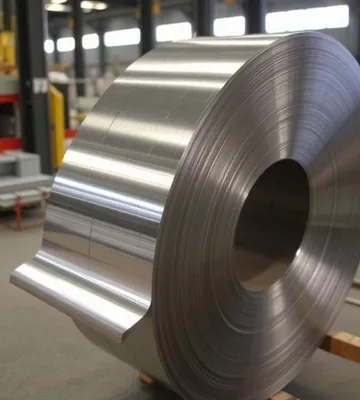
Nickel strips are thin, flat products manufactured from nickel and nickel alloys for electrical, battery, electronic, chemical processing and industrial applications. Their combination of corrosion resistance, ductility, thermal performance and electrical conductivity makes them useful where a thin and reliable metal strip is required.
Depending on the application, nickel strips can be supplied in different grades, thicknesses, widths, tempers and surface finishes. Nickel 200, Nickel 201 and Nickel 270 are among the grades used for different industrial and specialized applications.
For battery manufacturing, nickel strips are commonly used to connect cylindrical cells and create electrical connections between cells. However, the right material depends on the current requirement, welding process, mechanical requirements and overall battery design.
What Is a Nickel Strip?
A nickel strip is a narrow, flat metal product made by processing nickel into a controlled thickness and width. It may be supplied in coils or cut lengths.
Unlike a round wire, a strip provides a flat surface that can be formed, welded or connected to other components.
Nickel strips are available in a wide range of dimensions. The exact size depends on the manufacturer and the intended application.
Common specifications include:
- Material grade
- Thickness
- Width
- Length or coil weight
- Temper
- Surface finish
- Edge condition
- Applicable material standard
For precision applications, buyers may also specify dimensional tolerances and testing requirements.
Types of Nickel Strips
Different nickel grades offer different combinations of chemical, electrical and mechanical properties.
Nickel 200 Strip
Nickel 200, identified by UNS N02200, is a commercially pure nickel grade. It offers good corrosion resistance and useful electrical and thermal properties.
Nickel 200 strips are used in:
- Electrical components
- Chemical processing equipment
- Battery-related applications
- Electronic components
- Industrial fabrication
The grade is available in strip, sheet, plate and other product forms.
Nickel 201 Strip
Nickel 201, or UNS N02201, is a low-carbon commercially pure nickel grade.
Its lower carbon content makes it suitable for applications where exposure to higher temperatures can make carbon control important.
Nickel 201 strips can be considered for:
- Chemical processing
- Electrical applications
- Electronic components
- Specialized industrial equipment
- High-temperature applications where the grade is appropriate
Nickel 270 Strip
Nickel 270, or UNS N02270, is a high-purity nickel grade. It is particularly associated with specialized electrical and electronic applications where high purity and controlled electrical characteristics are important.
It can be supplied as precision strip for applications such as:
- Electrical components
- Resistance thermometers
- Electronic components
- Specialized battery connector applications
- Other precision applications
The material should be selected according to the applicable specification and the actual operating requirements.
Nickel Strip vs Pure Nickel Strip
The terms nickel strip and pure nickel strip are sometimes used interchangeably, but they do not necessarily mean the same thing.
"Nickel strip" is a broad term that can refer to strips made from different nickel grades.
"Pure nickel strip" generally refers to commercially pure or very high-purity nickel grades.
For example:
GradeUNSGeneral DescriptionNickel 200N02200Commercially pure nickelNickel 201N02201Low-carbon commercially pure nickelNickel 270N02270High-purity nickelThe correct grade should be selected based on the application's electrical, mechanical, thermal and corrosion requirements.
Nickel Strips for Battery Applications
One of the important applications for nickel strips is battery pack manufacturing.
Nickel strips can be used to create electrical connections between cylindrical battery cells. They are particularly relevant to battery assemblies using cells such as:
- 18650
- 21700
- 26650
- 32650
- 32700
The required strip size depends on the cell arrangement and electrical design.
Why Nickel Strip Is Used in Battery Packs
Nickel provides several useful characteristics for battery connections:
- Electrical conductivity
- Corrosion resistance
- Ductility
- Weldability under suitable conditions
- Availability in thin strip form
- Compatibility with resistance welding processes
However, not every nickel strip is suitable for every battery application.
The designer should consider current requirements, resistance, strip dimensions, welding performance and heat generation.
Pure Nickel Strip for Spot Welding
Resistance spot welding is widely used in battery pack assembly.
A nickel strip can be welded to battery terminals using suitable welding equipment and properly selected welding parameters.
The welding result depends on several factors:
- Nickel grade
- Strip thickness
- Surface condition
- Strip width
- Welding current
- Pulse duration
- Electrode pressure
- Electrode condition
- Battery terminal material
- Welding equipment
A strip that works well in one battery pack may require different welding parameters in another design.
For this reason, manufacturers should conduct welding trials using the actual cells, strip and equipment before starting production.