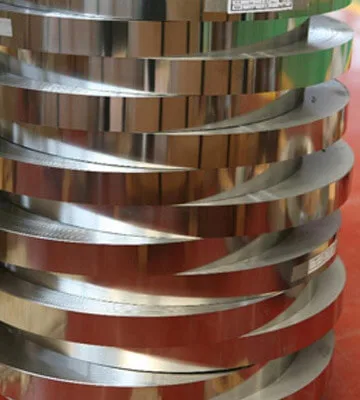
Nickel 200 Strips are commercially pure nickel products used where corrosion resistance, ductility, thermal conductivity and electrical properties are important. Identified as UNS N02200, Nickel 200 is commonly supplied in strip, coil, foil, sheet and other forms.
These strips are used in chemical processing, electrical and electronic equipment, food-processing equipment and other industrial applications. The grade is particularly useful in many caustic, alkaline and reducing environments.
For buyers, selecting the right Nickel 200 Strip means checking more than the material grade. Thickness, width, temper, finish, standard, quantity and inspection requirements should all be clearly specified.
What Are Nickel 200 Strips?
Nickel 200 is a commercially pure wrought nickel grade with a high nickel content. It is designated UNS N02200 and is valued for its corrosion resistance and good mechanical and fabrication characteristics.
Nickel 200 Strips are narrow, flat sections of the material that can be supplied as slit strips or in coil form. Depending on the application, buyers can specify different thicknesses, widths, surface finishes and material conditions.
Common applications include:
- Chemical processing equipment
- Electrical components
- Electronic equipment
- Food-processing equipment
- Chemical storage and handling
- Specialized industrial components
- Selected battery-related applications
Nickel 200 Strip Specifications
The exact specification should be confirmed before purchasing because requirements can vary according to the product form and application.
SpecificationNickel 200 StripGradeNickel 200UNSN02200MaterialCommercially pure nickelCommon StandardASTM B162FormStrip / CoilSurfaceBright, cold rolled or as specifiedWidthAs per customer requirementThicknessAs per customer requirementLengthCoil or cut lengthTemperAnnealed or cold worked, as requiredASTM B162 and ASME SB162 are commonly referenced for Nickel 200 sheet, plate and strip products.
Chemical Composition of Nickel 200
A typical Nickel 200 composition includes a minimum nickel content of around 99% along with controlled quantities of iron, copper, manganese, silicon, carbon and sulfur.
ElementTypical RequirementNickel99.0% min.Carbon0.15% max.Iron0.40% max.Copper0.25% max.Manganese0.35% max.Silicon0.35% max.Sulfur0.01% max.For critical industrial applications, buyers should verify the actual chemistry through the Mill Test Certificate (MTC) rather than relying only on typical values.
Properties of Nickel 200 Strips
Good Corrosion Resistance
Nickel 200 provides good resistance to several corrosive environments. It is particularly useful in many alkaline and caustic applications.
Excellent Ductility
The material can be formed and fabricated into different shapes, making it useful for applications requiring bending or forming.
Good Thermal Conductivity
Nickel 200 offers useful thermal conductivity, which can be beneficial in selected thermal and industrial applications.
Useful Electrical Properties
Its electrical characteristics make Nickel 200 suitable for selected electrical and electronic applications.
Good Weldability
Nickel 200 can be welded using suitable procedures, subject to the requirements of the particular application.
Nickel 200 Strip Sizes
Nickel 200 Strips can be supplied in different dimensions depending on the application and supplier capability.
For example, commercially available products include thin gauges and wider strip sizes, while custom dimensions may also be available. One supplier lists strip thicknesses from 0.15 mm to 3.50 mm, while another lists strips from 0.50 mm to 3.00 mm and widths up to 1000 mm.
Instead of assuming a standard size will suit your application, provide the supplier with:
- Required thickness
- Required width
- Coil or straight length
- Quantity
- Tolerance
- Temper
- Surface finish
This helps the supplier quote the correct product.
Nickel 200 Strip Surface Finish
Surface finish can affect fabrication, appearance and subsequent processing.
Depending on the requirement, Nickel 200 Strips may be available with finishes such as:
- Bright
- Cold rolled
- Hot rolled
- Annealed
- Pickled
- Polished
Some suppliers also offer custom finishing and processing.
For precision applications, the required finish should be included in the purchase specification.
Nickel 200 Strips Manufacturing Process
The manufacturing route depends on the required dimensions and final condition.
1. Material Selection
Suitable Nickel 200 material is selected according to the required grade and specification.
2. Rolling
The material is rolled to achieve the required thickness.
Cold rolling can be used where tighter dimensional control and a particular surface finish are required.
3. Annealing
Annealing may be used to obtain the required material condition and improve ductility.
4. Slitting
Wide material can be slit into narrower strips according to customer requirements.
5. Finishing
The strips can undergo cleaning or finishing operations according to the specified surface condition.
6. Inspection
Dimensions, surface quality and material properties are checked according to the applicable requirements.
7. Packaging
The finished strips are packed to protect them during handling and transportation.
Applications of Nickel 200 Strips
Chemical Processing
Nickel 200 is used in selected chemical-processing applications because of its resistance to various alkaline and corrosive environments.
Applications can include:
- Chemical processing equipment
- Caustic handling equipment
- Tanks
- Vessels
- Process components
Electrical and Electronics
Nickel 200's electrical and thermal characteristics make it suitable for selected electrical and electronic components.
Food Processing
Nickel 200 can be used in certain food-processing applications where its corrosion resistance and material characteristics are suitable.
Chemical Storage and Handling
The alloy can be considered for components exposed to compatible chemical environments.
Industrial Fabrication
Its ductility and fabrication characteristics make it useful for specialized industrial components.
Battery-Related Applications
Nickel strips are widely used in battery-related applications, but the exact grade should be selected according to the battery design and electrical requirements.
For battery manufacturers, important factors include:
- Strip thickness
- Width
- Current requirement
- Welding method
- Surface condition
- Material purity
- Battery chemistry
Do not assume that Nickel 200 is automatically suitable for every battery application.