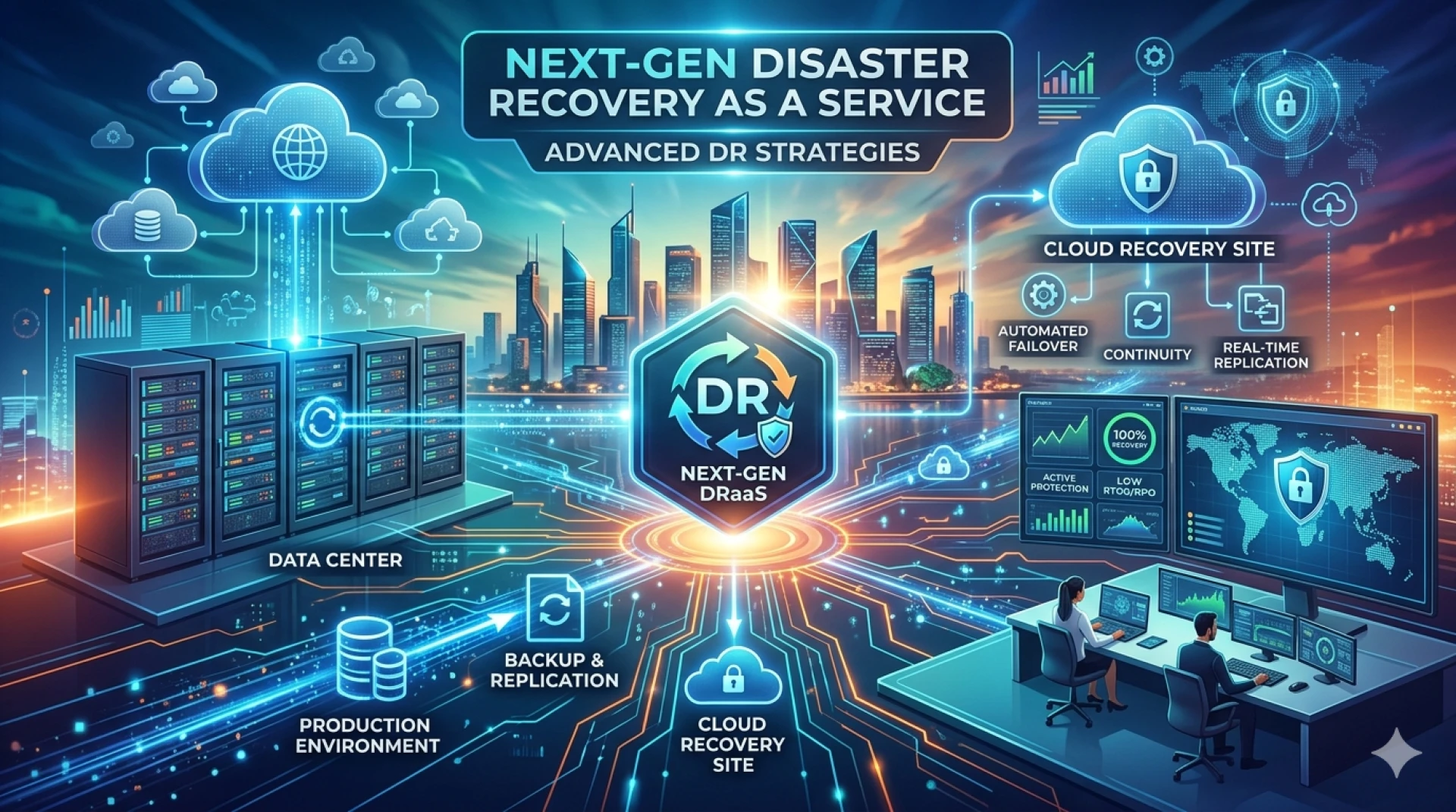
Enterprise technology architectures require resilience mechanisms that surpass traditional backup solutions. Disaster Recovery as a Service (DRaaS) has evolved from simple off-site storage into a highly orchestrated, multi-layered continuity strategy. For technology professionals managing complex environments, understanding advanced DRaaS concepts is essential for maintaining operational integrity during critical infrastructure failures. This guide examines the technical components, modern architecture requirements, and implementation best practices of next-generation DRaaS solutions.
The Imperative of Advanced DRaaS in Modern IT
Modern IT infrastructure operates across highly distributed, containerized, and virtualized environments, rendering basic active-passive failover models inadequate. Advanced DRaaS provides continuous data replication and automated orchestration, aggressively minimizing downtime and data loss. As threat actors deploy sophisticated ransomware targeting backup repositories, organizations must adopt advanced disaster recovery as a service frameworks that integrate robust cybersecurity measures directly into the recovery pipeline.
Key Components of an Advanced DRaaS Solution
Evaluating a next-generation DRaaS platform requires a deep understanding of its underlying architecture and capabilities.
Orchestration and Automation Beyond Basic Failover
Manual runbooks introduce human error and unacceptable latency during a crisis. Advanced DRaaS platforms utilize automated orchestration engine to provision compute resources, remap complex network dependencies, and execute multi-tier failover sequences programmatically. This ensures that web servers, application layers, and databases boot in the exact required order.
Granular Recovery Point and Time Objectives (RPO/RTO)
Legacy snapshots force organizations to accept significant data loss. Modern platforms utilize Continuous Data Protection (CDP) and journal-based recovery to achieve near-zero RPO and RTO. Administrators can rewind to a precise microsecond before a failure or corruption event occurred, rather than relying on a four-hour-old snapshot.
Immutable Backups and Ransomware Protection
Securing the recovery payload is just as critical as the production data. Advanced DRaaS implements immutable storage architectures—often utilizing Write Once, Read Many (WORM) protocols. This guarantees that once data is written to the backup repository, it cannot be altered, encrypted, or deleted by malicious actors or compromised internal credentials.
AI/ML-driven Anomaly Detection and Predictive DR
Machine learning algorithms now actively monitor backup solutions streams. By baselining normal I/O behavior and data change rates, these systems can instantly flag the encryption anomalies associated with ransomware. Predictive analytics can also identify degrading hardware patterns in the production environment, allowing administrators to initiate a proactive failover before a catastrophic crash occurs.
Hybrid and Multi-Cloud DRaaS Strategies
Vendor lock-in presents a significant risk to continuity. Advanced DRaaS enables agnostic hypervisor replication, allowing organizations to failover workloads across diverse environments, including AWS, Azure, and private enterprise clouds. This multi-cloud approach ensures maximum availability and geographic redundancy.
Implementing Advanced DRaaS: Best Practices
Deploying a sophisticated DRaaS architecture requires systematic planning and rigorous execution.
Comprehensive Business Impact Analysis (BIA)
Before provisioning resources, architects must conduct a rigorous BIA. This involves mapping the complex API and database interdependencies of all critical workloads. Workloads are then assigned to specific recovery tiers, ensuring that mission-critical systems consume the fastest storage and compute resources during a failover event.
Regular, Automated Testing and Validation
A disaster recovery plan is purely theoretical until it is tested. Modern DRaaS allows for non-disruptive sandbox testing. This isolates the failover environment from the production network, enabling automated, scheduled tests that validate RTOs and runbook execution without causing IP conflicts or user disruption.
Integration with Cybersecurity Frameworks
Disaster recovery and cybersecurity can no longer operate in silos. Advanced implementations align the DRaaS architecture directly with Zero Trust frameworks and Security Operations Center (SOC) incident response protocols.
Vendor Selection Criteria for Advanced DRaaS
Selecting a DRaaS provider requires stringent technical evaluation. Key criteria include native hypervisor compatibility, compliance with strict data sovereignty regulations, and legally binding SLA guarantees regarding storage IOPS and compute performance during a full-scale failover scenario.
Future-Proofing Your Enterprise Architecture
Transitioning to an advanced DRaaS model is a fundamental requirement for maintaining operational resilience. By integrating AI-driven anomaly detection, immutable storage, and automated orchestration, organizations can neutralize the impact of both hardware failures and cyberattacks. Evaluate your current disaster recovery posture today to ensure your infrastructure is prepared for the sophisticated threats of tomorrow.