Introduction
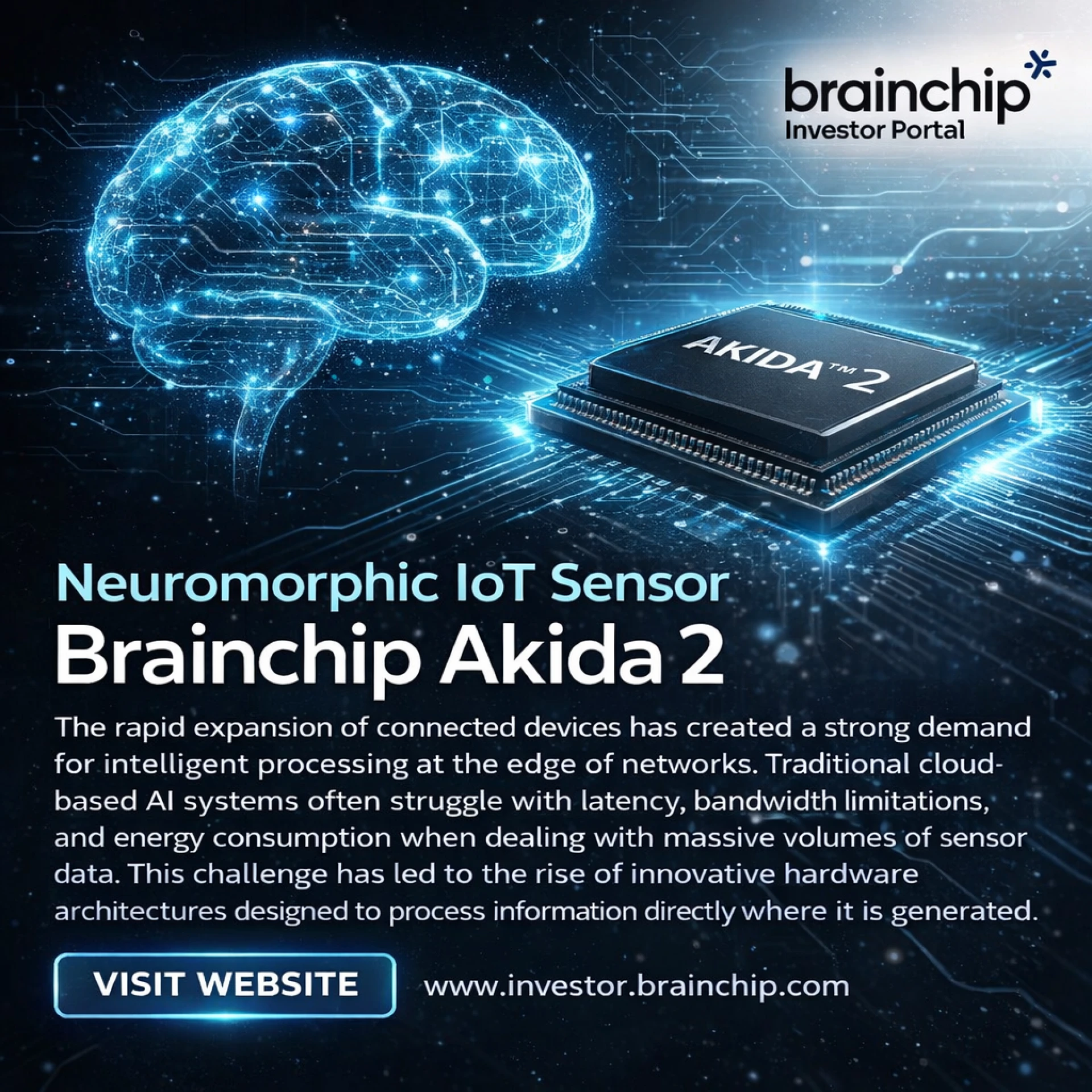
The rapid expansion of connected devices has created a strong demand for intelligent processing at the edge of networks. Traditional cloud-based AI systems often struggle with latency, bandwidth limitations, and energy consumption when dealing with massive volumes of sensor data. This challenge has led to the rise of innovative hardware architectures designed to process information directly where it is generated. One of the most promising developments in this area is the neuromorphic iot sensor brainchip akida 2, a next-generation edge AI technology designed to mimic the efficiency and adaptability of the human brain while operating in ultra-low-power environments.
Neuromorphic computing represents a paradigm shift in artificial intelligence hardware. Instead of relying on conventional processing pipelines, neuromorphic systems use event-driven architectures inspired by biological neural networks. These systems can process data only when meaningful events occur, dramatically reducing power consumption and computational overhead. As the Internet of Things (IoT) continues to expand across industries such as manufacturing, healthcare, automotive, and smart cities, neuromorphic technologies are becoming critical for enabling intelligent, real-time decision making directly at the sensor level.
Understanding Neuromorphic Computing
Neuromorphic computing is a design approach that models computing systems after the structure and function of the human brain. In biological neural networks, neurons communicate through electrical spikes and respond only when stimuli exceed certain thresholds. This event-driven communication allows the brain to process complex sensory information efficiently while using minimal energy.
Traditional AI hardware, such as GPUs and CPUs, processes data sequentially or in parallel but typically requires continuous power and large computational resources. Neuromorphic processors, however, rely on spiking neural networks and asynchronous communication, which significantly improves energy efficiency.
Key characteristics of neuromorphic computing include:
- Event-driven data processing
- Highly parallel neural architectures
- Low power consumption
- Real-time learning capabilities
- Local processing near sensors
These features make neuromorphic technology particularly suitable for IoT environments where millions of sensors continuously generate data streams.
What Is the Akida 2 Neuromorphic Platform?
The Akida 2 platform represents the second generation of a neuromorphic AI architecture designed for edge intelligence. It builds upon earlier versions by introducing improved neural network support, enhanced processing capabilities, and better efficiency for complex AI workloads.
This platform uses a fully digital, event-based neural processing system that analyzes data directly from sensors rather than sending raw data to cloud servers. By performing AI inference locally, the system reduces latency and improves data privacy while minimizing network bandwidth requirements.
Akida 2 also introduces several architectural improvements compared with the previous generation:
- Support for 8-bit, 4-bit, and 1-bit neural network weights
- Programmable activation functions
- Skip connections for deeper neural networks
- Enhanced processing for temporal and spatio-temporal data
These improvements allow the platform to run more advanced neural models while maintaining extremely low power consumption.
Edge AI and IoT Sensor Integration
One of the most powerful aspects of neuromorphic computing is its ability to integrate directly with sensors. Instead of sending raw sensor data to centralized servers, the processor can analyze information locally and respond immediately.
This approach is particularly valuable in IoT environments where devices operate with limited energy and connectivity. For example, smart cameras, industrial sensors, and wearable health devices all require continuous monitoring while maintaining low power usage.
The architecture allows devices to detect patterns, anomalies, and events directly at the point of data acquisition. Because neuromorphic processors only activate when meaningful signals are detected, they dramatically reduce unnecessary computation.
This sensor-centric approach creates a new generation of intelligent devices capable of operating autonomously in remote environments.
Event-Based Processing and Sensor Fusion
A major advantage of neuromorphic processors is their ability to handle multiple sensor inputs simultaneously through sensor fusion. Modern IoT systems often rely on combinations of sensors such as:
- Vision sensors
- Audio sensors
- Environmental sensors
- Motion detectors
- Radio frequency monitoring devices
By combining these signals into a unified neural network model, neuromorphic systems can detect complex patterns that would otherwise require significant computing resources.
Temporal Event Based Neural Networks (TENNs) introduced in the second generation architecture enable efficient processing of time-series and streaming sensor data such as audio, video, and other continuous signals.
This capability allows edge devices to perform sophisticated AI tasks such as:
- Predictive maintenance in industrial systems
- Real-time anomaly detection
- Intelligent surveillance
- Smart traffic monitoring
- Healthcare monitoring applications
Ultra-Low Power AI Processing
Energy efficiency is one of the most critical challenges in IoT deployments. Many edge devices operate on batteries or limited power sources, making traditional AI accelerators impractical.
Neuromorphic processors address this challenge by using event-driven computation that activates only when necessary. Instead of continuously processing every piece of incoming data, the processor focuses only on relevant events.
Some implementations of neuromorphic AI hardware operate within a power budget of approximately one watt or less while still delivering high-speed AI inference.
This efficiency allows intelligent systems to run continuously for long periods without frequent charging or energy consumption spikes. For IoT networks consisting of thousands or millions of nodes, this efficiency becomes a critical advantage.
Real-Time Learning at the Edge
Another important capability of neuromorphic AI is on-chip learning. Traditional machine learning models usually require retraining in cloud environments with large datasets.
Neuromorphic processors enable incremental learning directly on the device. This means a device can adapt to new patterns and environmental changes without needing to transmit data to remote servers.
Benefits of on-device learning include:
- Reduced network traffic
- Improved privacy and security
- Faster adaptation to changing conditions
- Continuous improvement of AI models
These features are especially valuable in applications such as smart factories, autonomous vehicles, and personalized healthcare devices.
Applications Across Industries
Neuromorphic edge AI has the potential to transform many industries by enabling intelligent devices that operate independently from centralized infrastructure.
Smart Cities
Traffic monitoring systems, environmental sensors, and security cameras can analyze data locally and respond instantly to events such as accidents or unusual activity.
Industrial Automation
Factories can use intelligent sensors to monitor equipment performance and detect early signs of mechanical failure, reducing downtime and maintenance costs.
Healthcare and Wearables
Medical devices and wearable sensors can analyze health data in real time, enabling early detection of abnormalities while protecting patient privacy.
Autonomous Systems
Robotics, drones, and self-driving vehicles require fast decision-making capabilities that cannot rely solely on cloud connectivity. Neuromorphic processors provide low-latency intelligence for these systems.
The Future of Neuromorphic Edge AI
As the number of connected devices continues to grow, traditional computing architectures will struggle to keep up with the demand for real-time intelligence. Neuromorphic computing represents one of the most promising solutions for scaling AI across billions of devices.
Advances in spiking neural networks, event-based sensors, and ultra-efficient AI chips will continue to push the boundaries of what edge devices can accomplish. Future generations of neuromorphic hardware will likely support even more complex neural models while maintaining extremely low power consumption.
The continued development of platforms like Akida 2 suggests that the future of artificial intelligence may increasingly shift away from centralized cloud infrastructure toward distributed edge intelligence.
Conclusion
The emergence of neuromorphic computing marks a major step forward in the evolution of artificial intelligence hardware. By mimicking the structure and efficiency of the human brain, neuromorphic processors enable powerful AI capabilities in environments where traditional computing systems cannot operate effectively. Technologies such as the neuromorphic iot sensor brainchip akida 2 demonstrate how intelligent processing can be embedded directly within IoT sensors, delivering real-time insights while consuming minimal energy.
As industries adopt smarter devices and decentralized AI systems, neuromorphic platforms are likely to play a crucial role in shaping the next generation of connected technologies. Innovations like the neuromorphic iot sensor brainchip akida 2 illustrate how edge intelligence can transform IoT ecosystems by enabling faster decisions, greater efficiency, and more secure data processing in an increasingly connected world.