
Introduction
NetSuite implementation is no longer just an IT project where a new ERP system is deployed. For large enterprises, it's a strategic decision that affects how the organization operates, scales, and makes decisions.
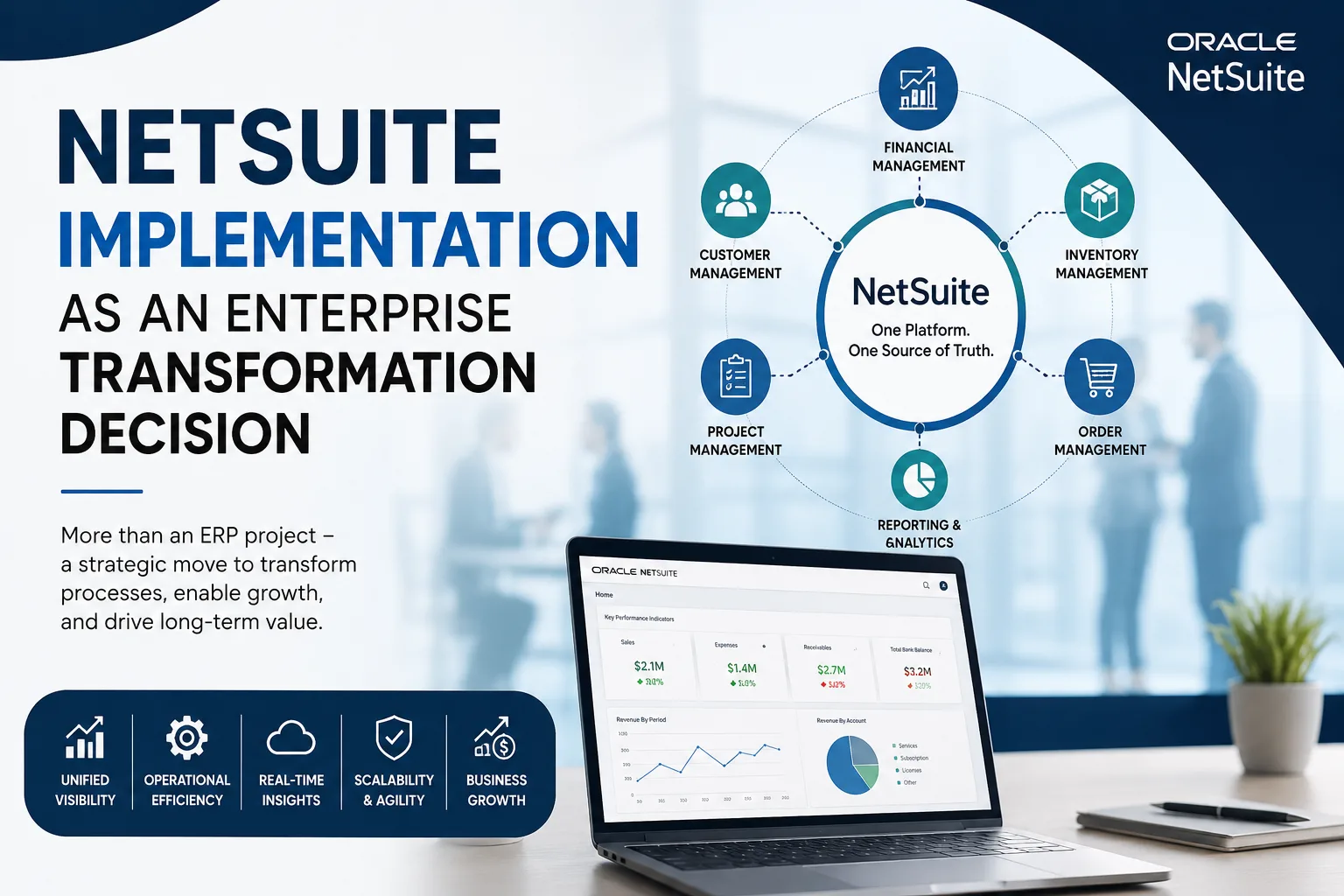
In many companies, existing ERP or legacy systems struggle to keep up with growing data, multiple business units, and global operations. This is where NetSuite comes in as a cloud-based ERP platform that brings finance, operations, inventory, and customer data into a single system.
But the real shift happens in how it is approached. Enterprises today don’t look at NetSuite implementation as a software installation. They treat it as part of a broader transformation initiative that affects processes, teams, and long-term business direction.
When implemented correctly, it can improve visibility across departments, reduce operational delays, and support faster decision-making. However, because of its scale and complexity, the success of NetSuite implementation depends heavily on planning, execution strategy, and alignment between business and IT teams.
Why Enterprises Treat NetSuite as a Transformation Decision
Enterprises don’t adopt NetSuite just to replace an old system. In most cases, the decision comes from a deeper need to fix how information flows across the business and how decisions are made.
Large organizations usually operate with multiple tools across finance, sales, supply chain, and operations. Over time, this creates disconnected data, manual reporting, and delays in getting a clear view of business performance. NetSuite helps bring these functions into a single cloud platform, but the real value is not just integration—it is alignment.
This is why NetSuite ERP implementation is often linked with broader digital transformation programs. It allows enterprises to move away from fragmented systems and toward a unified operating model where data is consistent and available in real time.
From a leadership perspective, this shift is important. CIOs and CTOs are not only evaluating technology fit, but also asking how the system will support scalability, compliance, and future growth. In many cases, Oracle NetSuite implementation becomes part of a long-term strategy to modernize core business infrastructure rather than a short-term IT upgrade.
Compared to traditional ERP environments, cloud-based systems like NetSuite reduce dependency on legacy infrastructure and improve agility. This makes it easier for enterprises to adapt to market changes, expand into new regions, or integrate acquisitions without rebuilding core systems from scratch.
Because of this impact, NetSuite adoption is rarely treated as a standalone project. It is viewed as a transformation decision that influences business structure, processes, and long-term operational strategy.
Core Components of Enterprise NetSuite Implementation
A successful NetSuite rollout in an enterprise environment depends on how well the implementation is planned and structured. At scale, it is not just about configuring the software—it is about aligning the system with real business processes across multiple teams and locations.
One of the first and most important steps is business process mapping. Enterprises need to clearly define how their finance, supply chain, procurement, and sales processes work today. Without this clarity, it becomes difficult to design a system that actually supports day-to-day operations.
Another critical area is data migration. Large organizations often deal with years of historical data spread across different systems. Cleaning, structuring, and moving this data into NetSuite requires careful planning to avoid inconsistencies or loss of critical information.
Integration is also a key component. Most enterprises already use multiple tools such as CRM platforms, HR systems, or industry-specific applications. A well-planned NetSuite ERP implementation ensures that these systems continue to work together smoothly without creating new data silos.
Customization versus standardization is another important decision. While NetSuite offers strong out-of-the-box capabilities, enterprises often need adjustments to match their specific workflows. The challenge is to avoid over-customization, which can increase complexity and long-term maintenance effort.
Finally, governance and change management play a major role. A NetSuite implementation services approach typically includes structured project governance, clear ownership, and communication across business and IT teams. Without this, even a technically sound implementation can struggle during adoption.
Key Challenges in Large-Scale NetSuite Implementation
Even with a strong plan, enterprise NetSuite projects often run into challenges that are less about the platform and more about scale, complexity, and internal alignment.
One of the most common issues is data complexity. Large organizations usually have fragmented data spread across multiple systems, regions, and formats. Cleaning and standardizing this data before migration takes more effort than expected, and any gap here can directly impact reporting accuracy after go-live.
Another challenge is multi-entity and multi-country operations. Enterprises working across different regions often need different tax rules, compliance structures, and reporting formats. Configuring NetSuite to handle these variations without creating inconsistencies is a delicate task.
Integration with legacy systems is also a major hurdle. Many organizations cannot fully replace older tools immediately, so NetSuite must coexist with existing applications. If integration is not planned properly, it can lead to duplicate data entry or broken workflows.
User adoption is another area where projects face resistance. Even when the system is technically sound, employees may struggle to adapt to new processes. This is especially true when workflows change significantly compared to older ERP systems.
Finally, scope creep can slow down or derail an implementation. As stakeholders see the system taking shape, new requirements often get added mid-way. Without strict governance, this can extend timelines and increase complexity.
These challenges are the reason why NetSuite consulting services and experienced implementation partners play an important role in enterprise deployments. They help bring structure, control, and practical experience to manage complexity at scale.
Strategic Best Practices for Successful Implementation
Successful enterprise NetSuite implementation is rarely about tools alone. It depends more on how clearly the program is structured and how well business and IT teams work together throughout the process.
One of the most important factors is executive sponsorship. When leadership is actively involved, decisions move faster, priorities stay aligned, and cross-departmental conflicts are easier to resolve. Without this, implementation efforts often lose direction midway.
A phased rollout approach also works better than a full-scale “big bang” launch in most enterprise environments. Rolling out NetSuite in stages allows teams to stabilize processes, fix early issues, and reduce disruption to daily operations.
Strong governance is another key element. Clear ownership, defined roles, and structured reporting help keep the project on track. This becomes especially important in large organizations where multiple teams are involved in parallel workstreams.
Choosing the right NetSuite implementation partner can significantly influence outcomes. Experienced partners bring practical knowledge from previous deployments, helping enterprises avoid common mistakes and design solutions that work in real environments, not just on paper.
Finally, post-go-live support and continuous improvement should not be ignored. NetSuite implementation is not a one-time activity. As the business evolves, the system needs ongoing refinement to support new processes, integrations, and reporting needs.
ROI & Business Impact of NetSuite Implementation
For most enterprises, the real question is not whether NetSuite can be implemented, but what changes after it goes live. The value comes from how it improves visibility, efficiency, and decision-making across the organization.
One of the most immediate impacts is faster financial and operational reporting. With data flowing into a single system, teams no longer spend time consolidating spreadsheets or reconciling information from different tools. This reduces reporting cycles and improves accuracy.
Another key benefit is better decision-making through real-time data. Leadership teams get a clearer view of business performance across departments, which helps in identifying issues early and responding faster to market changes.
From an operational standpoint, enterprises often see reduced manual effort and improved process efficiency. Tasks that were previously handled across multiple systems can be managed within a unified platform, reducing duplication and operational delays.
Scalability is another important outcome. A well-executed NetSuite ERP implementation allows businesses to expand into new regions, add subsidiaries, or integrate acquisitions without rebuilding core systems from scratch.
While exact ROI varies by organization, the broader impact is consistent: improved control, better transparency, and a more connected business environment. This is why enterprises increasingly view NetSuite implementation services not just as a technology investment, but as a long-term business enabler.
Conclusion
NetSuite implementation is not just a technical upgrade—it is a long-term decision that shapes how an enterprise operates and scales. When approached strategically, it improves visibility, strengthens process control, and supports better decision-making across the organization.
However, the success of any implementation depends on planning, governance, and the ability to align technology with real business needs. This is why many organizations prefer working with experienced experts who understand both enterprise systems and business complexity.