
Organizations announce their climate commitments with full confidence, yet their execution breaks down when actual trade-offs emerge. The achievement of a target requires more than its establishment as a goal. The process of achieving progress depends on how leaders handle their decision-making challenges within the framework of a valid net-zero strategy.
Most organizations already have climate risk knowledge because they understand climate change and stakeholder requirements. The challenge occurs when organizations need to take decisive action after they realize their financial, operational, and governance risks.
Organizations need more than their goals for execution success. Organizations need to establish a complete transition plan for net zero implementation, together with an accurate carbon emissions assessment and dedicated net zero training programs.
The Three Critical Net Zero Decisions Leaders Continue to Delay Despite Growing Pressure
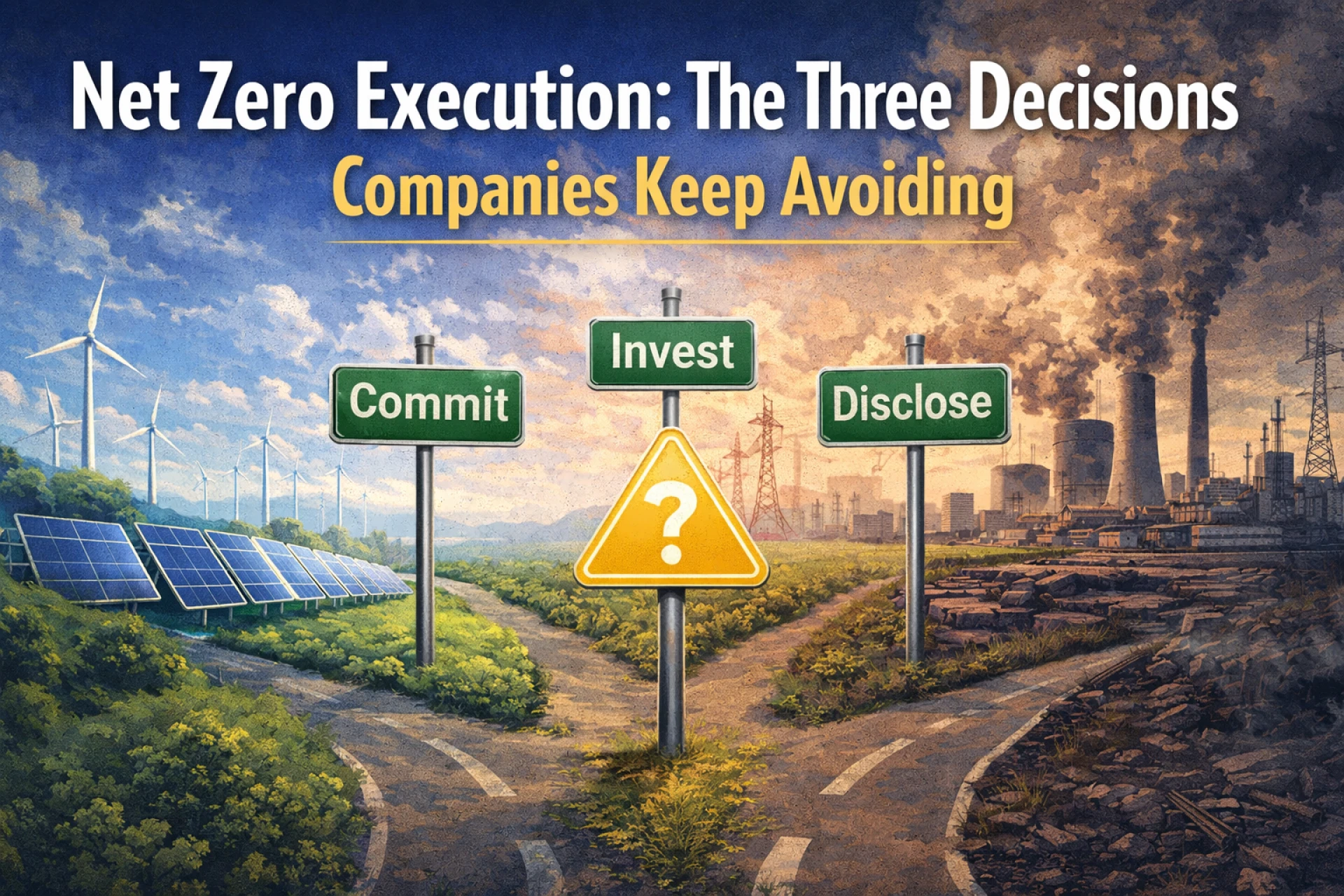
The net zero commitment process requires organizations to implement actual environmental targets because their operational targets become their main challenge. The first step to understanding corporate decision-making patterns is identifying the three decisions that organizations fail to make. Organizations tend to delay their decision-making process because they face both internal challenges and external risk factors.
1. Committing to a Real Net Zero Strategy Instead of a Distant Target
The first decision companies avoid is setting near-term actions within a measurable net-zero strategy. The risk of immediate operational changes prevents companies from making their first short-term commitment, which they need to establish their future net-zero target.
More than 900 of the world’s largest publicly listed companies have announced net zero targets according to the Net Zero Tracker, but many of these companies do not have specific short-term implementation plans.
The existing gap demonstrates uncertainty about two things, which include capital allocation and accountability procedures. The complete transition plan defines three elements, which include a timeline, scheduled governance frameworks, and industry-specific reduction strategies. The target becomes only a symbolic goal because it lacks the necessary components.
The net zero strategy establishes a connection between two elements, which include strategic goals, financial resources, motivational systems, and executive managerial control. The document establishes present requirements that organizations must implement instead of postponing their execution.
2. Investing in Accurate Carbon Accounting
The second avoided decision is strengthening carbon accounting systems. Many organisations rely on estimates or incomplete Scope 3 data. This restricts their capacity to focus on reduction efforts, which they should prioritize.
Transparent carbon accounting requires consistent methodologies, supplier engagement, and integration with financial reporting. The process needs internal expertise because outsourcing responsibility cannot fulfill all requirements.
Leaders can make better procurement decisions when data quality improves because it helps them understand energy sourcing and product design. The net zero strategy achieves better transparency through this clarity, which helps organizations credibly disclose their informationdisclose their information in a credible manner.
The team developed internal literacy through structured net-zero training, which helped them understand both measurement standards and strategic implications.
3. Building Capability Through Net Zero Training
The third decision companies delay is investing in capability. Sustainability teams handle climate strategy, which needs to be integrated throughout all business operations, including finance and procurement functions.
Leaders need to understand three elements to execute their plans successfully, which include policy risk, supply chain exposure, and technology pathways. The organisation requires all decision makers to understand the complete transition plan that needs their approval.
Executives gain from Net Zero training because it teaches them how emissions reduction efforts create business advantages, which enhance their operational abilities. The climate issue changes from a compliance requirement into a key business objective.
When organisations align their training programs with a specific net-zero strategy, they progress from disjointed efforts to unified implementation.
Why These Decisions Matter Now
The evaluation of corporate climate commitments by market regulators and investors increased their efforts to verify the credibility of these commitments. The reputational damage and operational hazards of companies that postpone their essential business decisions create their most significant dangers.
A well-defined transition plan supported by rigorous carbon accounting makes it easier for organizations to achieve their goals. The practice shows organizations how seriously they treat their commitments to both employees and stakeholders.
Organizations need to maintain operational control through their execution processes, which require them to handle both their execution needs and existing work requirements. The three decision points that organizations need to handle will create lasting effects for their operations.
Conclusion
The process of implementing net-zero targets requires companies to make tough decisions, which must be carried out through strategic planning. Companies must establish operational responsibilities that they should follow through on their net-zero strategy instead of making aspirational declarations.
Companies achieve effective net zero implementation through three essential steps, which include developing a practical transition plan, establishing effective carbon accounting systems, and providing net zero training for leadership development.
The evACAD program enables organizations and professionals who wish to develop their skills in climate governance strategy development and implementation through structured climate ambition execution.