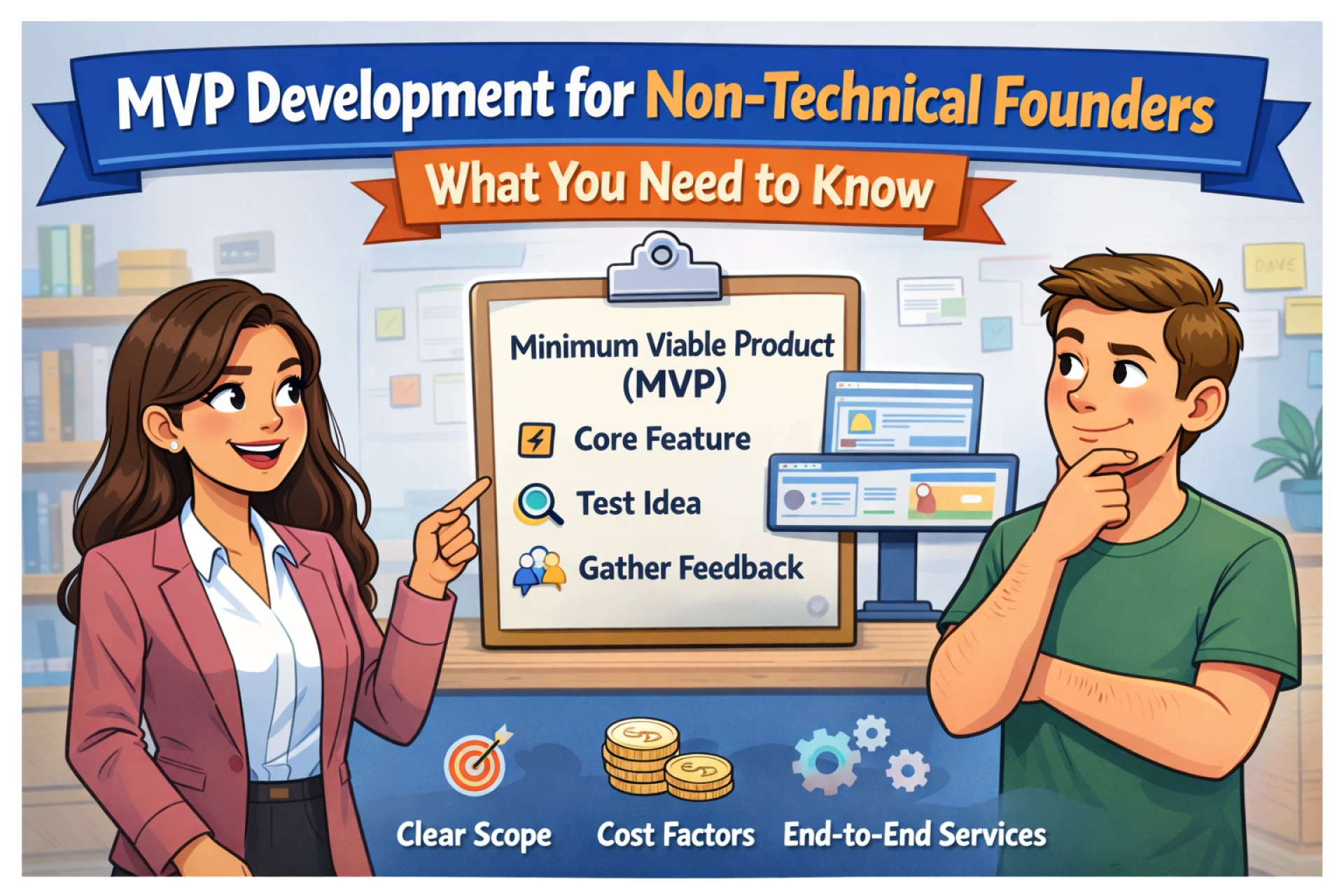
Launching a startup without a technical background can feel overwhelming. Many founders have strong business ideas, market insight, or domain expertise, but lack the technical experience needed to build software products.
This is where MVP development for non-technical founders becomes critical.
An MVP (Minimum Viable Product), as defined in The Lean Startup, allows founders to validate their idea and enable maximum validated learning with minimal resources before scaling. However, without technical clarity, the process can quickly become confusing, expensive, or misaligned.
This guide outlines what non-technical founders should understand before starting MVP development.
Understanding What an MVP Really Is
An MVP is not a rough draft of your final product. It is the simplest functional version designed to test a core business assumption.
The purpose of MVP development is validation, not perfection.
For non-technical founders, this means focusing on:
- The core problem being solved
- The primary user segment
- One essential workflow
- Measurable feedback
If an MVP includes every planned feature from the beginning, it defeats its purpose.
The goal is to test viability before scaling complexity.
Understanding What an MVP Really Is
An MVP is not a rough draft of your final product. It is the simplest functional version designed to test a core business assumption.
The purpose of MVP development is validation, not perfection.
For non-technical founders, this means focusing on:
- The core problem being solved
- The primary user segment
- One essential workflow
- Measurable feedback
If an MVP includes every planned feature from the beginning, it defeats its purpose.
The goal is to test viability before scaling complexity.
Defining Clear Product Scope
One of the most important steps in MVP development for non-technical founders is scope control.
Before engaging a development team, founders should clearly define:
- The single most important feature
- The main user journey
- The core value proposition
- What success looks like in measurable terms
Avoid starting with technical specifications. Start with outcomes.
For example, instead of saying:
“We need a dashboard with analytics.”
Define:
“We need users to complete X action within 3 minutes of signup.”
Clarity reduces ambiguity and protects your budget.
Understanding MVP Cost Factors
A common concern among non-technical founders is MVP cost. However, cost is influenced by several variables:
- Feature complexity
- Technology stack
- Development timeline
- UI/UX design requirements
- Integration needs
- Team structure (freelancers vs agencies vs end-to-end services)
It is important to understand that cost is not determined solely by the number of screens or features. Complexity behind the scenes, such as database architecture or third-party integrations, can significantly affect the budget.
The most effective way to control MVP cost is through disciplined feature prioritization and agile development practices that emphasize iterative improvement.
Reducing unnecessary features reduces financial risk.
The Value of End-to-End MVP Development Services
For non-technical founders, end-to-end MVP development services can provide structure and clarity throughout the process.
These services typically include:
- Product discovery and validation
- UX/UI design
- Software development
- Testing and iteration
- Launch support
Instead of managing multiple freelancers or vendors separately, end-to-end services create alignment between strategy and execution.
This reduces communication gaps and minimizes the risk of scope misinterpretation.
More importantly, it ensures that business objectives remain central throughout development.
Communication Is More Important Than Coding Knowledge
Non-technical founders do not need to understand code.
They do need to understand:
- What problem the product solves
- What assumptions are being tested
- What metrics define validation
- What the launch objective is
Effective communication with technical teams should focus on user outcomes rather than implementation details.
When founders lead with clarity, development teams can build more efficiently.
Common Mistakes to Avoid
Non-technical founders often encounter similar pitfalls during MVP development:
1. Expanding Scope Too Early
Adding features before validation increases complexity and cost.
2. Delaying Launch for Perfection
An MVP should be usable, not perfect.
3. Ignoring Feedback
User feedback during early stages is more valuable than assumptions.
4. Choosing Based on Lowest Cost Alone
The cheapest option may lack strategic alignment or long-term scalability.
Avoiding these mistakes improves the chances of building a sustainable product.
When to Move Beyond the MVP
An MVP is a validation tool, not the final product.
Once the following indicators appear, expansion can be considered:
- Consistent user engagement
- Repeat usage
- Clear monetization signals
- Identified friction points
- Positive feedback trends
At this stage, feature expansion and infrastructure scaling become data-driven rather than speculative.
Building with Confidence as a Non-Technical Founder
Being non-technical is not a disadvantage.
Many successful startup founders began without coding backgrounds.
The advantage lies in strategic thinking and disciplined decision-making.
By focusing on:
- Clear validation goals
- Controlled scope
- Structured development
- Transparent communication
- Cost awareness
Non-technical founders can successfully navigate MVP development while minimizing risk.
MVP development for non-technical founders is not about learning to code. It is about learning to validate.
By understanding scope discipline, cost drivers, and the importance of structured end-to-end MVP development services, founders can make informed decisions before scaling.
Launching an MVP with clarity protects capital, accelerates learning, and builds a strong foundation for future growth.
With the right framework and execution discipline, non-technical founders can transform ideas into validated products with confidence.