
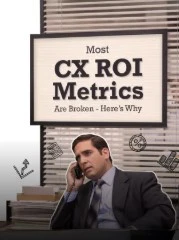
Remember that hilarious scene in The Office where Michael Scott proudly claims that sending birthday cards equals customer happiness? It’s funny—until you realize many companies do the same with their Customer Experience (CX) metrics. They cling to numbers like NPS or CSAT without asking why customers feel that way. On paper, these CX scores look great, but underneath, customers might be frustrated, leaving, or simply indifferent.
Relying only on surface-level Customer Experience (CX) metrics is risky. They create false confidence, leading businesses to celebrate while losing loyal customers quietly. Measuring CX ROI isn’t optional anymore—it’s a business must-have. Great CX drives growth by keeping customers loyal and turning them into brand advocates. Studies show companies with strong CX earn significantly more revenue than their competitors..
However, common pitfalls exist: vanity metrics, short-term focus, and ignoring context all skew reality. To truly measure CX ROI, companies must move beyond shallow Customer Experience (CX) metrics and adopt deeper strategies. This includes integrating operational, financial, and experiential metrics, mapping the entire customer journey, and using predictive analytics to spot trends before they become problems.
Listening directly to customers through Voice of Customer programs closes the loop—turning feedback into real action. Leading brands like Capital One and FCL have shown that when you empower teams and streamline processes, CX success naturally follows.
In the end, smart businesses know that good Customer Experience (CX) metrics aren’t about pretty numbers—they’re about meaningful insights that drive loyalty, retention, and growth. So, ditch the “birthday card logic” and focus on what truly matters: real experiences that make customers stay.