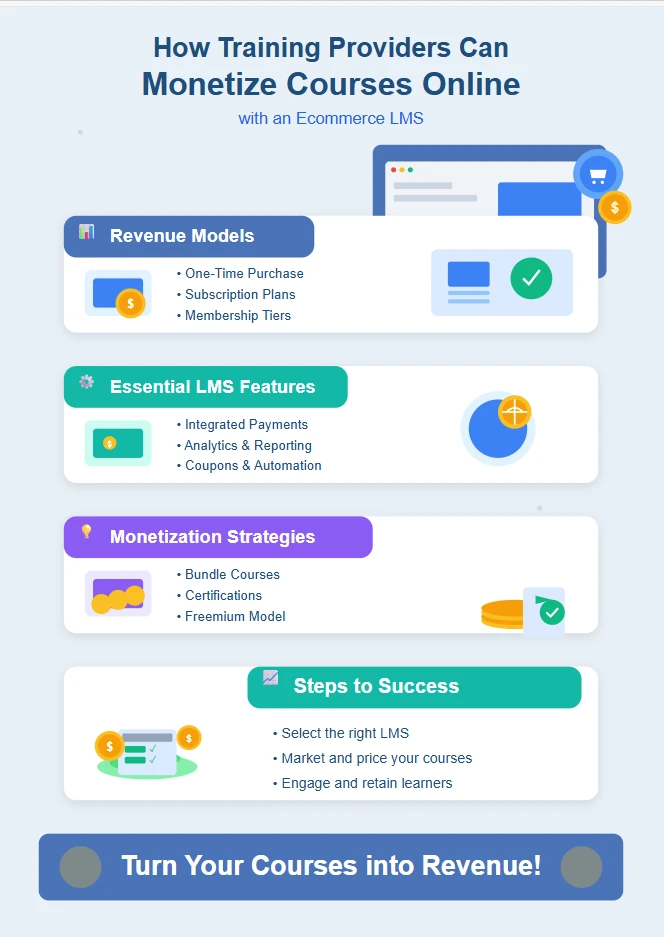
Your courses deserve to generate income. See how an e-commerce LMS makes it easy to monetize your training with strategies designed for growth and scalability.
Introduction: Turning Expertise into Sustainable Online Revenue
Online learning is no longer an experiment; it’s a business model. With the global eLearning market expected to cross $460 billion by 2026 (Statista), training providers are sitting on a massive opportunity. Yet many still rely on manual payments, scattered tools, or one-time course sales that limit long-term growth.
This is where an e-commerce LMS for training business becomes a game-changer. Instead of acting as a simple course host, it allows you to package, price, and sell knowledge in ways that scale. Whether you’re an independent trainer, a coaching institute, or a professional training company, the right monetization strategy can help you build a predictable income while delivering real value to learners.
Let’s explore how training providers are successfully monetizing online courses without turning learning into a hard sell.
Why Monetization Starts with the Right Learning Platform
Before discussing revenue strategies, it’s important to address the foundation. Monetization becomes difficult when content delivery and payment systems are disconnected.
An e-commerce-enabled LMS brings everything together. It manages course access, handles payments, supports multiple pricing models, and tracks learner engagement in one place. This makes it far easier to experiment with how you sell, refine what works, and grow without adding operational complexity.
For training businesses looking to professionalize their offerings, this setup is no longer optional; it’s expected.
Selling Individual Courses Without Limiting Growth
Many training providers begin by selling standalone courses, and for good reason. It’s simple, familiar, and easy for learners to understand. Short-term skill programs, certification prep, or focused workshops often perform well as individual purchases.
What makes this model more effective today is flexibility. Instead of a single fixed price, trainers are offering variations of basic access, premium content, or certification-inclusive options. This approach allows learners to choose based on their goals while increasing overall revenue potential.
For those looking to sell courses online for trainers, this is often the most practical starting point.
Building Recurring Revenue Through Memberships
One-time sales can generate cash flow, but subscriptions create stability. Membership-based learning programs allow learners to pay monthly or annually for ongoing access to content, updates, and live sessions.
This model works particularly well for professional upskilling, leadership development, and continuous education. Learners stay engaged because new material keeps coming, and training providers benefit from predictable income.
Research from Zuora shows that subscription-based businesses grow revenue significantly faster than traditional sales models, a strong reason why memberships are becoming central to how educators monetize online courses and training programs.
Expanding Reach with a Training Course Marketplace
Some training providers move beyond selling their own content and build a collaborative ecosystem. A branded training course marketplace allows multiple instructors to publish courses under one platform, sharing revenue while expanding the catalogue.
This approach benefits everyone involved. Learners get more choice, instructors gain visibility, and the platform owner builds authority within a niche. Over time, the marketplace itself becomes an asset, not just a sales channel.
It’s a strategy often used by industry academies, professional bodies, and fast-growing training brands.
Increasing Value Through Course Bundles and Learning Paths
Another effective way to improve monetization is by grouping related courses into structured programs. Instead of selling isolated lessons, training providers create learning journeys that guide learners from beginner to advanced levels.
From a learner’s perspective, bundles offer clarity and direction. From a business perspective, they increase average order value without requiring new content. This strategy is especially effective in e-commerce for training institutes targeting career-focused or corporate learners.
Monetizing Live and Hybrid Training Experiences
Despite the growth of self-paced learning, live training continues to command higher prices. Webinars, instructor-led workshops, and hybrid programs offer something that recorded content can’:t real-time interaction.
When combined with an e-commerce LMS, live training becomes easier to sell, manage, and scale. Learners are willing to pay more for direct access to experts, structured schedules, and accountability, making this a powerful revenue stream.
Adding High-Value Services Beyond Courses
Courses don’t have to be the final product. Many successful training providers increase revenue by offering certifications, assessments, personalized feedback, or one-on-one coaching as paid add-ons.
These services enhance credibility and outcomes, especially when delivered through a professional digital course-selling platform. For learners, they signal quality. For businesses, they significantly boost lifetime value.
Conclusion: Monetization Is About Strategy, Not Just Sales
Successful course monetization isn’t about pushing more content; it’s about aligning learning value with smart delivery and pricing models. An e-commerce LMS for training business gives you the flexibility to experiment, combine strategies, and grow sustainably.
Whether you’re selling individual courses, running memberships, building a marketplace, or offering premium services, the goal remains the same: create meaningful learning experiences while building a business that lasts.