Meta’s 5 GW Pivot: When a Tech Company Becomes an Energy Giant
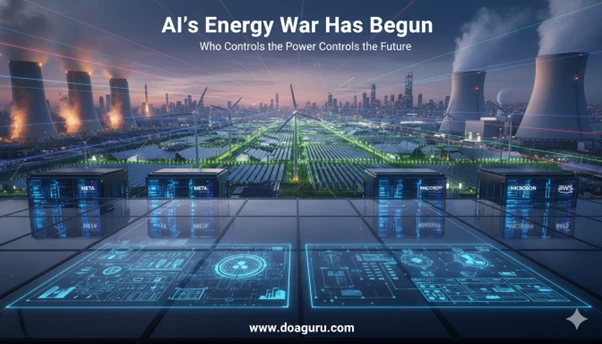
Meta has taken one of the boldest steps in the AI race by entering the energy sector. The company is committing more than ten billion dollars to secure nearly five gigawatts of dedicated power capacity for its next-generation AI data centers. This includes new gas-based generation, a massive solar buildout, and the creation of Meta’s own electricity-trading subsidiary.
At the core of this strategy is Meta’s new AI super-campus in Louisiana. It is designed to become the company’s largest compute facility and will ultimately draw power equivalent to what several million homes consume. The first phase includes multiple natural-gas power plants delivering more than two gigawatts of baseload power, combined with large-scale solar installations meant to offset part of the carbon footprint.
To support this, Meta established a licensed electricity-trading company. It can now procure power directly from wholesale markets and even sell surplus capacity when compute clusters are idle. This gives Meta a degree of control that no major tech player has exercised at this scale before. For a company planning AI clusters the size of entire city blocks, energy is no longer an input—it is the strategic bottleneck to unlock.
The broader picture is clear: Meta is preparing for an AI world where grid limitations, rising global demand, and uneven renewable availability could slow expansion. Owning and trading part of the power supply creates insulation from those risks.
Google: Building Renewable Energy Parks and Betting on Advanced Nuclear
Google approaches the energy challenge through clean-power innovation rather than direct ownership. It is backing multibillion-dollar “energy parks” that co-locate data centers with newly built solar farms, wind plants, and utility-scale batteries. These projects are designed to bypass overloaded transmission networks by placing compute directly next to newly generated renewable power.
Google is also investing in advanced nuclear technologies. The company has agreements in place to secure future output from small modular reactors and other emerging nuclear sources. These reactors are intended to deliver consistent, carbon-free power to support Google’s 24/7 clean energy target, which becomes increasingly difficult as AI workloads multiply.
Unlike Meta, Google has been active for more than a decade in managing wholesale energy purchases through its internal energy subsidiary. Its strategy blends real-time load shifting, massive renewable contracts, co-location with power plants, and early adoption of frontier technologies like geothermal and modular nuclear.
For Google, the competitive edge comes from decarbonized reliability rather than pure capacity.
Microsoft: The Nuclear-First Strategy for AI Reliability
Microsoft is making one of the largest infrastructure bets in tech history. Its AI-focused data-center spending is approaching eighty billion dollars in the current cycle, and energy sourcing is at the center of that expansion.
To support the next generation of AI clusters running on Azure and OpenAI systems, Microsoft is leaning heavily into nuclear power. It has secured a multidecade agreement to take the full output of a restarted nuclear reactor, providing a significant block of always-on electricity. The company is also working with private partners on a ten-gigawatt clean-energy development program spanning wind, solar, and long-duration storage.
In the background, Microsoft continues to pioneer alternative technologies. It is testing large hydrogen fuel-cell systems as replacements for diesel backup generators, exploring battery-based grid interaction, and piloting new microgrid designs around its data centers. The company has also hired nuclear engineering specialists to help evaluate advanced reactors, including the possibility of integrating nuclear heat and power directly into data-center campuses.
Microsoft’s philosophy differs from Google’s and Meta’s: it is not building its own plants, but it is securing long-term, guaranteed access to firm power through multidecade contracts.
Amazon (AWS): Nuclear Partnerships, On-Site Generation, and Global Renewables
Amazon’s energy strategy is the most diversified of all hyperscalers. AWS is already the world’s largest corporate buyer of renewable energy, with more than a dozen gigawatts of wind and solar in development globally. But the surge in AI demand forced Amazon to pursue more aggressive solutions.
One of the most significant moves is Amazon’s long-term agreement to draw nearly two gigawatts of electricity directly from an existing nuclear power station. Amazon is also exploring modular nuclear reactors and has hired teams with nuclear engineering backgrounds to evaluate potential future reactors for its campuses.
Where grid infrastructure lags, Amazon builds its own power supply. In the Pacific Northwest, AWS deployed large natural-gas fuel-cell systems across multiple data centers to avoid expansion delays caused by utility congestion. These systems act as primary on-site generators rather than backups.
Amazon’s approach is pragmatic. It uses renewables where possible, nuclear where necessary, and on-site generation when grid constraints threaten timelines. Across all tactics, the objective remains constant: AWS must scale AI compute globally, and energy availability must never limit cloud adoption.
Nvidia: Efficiency Over Ownership
Nvidia is not a hyperscale cloud operator, so it does not build power plants or negotiate multi-gigawatt energy deals. Instead, Nvidia focuses on making each generation of its AI hardware significantly more efficient in performance per watt.
Nvidia’s own facilities run on fully renewable energy, but its real energy influence comes from the design philosophy behind its chips. If Nvidia can raise GPU efficiency by even 20 to 30 percent, the global power footprint of AI data centers shifts dramatically. For this reason, the company invests heavily in cooling innovation, liquid-based thermal systems, and optimization software that reduces data-center overhead.
Nvidia’s role in the energy race is indirect but powerful: it reduces the electricity demand per unit of AI performance, allowing hyperscalers to get more compute out of their limited power allocations.
Tesla: The Automotive Company with AI Power Demands
Tesla’s AI ambitions center on autonomous driving and robotics, both of which require enormous training clusters. The company is building its own supercomputer powered by custom silicon, and its power requirements are beginning to rival small cloud regions.
Tesla’s strategy leans on rapid grid upgrades rather than long-term procurement. In multiple regions, the company has partnered with local utilities to accelerate substation expansions and transformer installations to handle AI compute loads approaching hundreds of megawatts.
Because Tesla is also a major energy manufacturer—producing solar systems, grid-scale batteries, and energy-trading software—it can use its own technology to support reliability at its AI facilities. Still, Tesla has not pursued dedicated power plants for AI; instead, it uses a mix of upgraded grid connections and its own storage technologies.
The Competitive Landscape: How Each Company Seeks Power Dominance
If we compare the approaches:
- Meta is securing raw power capacity through its own trading arm and dedicated generation.
- Google is building clean-energy ecosystems and experimenting with advanced nuclear.
- Microsoft is locking in multidecade nuclear supply for AI reliability.
- Amazon is using a flexible mix of nuclear, renewables, and on-site generation to scale anywhere.
- Nvidia is reducing power intensity through efficient hardware.
- Tesla is rapidly upgrading grids to power its AI clusters.
The conclusion is unavoidable:
AI has outgrown the traditional data-center model. Energy is now the strategic battlefield.
The companies that secure the most reliable and scalable power supply will dictate the pace of AI progress in the next decade.
Where DOAGuru Fits In
As global AI leaders restructure their energy strategies, businesses everywhere face a similar challenge on a smaller scale: preparing their digital infrastructure for an AI-first world. DOAGuru Infosystems helps organisations adopt AI-ready digital ecosystems—covering software, cloud, SEO, automation, and performance intelligence—so that growth never gets restricted by technology limitations.
In a world where AI power defines competitiveness, DOAGuru ensures businesses stay ahead of the curve.
FAQS
1. Why is Meta investing in energy infrastructure?
To secure reliable power for its AI data centres and avoid grid bottlenecks.
2. Why are tech companies turning to nuclear energy?
It provides the continuous, stable power required for large-scale AI workloads.
3. How does Google’s energy strategy differ from Meta’s?
Google focuses on renewable ecosystems and innovation, while Meta is securing direct control through trading and generation.
4. Why does Amazon build its own on-site power systems?
To maintain cloud and AI expansion even in regions with limited grid capacity.
5. What role does DOAGuru play in this environment?
DOAGuru helps businesses build AI-ready digital systems to compete in an AI-driven market.