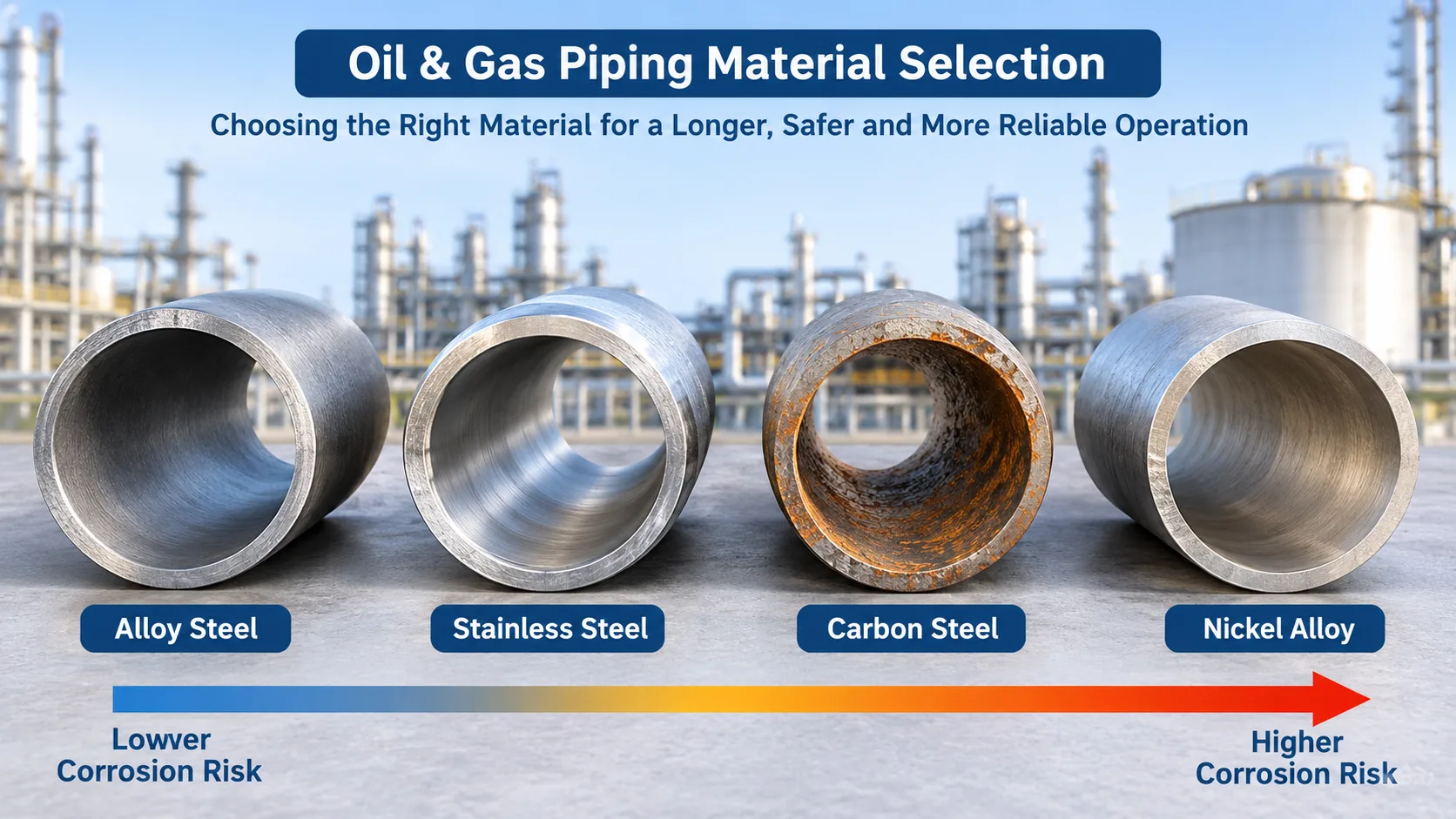
A piping material that lasts decades in one oil and gas system can fail within months in another. The difference is rarely the pipe's size or schedule. It is the combination of chlorides, hydrogen sulphide (H2S), carbon dioxide, temperature and pressure that the line actually sees, matched against the alloy that was chosen to handle it.
This guide walks through the four material families used most often in oil and gas piping: carbon and alloy steel, austenitic stainless steel, duplex and super duplex stainless steel, and nickel alloys. It explains where each one performs well, where it runs out of margin, and how to choose without overspending or under-specifying.
Start With the Service Conditions, Not the Material
Every good material decision begins with a clear description of what the pipe will carry and where it will sit. In oil and gas, a handful of factors do most of the damage. Carbon dioxide dissolved in water forms carbonic acid and causes "sweet" corrosion in carbon steel. Hydrogen sulphide makes a service "sour", which can cause sulphide stress cracking in hard or high-strength steels and is governed by NACE MR0175/ISO 15156. Chlorides in produced water and seawater drive pitting, crevice corrosion and chloride stress corrosion cracking in many stainless steels. Temperature speeds up every one of these mechanisms and also reduces strength at the high end.
Before comparing alloys, write down the fluid composition, chloride level, H2S and CO2 partial pressures, operating and design temperature, pressure, and the minimum design temperature for cold climates or depressurisation. Then add the design life and the cost of a failure, because a leak on a subsea or high-pressure line costs far more than the pipe it came from.
Carbon and Alloy Steel: The Economical Workhorses
Carbon steel remains the default for most hydrocarbon piping because it is strong, easy to weld and far cheaper than corrosion-resistant alloys. ASTM A106 seamless pipe is common for general process lines, and A333 Grade 6 is used where impact toughness is needed at low temperatures. Where the fluid is mildly corrosive, designers extend life with a corrosion allowance, inhibitor injection, internal coatings or cathodic protection.
Chromium-molybdenum alloy steels such as ASTM A335 P11, P22 and P91 take over where temperature is the main problem. Their creep strength and resistance to oxidation and hydrogen attack make them the standard choice for high-temperature refinery heaters, steam lines and furnace piping. For this kind of duty, Inox Steel India offers alloy steel seamless pipes alongside its carbon and stainless ranges.
The limit for both materials is corrosion. Neither resists chlorides or CO2 well without help, and in sour service both must meet strict hardness and heat-treatment limits.
Stainless Steel: 304, 316 and Where They Run Out of Margin
Austenitic stainless steels such as 304L and 316L (ASTM A312) are the first step up in corrosion resistance. The molybdenum in 316L gives it noticeably better pitting resistance than 304L, so it is widely used for instrumentation tubing, topside process piping, heat exchanger tubes and clean utility lines in mildly corrosive service.
Their weaknesses show up in exactly the conditions oil and gas creates. In warm, chloride-rich water, austenitic grades can suffer pitting, crevice attack and chloride stress corrosion cracking, a risk that rises sharply above roughly 60°C. They are also relatively low in strength, with a minimum yield of about 170 MPa for 316L, which means thicker walls under pressure. When a line needs both strength and chloride resistance, duplex is usually the better answer.
Duplex and Super Duplex: Strength Plus Chloride Resistance
Duplex stainless steels combine austenite and ferrite in roughly equal parts. The common 2205 grade contains about 22% chromium, 5% nickel and 3% molybdenum and has a minimum yield strength of about 450 MPa, more than double that of 316L. That strength allows thinner walls and lighter piping, which matters on offshore platforms and long pipelines. Its pitting resistance is also far better, with a pitting resistance equivalent (PREN) of roughly 35 against about 24 for 316L.
Super duplex grades such as 2507 push this further, with a PREN above 40 and a minimum yield of about 550 MPa. They are the usual choice for seawater cooling, produced water, injection lines and subsea or topside systems with high chloride loads. Inox Steel India supplies duplex and super duplex pipes for this kind of demanding service.
Duplex has limits of its own. Prolonged exposure above about 300°C can embrittle the ferrite phase, and welding needs controlled heat input and qualified procedures to keep the phase balance right. In sour service, duplex grades are acceptable only within the environmental limits set in ISO 15156.
Nickel Alloys: When Everything Else Falls Short
Nickel alloys are specified when corrosion severity, temperature or both exceed what duplex can handle. Alloy 625 (UNS N06625) is widely used for offshore and subsea equipment and seawater piping because of its excellent resistance to pitting, crevice attack and cracking. Monel 400 is a long-standing choice for seawater lines and hydrocarbon handling, while Hastelloy C22 (UNS N06022) is selected for strongly acidic and oxidising conditions such as scrubbers. High-pressure, high-temperature wells with H2S, CO2 and chlorides together are another typical home for these alloys.
The trade-off is cost and lead time, since nickel alloys cost many times more than stainless steel. For long lines, many projects use carbon steel pipe with a nickel alloy internal cladding or weld overlay, which puts the corrosion resistance at the surface without paying for solid alloy throughout. When solid pipe is the right answer, Inox Steel India offers nickel alloy seamless pipes in grades such as Inconel 625, Monel 400 and Hastelloy C22, with standards including ASTM B444 for alloy 625 and B622 for alloy C22.
Comparing the Options at a Glance
The table splits carbon and alloy steel into two rows and shows where each material fits. Cost is relative and varies with grade, size and market.
| Material | Typical grades and standards | Best suited to | Main limits | Relative cost |
| Carbon steel | A106 Gr B, A333 Gr 6 | Non-corrosive or inhibited hydrocarbon lines, low-temperature service (Gr 6) | CO2 and chloride corrosion without protection | Low |
| Alloy steel (Cr-Mo) | A335 P11, P22, P91 | High-temperature refinery and steam lines | Limited corrosion resistance, strict heat-treatment control | Low to medium |
| Austenitic stainless | 304L, 316L (A312) | Instrumentation, mildly corrosive process lines | Chloride cracking above about 60°C, lower strength | Medium |
| Duplex and super duplex | 2205, 2507 (A790) | Seawater, produced water, high-chloride and high-pressure lines | About 300°C upper limit, welding control, sour-service limits | Medium to high |
| Nickel alloys | 625 (B444), 400, C22 (B622) | Severe sour, acid, high-pressure high-temperature and subsea service | Very high cost, longer lead times | Very high |
How to Choose: A Practical Sequence
Start with the cheapest material that can plausibly work and rule it out only on evidence. Check carbon steel against your CO2 corrosion rate and your sour-service limits. If the corrosion allowance and inhibition cannot deliver the design life, move to the next family and repeat the test on chlorides, temperature and strength.
Look at strength and weight at the same time as corrosion. A more expensive duplex pipe can be cheaper overall if its higher yield strength allows a thinner wall, lighter supports and lower transport and installation cost. Then confirm that the material is qualified for your sour-service conditions, since compliance with ISO 15156 depends on environmental limits, hardness and heat treatment, not just the grade name.
Finally, compare lifecycle cost instead of purchase price. Include inspection, inhibitor programmes, downtime and replacement over the field life, and confirm that your fabricators can weld the chosen alloy to qualified procedures. A material you cannot weld properly is not a good choice, however good it looks on paper.
Documentation and Testing to Insist On
Grade mix-ups are one of the most expensive mistakes in piping, especially between 316L and duplex or between different nickel alloys. Ask for mill test certificates to EN 10204 3.1 (or 3.2 when a third party must witness), heat-number traceability on every length, and positive material identification (PMI) before dispatch. Hydrostatic testing and non-destructive examination such as ultrasonic testing add assurance on pressure lines, and duplex pipe should also come with ferrite content and corrosion test results where the specification calls for them.
Inox Steel India documents its material to EN 10204 3.1 and 3.2 with heat-number verification, and its export documentation can include third-party inspection reports from agencies such as BV, TÜV, SGS or LR.
Conclusion
Material selection for oil and gas piping is a matching exercise, not a ranking. Carbon and alloy steels win on cost and temperature capability, 316L suits mild service, duplex and super duplex handle chlorides and pressure, and nickel alloys cover the harshest sour, acidic and subsea conditions. Define the service conditions first, test each family against them, and compare lifecycle cost instead of purchase price.
If you are specifying a line and want help matching grade, size and standard to your service, send Inox Steel India your fluid conditions, temperature and pressure, pipe size and schedule, preferred standard, quantity and documentation needs, and the team can recommend a suitable material and quote.