
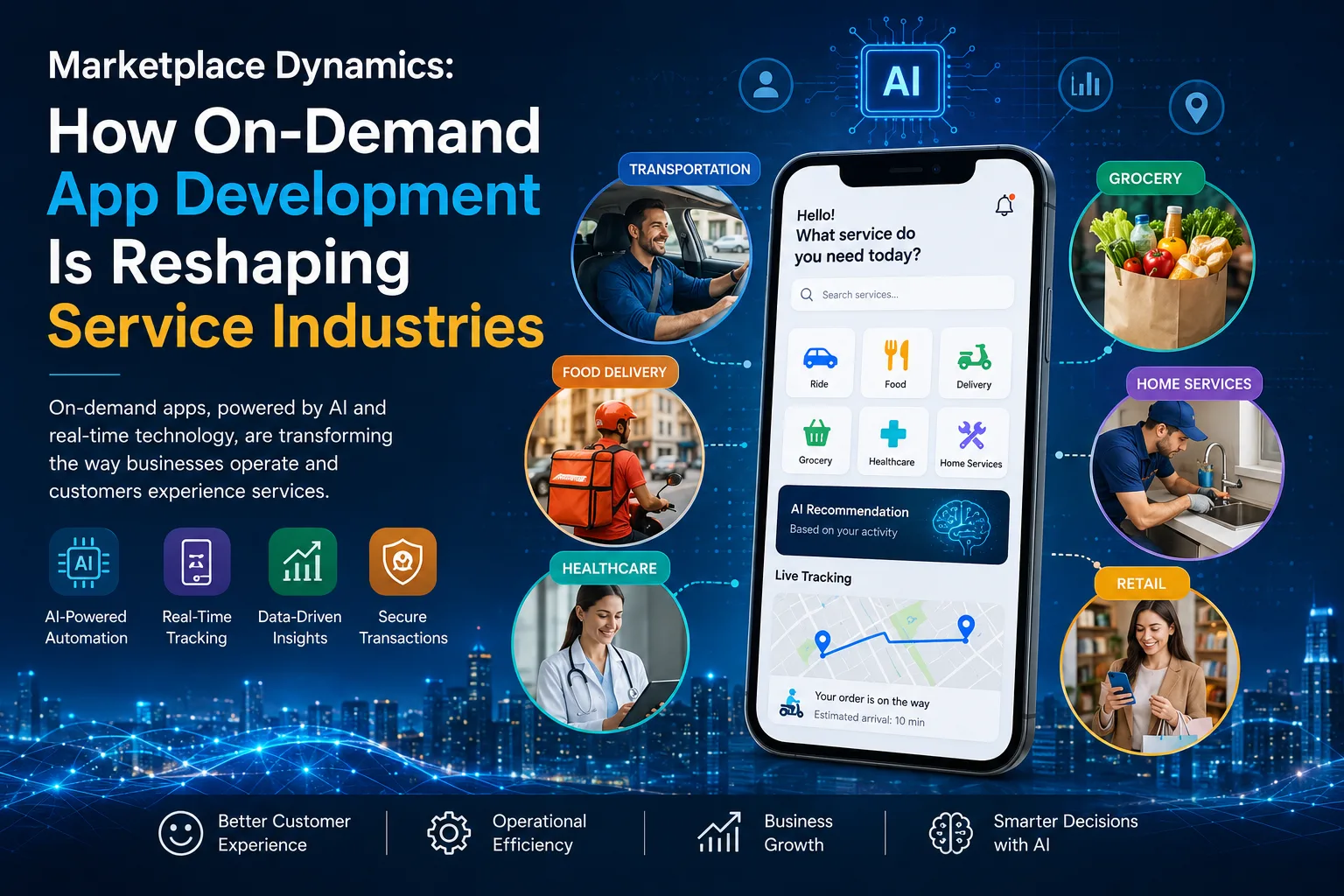
Digital transformation has significantly changed how consumers access products and services. Businesses across transportation, healthcare, retail, logistics, and home services are increasingly adopting mobile-first ecosystems to meet evolving customer expectations. One of the most influential drivers behind this transformation is on demand app development, which enables users to access services instantly through mobile platforms.
Consumers now expect convenience, personalization, and speed in nearly every interaction. As a result, companies are restructuring traditional operational models and investing in technologies that support faster communication, automated workflows, and data-driven decision-making.
The Rise of Instant Service Economies
The modern marketplace revolves around immediacy. Food delivery, ride-hailing, healthcare consultations, and grocery delivery platforms have changed how industries function. These platforms operate within ecosystems that prioritize user accessibility, predictive analytics, and seamless customer experiences.
An increasing number of businesses are studying how an on demand app development company builds scalable digital systems that support high-volume service requests, real-time tracking, and secure payment integration. These capabilities have become essential in industries where customer convenience directly influences brand loyalty and retention.
The shift toward mobile-centric business models has also encouraged organizations to experiment with subscription services, hyperlocal delivery systems, and AI-powered recommendations. These innovations are reshaping competitive strategies across service industries worldwide.
AI as the Core Engine of Modern On-Demand Platforms
Artificial intelligence is now central to the evolution of digital marketplaces. AI-driven automation improves operational efficiency while helping businesses analyze customer behavior more accurately. Modern platforms use machine learning to forecast demand patterns, optimize delivery routes, and personalize user experiences.
Many organizations exploring on demand app development services are integrating AI technologies such as chatbots, predictive analytics, and recommendation engines into their applications. These systems reduce response times and improve customer satisfaction while lowering operational costs.
For example, AI-powered logistics systems can analyze weather conditions, traffic congestion, and customer demand simultaneously to optimize delivery schedules. Similarly, AI assistants in healthcare apps can help patients schedule consultations or receive preliminary symptom guidance before connecting with professionals.
Industry-Wide Impact of On-Demand Platforms
Transportation and Mobility
Ride-sharing applications transformed urban transportation by introducing flexible mobility solutions. Today, AI-powered transportation systems use dynamic pricing models, route optimization, and driver allocation algorithms to improve efficiency.
A growing number of companies categorized as an on demand delivery app development company are also contributing to mobility innovation by building platforms that support electric vehicle rentals, bike-sharing services, and last-mile delivery operations.
Retail and E-Commerce
Retail businesses have shifted toward convenience-based commerce models. Consumers increasingly expect same-day deliveries, personalized shopping suggestions, and contactless payment systems.
This shift has increased interest in solutions developed by an on demand mobile app development company, particularly for grocery delivery, fashion retail, and pharmacy distribution services. AI helps these platforms analyze purchasing patterns, improve inventory forecasting, and reduce abandoned carts.
Retailers are also investing in voice search optimization, automated customer support, and AI-powered loyalty programs to enhance user engagement.
Healthcare and Telemedicine
Healthcare providers are adopting digital consultation platforms to improve patient accessibility. Telemedicine applications now support appointment scheduling, digital prescriptions, video consultations, and AI-assisted diagnostics.
Technology firms operating as an on demand app development company in california are often associated with healthcare innovation due to the region’s concentration of AI startups and health-tech research ecosystems. These developments continue to influence global healthcare digitization trends.
AI is particularly valuable in healthcare because it enables faster patient triage, medical data analysis, and predictive monitoring for chronic conditions.
Changing Consumer Expectations
The success of digital service platforms reflects changing consumer behavior. Modern users prioritize convenience over traditional purchasing processes. They expect platforms to offer:
- Real-time notifications
- Personalized recommendations
- Fast customer support
- Secure digital payments
- Easy order tracking
- Cross-device accessibility
Businesses investing in on demand service app development are adapting to these expectations by building systems that simplify customer journeys while maintaining operational transparency.
The emphasis on user experience has also increased the importance of intuitive interfaces, accessibility features, and multilingual support in mobile applications.
The Growing Role of Data Analytics
Data has become one of the most valuable assets in the digital economy. On-demand platforms generate large volumes of behavioral, transactional, and geographic data that businesses can use to improve services.
Organizations involved in on demand delivery app development often rely on AI-powered analytics dashboards to monitor customer retention, delivery performance, and purchasing trends. These insights help businesses refine pricing strategies, identify operational bottlenecks, and forecast future demand more effectively.
Predictive analytics also supports workforce planning by helping companies allocate resources based on peak usage patterns.
Customization and Scalable Infrastructure
As industries become more specialized, businesses increasingly require flexible digital ecosystems tailored to unique operational needs. This has contributed to the rise of custom on demand app development strategies that focus on modular architecture and scalable infrastructure.
Scalability is essential for handling fluctuations in user activity, especially during seasonal demand spikes. Cloud-native technologies, microservices architecture, and AI-based automation help platforms maintain performance under heavy traffic conditions.
Many organizations also prioritize API integrations to connect their applications with payment gateways, CRM systems, inventory management tools, and third-party logistics providers.
The Expanding Role of Skilled Developers
The rapid growth of digital marketplaces has increased global demand for technical talent. Businesses now require specialists in mobile development, AI engineering, cybersecurity, and cloud computing.
The growing influence of on demand developers reflects the broader shift toward agile product development and continuous deployment models. These professionals contribute to platform optimization, performance testing, and AI integration processes.
Similarly, industries exploring on demand retail app development are focusing on development teams capable of implementing augmented reality shopping experiences, personalized recommendation systems, and AI-driven customer engagement tools.
As development methodologies evolve, businesses increasingly adopt DevOps practices and automation pipelines to accelerate deployment cycles.
Security, Privacy, and Regulatory Challenges
Despite the advantages of digital transformation, on-demand ecosystems also face significant security and compliance challenges. Platforms handling financial transactions and customer data must comply with evolving privacy regulations.
Businesses implementing on demand app development solutions often prioritize end-to-end encryption, biometric authentication, and AI-based fraud detection systems to protect user information.
Cybersecurity concerns are especially important in healthcare, finance, and logistics industries where sensitive data is frequently exchanged. Governments worldwide are also introducing stricter digital compliance standards that influence platform architecture and data management strategies.
The Future of AI-Driven Service Industries
The future of service industries will likely involve deeper integration of AI, automation, and intelligent infrastructure. Technologies such as generative AI, IoT devices, and edge computing are expected to further enhance digital service ecosystems.
Companies operating in the broader field of on-demand app development company ecosystems are already experimenting with predictive automation, voice-enabled commerce, and AI-powered virtual assistants. These innovations may redefine customer interaction models across industries.
At the same time, advancements in on demand software development are enabling businesses to create adaptive systems capable of learning from user behavior in real time. This trend supports more efficient operations and improved customer experiences.
The concept of developer on demand models is also gaining relevance as businesses seek flexible technical expertise for rapidly evolving digital projects. Similarly, the role of on demand app developers continues to expand as organizations invest in scalable, AI-integrated platforms designed for future growth.
Conclusion
On-demand platforms have fundamentally changed the structure of modern service industries. Businesses are increasingly adopting AI-driven technologies to improve efficiency, personalize user experiences, and respond to rapidly evolving consumer expectations.
From transportation and retail to healthcare and logistics, digital ecosystems are transforming traditional business models into highly responsive service networks. As artificial intelligence, automation, and cloud infrastructure continue to evolve, on-demand applications will likely remain central to the future of global commerce and customer engagement.