
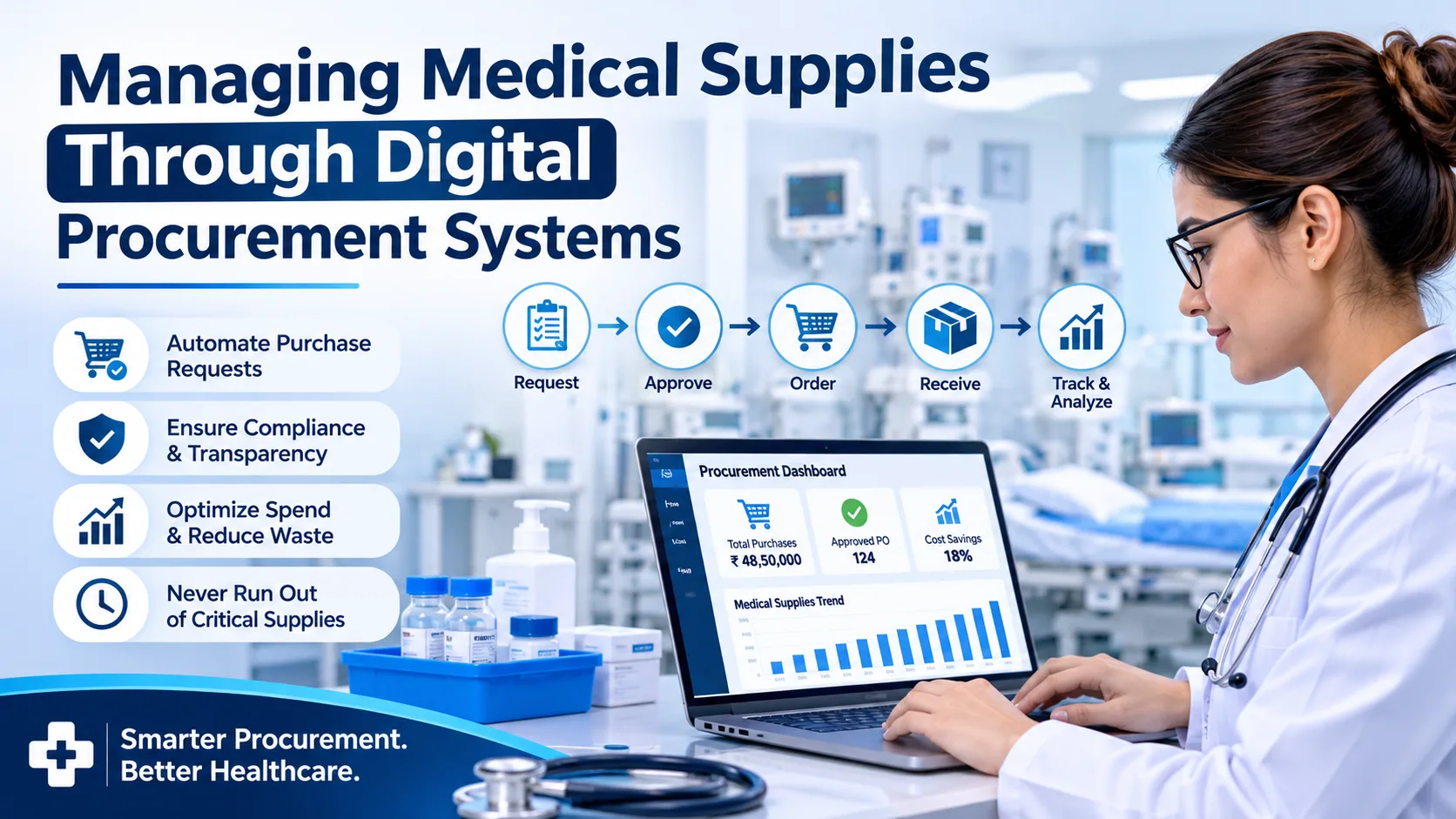
A nurse reaches for a box of syringes and finds the shelf empty. Somewhere else in the same hospital, a storeroom holds three months of a different item that is close to expiry. Both problems have the same root: medical supplies are being managed through disconnected requests, memory and manual counting.
Medical supplies are bought often, in small lots, from many vendors, and they cannot run out. That makes them a perfect case for a digital procurement system. In this blog, we will cover why supplies are hard to manage by hand, what a digital system changes, and how to roll it out in a hospital, clinic or diagnostic centre without disrupting daily work.
Why Medical Supplies Are Hard to Manage
Capital equipment is bought rarely and discussed at length. Supplies are the opposite: gloves, syringes, dressings, reagents, IV fluids and surgical consumables are ordered every week, by many departments, and consumed fast. That brings its own set of challenges:
- Stockouts affect care. A missing item can delay a procedure or force a costly emergency purchase.
- Overstocking wastes money. Items with limited shelf life can expire before they are used.
- Many departments buy independently. Wards, labs, pharmacy and operation theatres each raise requests, often for the same items from different vendors at different rates.
- Vendor lists grow without control. Over time, the hospital deals with dozens of suppliers, and nobody has a clear view of who performs well.
- Records must be accurate. Purchases need a clean trail from request to payment, both for internal control and for audits.
What Goes Wrong Without a Digital System
When supplies are managed through registers, calls and spreadsheets, a few things happen again and again:
- Requests arrive by phone or on paper, and some are forgotten or duplicated.
- Reorder decisions depend on someone remembering to check the shelf.
- Rates differ from vendor to vendor and from month to month, with no easy way to compare.
- Deliveries are accepted without a proper check against the order.
- Invoices are paid based on trust rather than a match with what was ordered and received.
- Management sees total spend only after the month closes, and even then not by category or department.
How Digital Procurement Systems Improve Medical Supply Management
1. One channel for every request
A digital system gives each ward and department one place to raise requirements. A structured purchase request captures the item, quantity, department and required date. No more missed calls or lost chits, and the purchase team can see all demand together before ordering.
Seeing demand together is useful in itself. Five small requests for the same item can become one planned order at a better rate.
2. Approvals that match the risk and value
Routine consumables should not wait days for approval, while high-value or unusual purchases deserve more scrutiny. Digital approval workflows let you set rules by value, department and item category. Urgent requests move fast along a defined path, and nobody has to chase a physical file.
3. A vendor base you can measure
With vendor management, every supplier has one record: documents, product range, rates, past orders and delivery performance. The team can see who delivers on time and who does not, and decide where to place orders on facts. A vendor portal lets suppliers update their documents and respond to requests themselves, which cuts down on calls and emails.
3. Rates that are compared, not assumed
For repeat items, quotation management lets you collect quotes from several vendors and compare them side by side. For larger supply categories, or when you want to set up annual supply arrangements, a structured RFP helps you evaluate vendors on the same criteria. Over time, this discipline alone brings rates under control.
4. Contracts and agreed rates in one place
Many hospitals negotiate rate contracts for high-volume items. The benefit is lost if the buyer does not know the agreed rate at the time of ordering. With contract management, terms, validity dates and agreed prices are stored and visible, so off-contract purchases are easy to spot.
5. Stock visibility across stores
The most useful change is seeing stock and purchasing together. Inventory management shows what is available, what is on order and what is running low, so reorders are planned instead of reactive. If your supplies are held in more than one store, visibility across locations lets you move stock where it is needed before you buy more.
For items with a short shelf life, check that your system supports the tracking you need, such as batch details and expiry dates, so that older stock is used first.
6. Delivery checks at the door
When supplies arrive, the store team records them through a GRN against the original order, noting the quantity and any shortages or damage. This one habit prevents most disputes with vendors, and it gives the finance team something solid to match against.
7. Invoices matched before payment
With accounts payable linked to orders and receipts, each invoice is checked against both before payment. Wrong quantities, wrong rates and duplicate bills are flagged early. This 3-way match is a core part of any procure-to-pay process.
8. Spend you can actually see
Because every purchase goes through one system, reporting is automatic. Spend analytics shows how much each department spends, which categories grow fastest and which vendors receive the most business. Leadership can plan budgets and negotiations on real numbers.
9. Less manual typing with AI
AI can handle specific routine tasks. AI Intake can turn a plain-language request into a structured purchase request, and AI-based invoice verification can capture invoice data and flag mismatches for a person to review. Staff stay in charge of decisions while the repetitive work gets lighter.
How ZYNO Procurement Fits Healthcare Supply Needs
ZYNO Procurement connects the full purchasing cycle in one platform: request, approval, vendor selection, quotation, purchase order, goods receipt, invoice and payment. For hospitals, clinics and labs, it means one workflow for all supplies, one record per vendor and one view of spend, with a clear trail behind every purchase.
A Practical Rollout Plan
You do not need to move everything at once. A sensible order looks like this:
- Pick a starting category. High-volume consumables are a good place to begin.
- Clean the vendor and item lists. Remove duplicates and inactive suppliers before loading them.
- Move requests and approvals online. Get every department raising requests in the same format.
- Add quote comparison and contracts. Load existing rate agreements so buyers can see them.
- Start GRN and invoice matching. Make delivery entry a daily habit in the store.
- Review reports monthly. Look at spend, delivery performance and stock levels, and act on them.
Train store and ward staff first, because they raise the most requests and receive the most deliveries.
Common Mistakes to Avoid
- Digitizing a messy process without simplifying it first.
- Skipping the store team in training.
- Leaving some departments outside the system, which creates a second, hidden purchasing channel.
- Ignoring reports once the system is live.
Frequently Asked Questions
What is a digital procurement system for medical supplies? It is software that manages requests, approvals, vendor quotes, orders, deliveries, invoices and payments for medical supplies in one connected workflow.
How does it prevent stockouts? By showing stock levels and open orders together, so buyers can reorder in time. Demand from all departments is also visible in one place.
Can it reduce the cost of supplies? It helps by making quote comparison easier, flagging off-contract buying and catching invoice mismatches. The actual saving depends on your current process and spend.
Is it suitable for small clinics and labs? Yes. Smaller facilities often have fewer people to chase paperwork, so a simple, connected process saves them more time than it saves a large hospital.
Does it support audits? Every request, approval, order, receipt and payment is recorded and linked, so you can show the full trail for any purchase.
Final Thoughts
Medical supplies are small purchases that add up to a big responsibility. When requests, vendors, stock and invoices live in separate places, shortages and waste follow. A digital procurement system brings them together, so your team can order on time, pay what is correct and see where the money goes.
Want to see how it would work in your facility? Book a demo of ZYNO Procurement and walk through the process with our team.