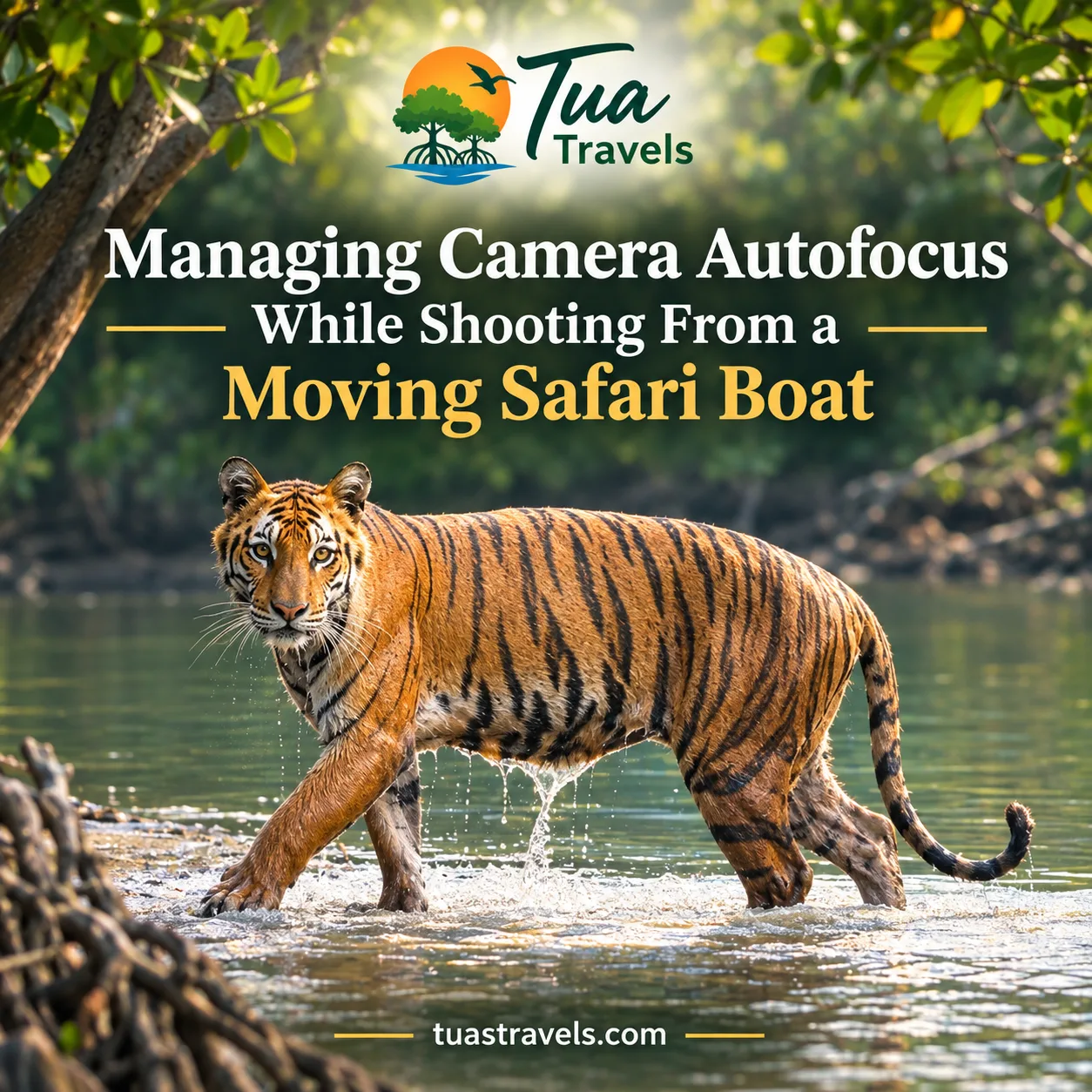
The moving safari boat is an interesting autofocus conundrum. Tides, currents and wind are always a factor in the Sundarbans and animals can suddenly be seen on the riverbank or deep inside dense mangroves. The slightest movement makes it difficult for the camera to lock focus fast. Learning to control the autofocus is good to take sharp pictures and not miss any fleeting moments of wildlife.
Choose a Suitable Autofocus Mode
Continuous autofocus works better than single-shot autofocus when taking photos of wildlife while in a boat. Some cameras have modes that can set the focus to continuously adjust as the subject or camera position changes (AF-C).
The Animals that are moving, continuous autofocus helps keep them focused when they walk, swim or fly. It is especially helpful in shooting birds as they leave branches and animals as they traverse mud banks.
Choose the Right Focus Area
In mangrove areas a wide AF area may not be the best option. It is easy for the camera to be drawn to branches, leaves and grass when the animal is the topic of interest.
A smaller focus area or proper tracking zone can provide more control to the photographer. If it has an animal/bird detection feature, it can be helpful as well - but photographers should still check out what the camera is actually taking pictures of.
If the animal is a stationary animal partly concealed by vegetation, it may be useful to carefully place the focus point over the exposed eye or head.
Do not stray from the Subject in the Focus Area
This apparent difficulty in framing is caused by the movement of the boat. When the boat moves the focal point can move outside the chosen focus zone. Keeping the camera still and the subject close to the centre of the tracking area may help to keep the attention focused.
This can also help with slight movement that occurs in the boat due to the faster shutter speed. With long telephoto lenses, the camera's movement will be amplified and this will be especially important.
Take care of mangrove vegetation
When animals are in branches and leaves, it is difficult for autofocus. A smaller focus point might be appropriate if the camera is continually focusing on foreground plant material.
Sometimes it is helpful to use manual focus when photographing a still scene in a dark opening in the foliage. But it takes some practice and may not be so useful if an animal suddenly moves.
The Settings Screen is adjusted before the Safari begins
While on the move, you have to make instant decisions on settings, or you may miss photographs because you are too busy adjusting settings. Always review the autofocus, focus area, shutter speed and ISO before entering in areas where wild life is likely to be found.
The photographer should also try his or her AUTO FOCUS with a moving boat. This allows them to learn the time that the camera takes to react to distance and movement.
Practice Tracking From the Boat
Performance with the auto-focus is just half the story. The photographer must also predict movement and be sure of the composition. Practice flushing birds over water or objects along the riverbank can help to build up tracking skills.
Using the proper autofocus mode, choosing a focus area and steady camera control, photographers can be more confident in the moving safari boat. Preparation is especially important in the Sundarbans due to the often fleeting and random nature of wildlife interactions.