
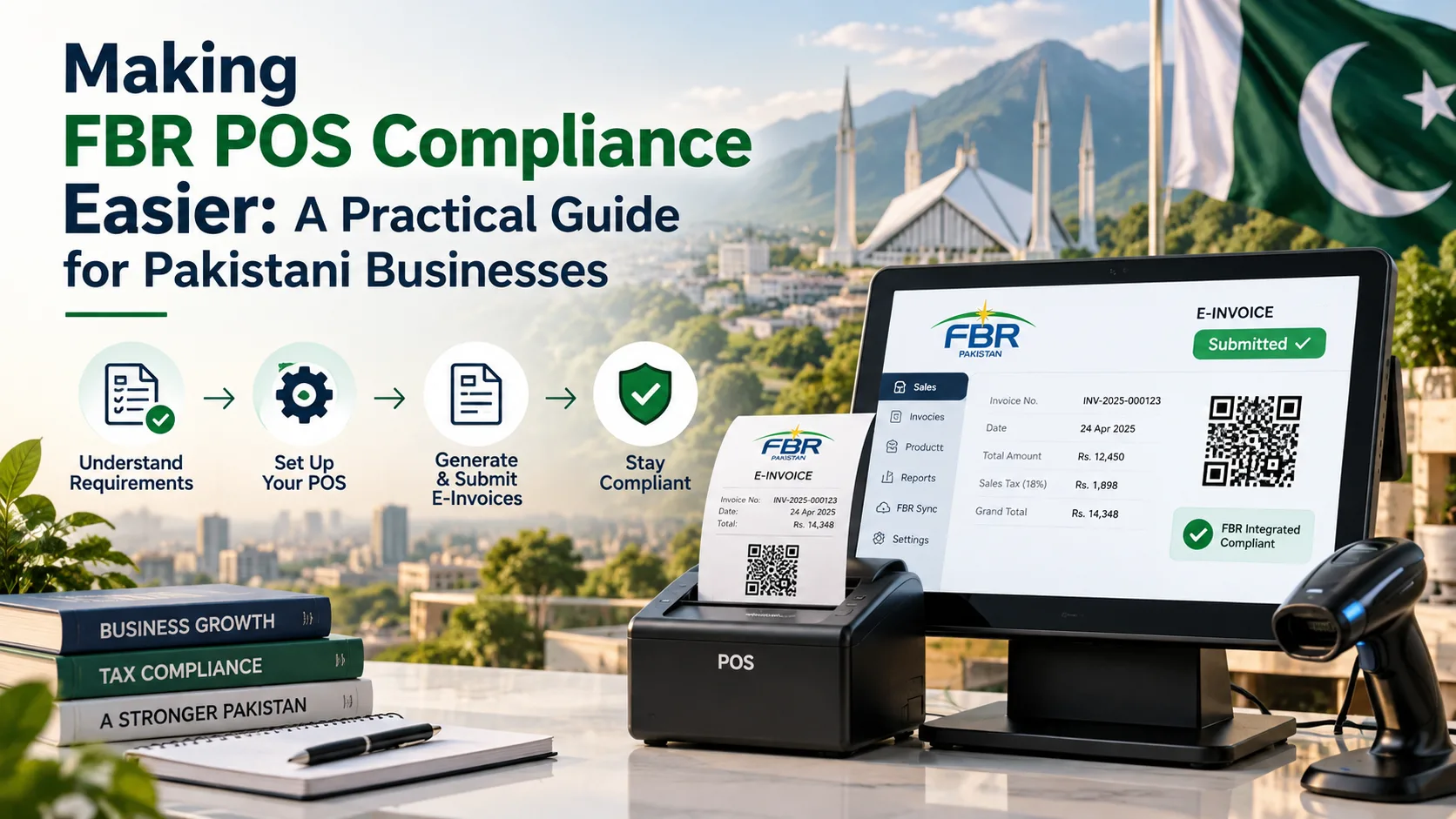
For many Pakistani businesses, a point-of-sale system is now more than a tool for printing receipts and recording sales. As digital tax reporting becomes more important, businesses need billing systems that produce accurate invoices, maintain organized records, and connect with the Federal Board of Revenue where required. Understanding FBR POS Compliance is essential for retailers, restaurants, pharmacies, wholesalers, and other businesses affected by electronic invoicing rules.
What Does FBR POS Compliance Mean?
FBR POS Compliance means making sure that a business’s point-of-sale system, invoicing workflow, records, and reporting practices meet applicable Federal Board of Revenue requirements. It is not simply about purchasing software.
A compliant setup can connect sales operations with FBR digital invoicing, helping businesses reduce manual reporting and improve visibility over daily transactions. Obligations vary according to taxpayer category, business activity, registration status, and relevant FBR notifications.
Why Proper POS Integration Matters
A disconnected billing process can create problems as transaction volumes increase. Manual invoices, separate spreadsheets, inconsistent product records, and incomplete sales information can make reconciliation difficult and complicate tax reviews.
An integrated FBR POS system creates a structured workflow. Sales are recorded through the POS, invoice information can be processed through the required integration, and the business can maintain better digital records. This can improve compliance and operational control.
FBR public data shows that thousands of retailers and branches are already integrated with its POS system, demonstrating how widely digital sales reporting has become part of the business environment.
Who Should Review POS Compliance?
Businesses should not assume that only large retail chains need to assess their systems. Depending on applicable rules, notified categories can include certain retailers, restaurants, textile and leather businesses, and other registered persons subject to electronic invoicing requirements.
Businesses using an ERP, accounting platform, or existing POS should evaluate whether their software supports POS integration in Pakistan.
Step One: Review Registration and Business Data
The first stage is reviewing the business information used in the billing system. This can include tax registration details, business name, outlet information, product records, tax rates, units, pricing, discounts, and customer information where applicable.
Accurate master data is essential for FBR compliant invoicing. Cleaning data before integration makes testing more reliable.
Step Two: Choose the Right Integration Approach
FBR states that notified registered persons must integrate their POS, ERP, or invoicing system through a licensed integrator. Businesses should confirm the integration partner before implementation.
Professional POS integration services can add value by reviewing software, identifying technical gaps, preparing configuration, coordinating integration, and helping test the workflow before going live.
Step Three: Configure Products, Taxes, and Invoices
Configuration is one of the most important parts of compliance. The POS should reflect the actual structure of the business rather than generic settings.
Products should be mapped correctly, tax rates reviewed, discounts handled consistently, and invoice fields completed with required information. Businesses should also configure payment types, branches, users, and permissions.
For multi-location companies, multi branch POS management helps standardize billing while keeping outlet information organized.
Digital Invoices and QR Verification
Modern digital invoicing services help businesses move from basic receipts to structured electronic invoices.
For eligible POS invoices, customers can use FBR-supported verification methods, including QR-based checking. This improves transparency because customers can confirm whether an electronically generated invoice is recognized in the system.
However, a QR code alone does not make an invoice compliant. The transaction, invoice data, transmission process, and recordkeeping must also be accurate.
Testing Before Going Live
Businesses should conduct controlled testing before full production use. Test transactions can include normal sales, discounts, returns, different payment methods, different tax treatments, and transactions from multiple outlets.
A strong FBR invoice integration process should verify that information reaches the required system correctly and that returned information is captured by the POS. Rejected or failed transactions should be investigated rather than ignored.
Staff training is equally important. Cashiers and managers should understand invoice procedures, correction workflows, connectivity problems, and escalation steps.
Maintaining Compliance After Integration
Integration is not a one-time task. Businesses should continuously monitor transaction records and compare POS data with accounting records, inventory movement, and tax reporting.
Regular POS compliance monitoring can identify missing invoices, duplicate transactions, unusual adjustments, rejected transmissions, or data mismatches. Backups, access controls, software updates, and documented configuration changes should also support compliance.
When a company opens a branch, changes products, modifies tax settings, or upgrades its POS, the new configuration should be reviewed before operations continue.
Common Mistakes to Avoid
One major mistake is assuming that a popular POS product is automatically compliant. Another is allowing incorrect product and tax data to remain in the system. Skipping integration testing, ignoring failed transmissions, giving unrestricted user access, and failing to reconcile records can create avoidable risks.
Businesses should also avoid choosing an integration provider without checking whether it has appropriate authorization. Compliance depends on both technology and implementation.
How PFOC Can Support Your Business
Professional support can simplify the move from ordinary billing to a controlled compliance environment. PFOC provides POS Compliance Services covering system assessment, configuration, FBR integration support, digital invoicing, QR-enabled invoices, testing, staff training, and ongoing technical assistance.
The goal is not simply to install software. It is to create a connected workflow that fits the business, keeps sales records organized, supports required reporting, and reduces setup mistakes.
Final Thoughts
FBR POS compliance is becoming an important part of modern business operations in Pakistan. Businesses that treat integration as a technical task alone may overlook data quality, employee training, recordkeeping, and monitoring.
A stronger approach combines the right POS technology with accurate tax data, proper integration, testing, and continuous review. By establishing a reliable FBR POS Compliance process, businesses can improve billing accuracy, strengthen internal controls, support digital invoicing, and remain better prepared for regulatory requirements.
The objective is simple: every sale should be recorded correctly, every required invoice should follow the applicable process, and the business should have reliable records when compliance questions arise. With professional guidance and a well-configured system, FBR compliance can become part of everyday business operations rather than a recurring source of uncertainty.