
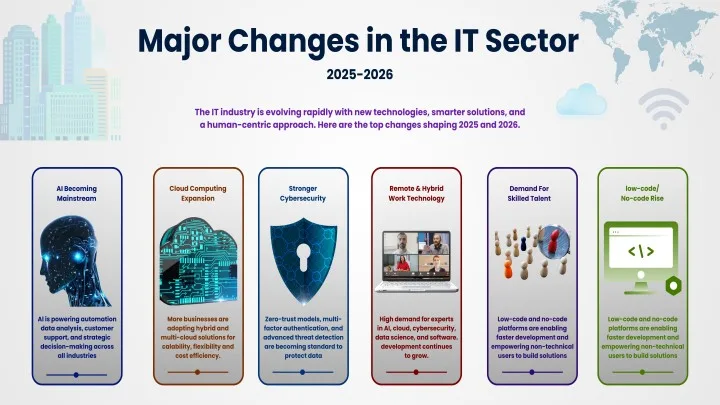
The IT industry is now poised to enter an era of exponential growth and evolution from 2025 to 2026. The use of technology is no longer just limited to big firms or software firms. Nowadays, all industries, ranging from healthcare to retail and finance, rely on technology to become more efficient and offer better service to customers. There are huge changes being witnessed by the IT sector due to the ongoing evolution in the business world.
Artificial Intelligence Becoming Mainstream
One of the most important developments that has occurred within the IT sector includes the implementation of Artificial Intelligence. AI was once considered a highly theoretical topic. However, in 2025 and 2026, AI will be employed by many enterprises as a practical tool to automate processes, make important decisions, provide customer support, and conduct analyses.
Many firms are utilizing AI-based tools such as chatbots to respond to customer inquiries effectively. AI has made it easier to analyze large quantities of data, thus allowing firms to understand consumer behavior and make strategic business decisions based on this information.
Growth of Cloud Computing
Cloud computing will continue to be one of the significant drivers in the IT sector in the future. Many firms are increasingly adopting cloud computing due to its agility, cost-effectiveness, and scalability. Firms no longer need to invest in costly servers but simply store their data and use applications from the cloud.
Hybrid cloud and multi-cloud computing are gaining traction among businesses in the coming years of 2025 and 2026. Companies are increasingly relying on various cloud service providers to enhance their efficiency, ensure high availability, and maintain the integrity of their data. The adoption of cloud computing is particularly beneficial for new ventures and expanding companies.
Stronger Focus on Cybersecurity
With the rise in digital transformation, there is a greater need for cybersecurity. Cyber threats like ransomware, phishing, and data breaches have affected organizations globally. As a result, many firms are spending millions of dollars on state-of-the-art cybersecurity technology.
In 2025 and 2026, there will be increased adoption of zero-trust architecture. Zero trust is a model that requires all users and devices to be verified before gaining access to the system. These processes include multi-factor authentication, endpoint protection, encryption, and security audits.
Additionally, businesses are educating their staff on the identification of cybersecurity risks. Human error is still the leading cause of cybersecurity breaches. As such, companies must take responsibility for protecting themselves from cyber attacks.
Rise of Remote and Hybrid Work Technology
The nature of the working environment has evolved, and telecommuting has emerged as a major trend. Many companies have implemented the use of hybrid workplaces, where their employees spend some of their working days at the office and others working remotely.
The IT industry is creating innovative video conferencing solutions and more efficient collaboration tools, such as cloud-based tools for managing projects. Teleworking processes have become much more advanced in 2025 and 2026.
The development of remote work is also having an impact on recruitment practices because companies can hire experienced specialists not just from another city but even from another country.
Increased Demand for Skilled IT Professionals
The fast development of technology is creating a high demand for experts. Firms are recruiting software developers, artificial intelligence engineers, cybersecurity experts, cloud architects, data analysts, and UI/UX designers.
In 2025 and 2026, hands-on experience will be more important than academic credentials. Nowadays, many employers look for employees who have certifications, project experience, and the latest knowledge about technology. It is vital to keep up with the pace since technological advancements occur quickly.
Therefore, there is a surge in online education platforms, boot camps, and professional courses.
Low-Code and No-Code Development
A further important development within the information technology industry is the emergence of low-code/no-code solutions. These solutions are software packages that enable users to construct their applications, websites, and processes without any need for extensive programming skills. Companies have been implementing such solutions in order to accelerate project deployment as well as save on development costs.
Coding will still be necessary when developing complicated systems; however, low-code solutions will continue to help small firms and organizations develop digital solutions without the need for extensive coding.
Green IT and Sustainability
Sustainability has become one of the top priorities within the IT industry. Energy consumption is high in data centers, and electronic waste is emerging as a big issue. Hence, IT firms are increasingly concentrating on sustainable approaches.
From 2025 to 2026, firms will invest in energy-efficient servers, data centers powered by renewable energy sources, and recycling programs that minimize electronic waste. Software companies will work on making their applications more efficient, using less computing power.
Conclusion
Innovation, security, and efficiency define the IT industry of 2025 and 2026. Artificial Intelligence, cloud computing, cybersecurity, telecommuting tools, and sustainability initiatives are revolutionizing the way companies conduct their operations. Meanwhile, there is an ever-growing need for competent personnel, thus generating job prospects.
Businesses that embrace such trends will stay competitive and prepared for the future. Innovation is not just about developing new technologies, but also employing them in the most efficient ways possible.