
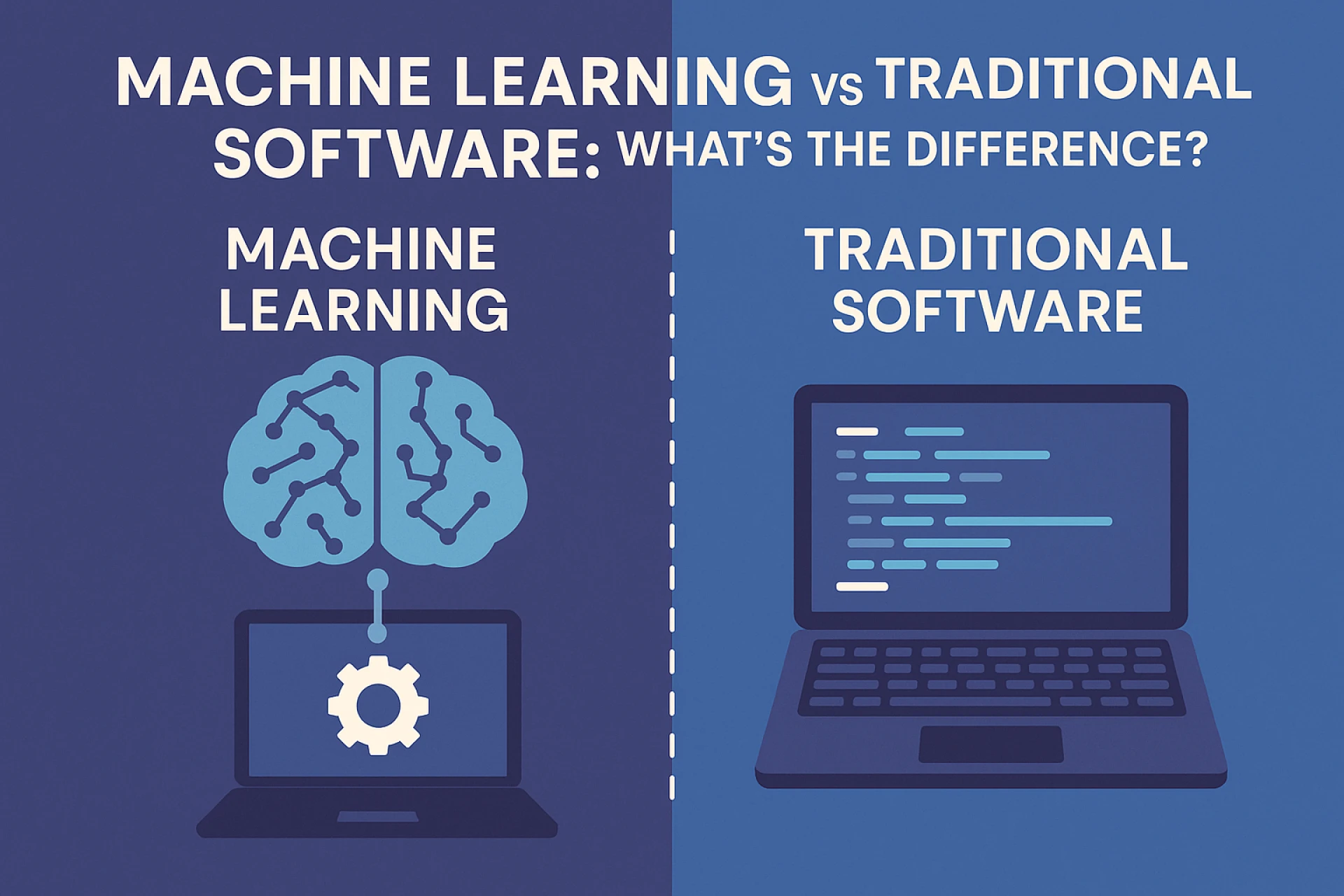
In today's rapidly evolving tech ecosystem, machine learning has become a core driver of intelligent systems. From personalized recommendations to self-driving cars, ML-based systems are outperforming traditional software in many domains. But what exactly sets machine learning apart from traditional software development? How do their processes, logic, and applications differ? And most importantly, when should a business choose one over the other?
In this blog, we’ll explore the fundamental differences between machine learning and traditional software, breaking down their architectures, development workflows, and ideal use cases. Whether you are a business owner looking to implement intelligent solutions or a developer diving into AI, understanding these distinctions is key to success.
What is Traditional Software?
Traditional software refers to computer programs developed through explicit programming. Developers write detailed instructions in code that dictate exactly what the program should do, based on well-defined rules and logic.
Characteristics of Traditional Software:
- Rule-based logic: If-then-else conditions drive the behavior.
- Deterministic output: Given the same input, it always produces the same result.
- Manual feature engineering: Developers decide what data is important.
- Fixed functionality: Updates require code modification and redeployment.
Example Use Cases:
- Accounting systems
- Inventory management
- Payroll processing
- Basic data entry automation
Traditional software excels when the problem domain is well understood and rules can be clearly defined.
What is Machine Learning?
Machine Learning (ML) is a subset of artificial intelligence where systems learn from data instead of being explicitly programmed. Instead of writing rules, developers build models that can generalize from examples to make predictions or decisions.
Characteristics of Machine Learning:
- Data-driven logic: The system learns patterns from data.
- Probabilistic output: Results may vary based on model confidence.
- Automatic feature discovery: ML models often identify patterns in data that humans may miss.
- Adaptive behavior: Models can improve over time with more data.
Example Use Cases:
- Fraud detection in banking
- Customer churn prediction
- Image and speech recognition
- Personalized marketing and recommendations
Modern businesses increasingly partner with a Machine Learning Development Company to leverage these intelligent capabilities.
Key Differences Between Machine Learning and Traditional Software
Let’s examine the core differences in terms of development process, maintenance, performance, and scalability.
1. Development Workflow
Traditional Software:
- Requirement gathering
- Design and architecture
- Rule-based coding
- Manual testing
- Deployment
Machine Learning:
- Problem definition
- Data collection and preprocessing
- Model selection and training
- Validation and tuning
- Integration and monitoring
With ML, the focus shifts from programming logic to data engineering and model experimentation. This is why Machine Learning Services often include data scientists and ML engineers rather than just software developers.
2. Handling Complexity
Traditional software struggles with tasks that require subjective judgment or pattern recognition — such as identifying objects in images or translating languages.
ML thrives in these cases because it can learn from past data and detect complex correlations that rule-based systems can't easily encode.
Example:
- A traditional spam filter might look for specific keywords.
- An ML-based spam filter learns from thousands of examples of spam and non-spam to build a probabilistic model.
3. Flexibility and Adaptability
Traditional software is static. If the environment changes, developers must update the code.
ML systems are dynamic. With retraining, the model can adapt to new patterns.
Example: In fraud detection, fraudsters constantly evolve tactics. A traditional system might quickly become obsolete. An ML model, retrained regularly, can adapt to these changing patterns.
4. Performance and Accuracy
In tasks involving classification, prediction, or pattern recognition, ML systems often outperform traditional ones.
However, this comes with a trade-off:
- ML models may produce incorrect results with a certain probability.
- Traditional software offers deterministic behavior — making it more reliable in domains requiring strict consistency (e.g., financial calculations or legal compliance).
5. Explainability and Transparency
One major challenge with ML is the "black-box" problem — it’s often hard to explain why a model made a certain decision.
Traditional software, on the other hand, is transparent because the rules are explicitly defined in the code.
To address this, AI Machine Learning Development increasingly incorporates techniques like Explainable AI (XAI) to improve model interpretability in sensitive applications like healthcare and finance.
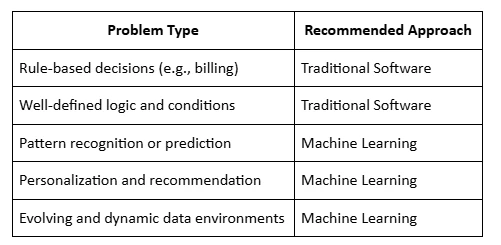
When to Use Traditional Software vs Machine Learning?
Challenges in Machine Learning Development
While ML offers flexibility and intelligence, it also introduces several challenges:
- Data dependency: Quality and quantity of data directly affect model performance.
- Computational cost: Training models requires significant processing power.
- Model drift: Over time, models can become less accurate if not updated.
- Ethical and bias concerns: ML systems can inherit biases present in data.
That’s why it’s essential to work with an experienced Machine Learning Development Company that understands the nuances of ML model development, deployment, and monitoring.
The Rise of AI-Driven Solutions
Today, businesses are rapidly adopting AI Machine Learning Development to gain competitive advantages. From automating customer support to predicting supply chain disruptions, the applications are vast and transformative.
Machine Learning Services are now offered across various sectors including healthcare, finance, retail, manufacturing, and logistics — helping organizations innovate faster and make smarter decisions.
Conclusion
The fundamental difference between machine learning and traditional software lies in how logic is created: rule-based programming versus data-driven learning. Traditional software is ideal for well-defined, rule-bound tasks. Machine learning shines in complex, dynamic, and data-rich environments.
For businesses aiming to integrate intelligent features and predictive capabilities, partnering with a trusted Machine Learning Development Company ensures proper implementation, scalability, and long-term ROI. As AI and ML continue to evolve, knowing when and how to leverage these technologies is critical for staying ahead in a competitive market.
Need help implementing Machine Learning in your business?
Reach out to a professional Machine Learning Services provider and unlock the full potential of your data through smart, adaptive solutions.