Water pumps are essential for maintaining a steady water supply in commercial buildings, industries, hospitals, hotels, and residential communities. However, one of the most common causes of pump failure is low water levels. When pumps continue operating without sufficient water, they can overheat, suffer mechanical damage, and eventually fail, leading to costly downtime and repairs.
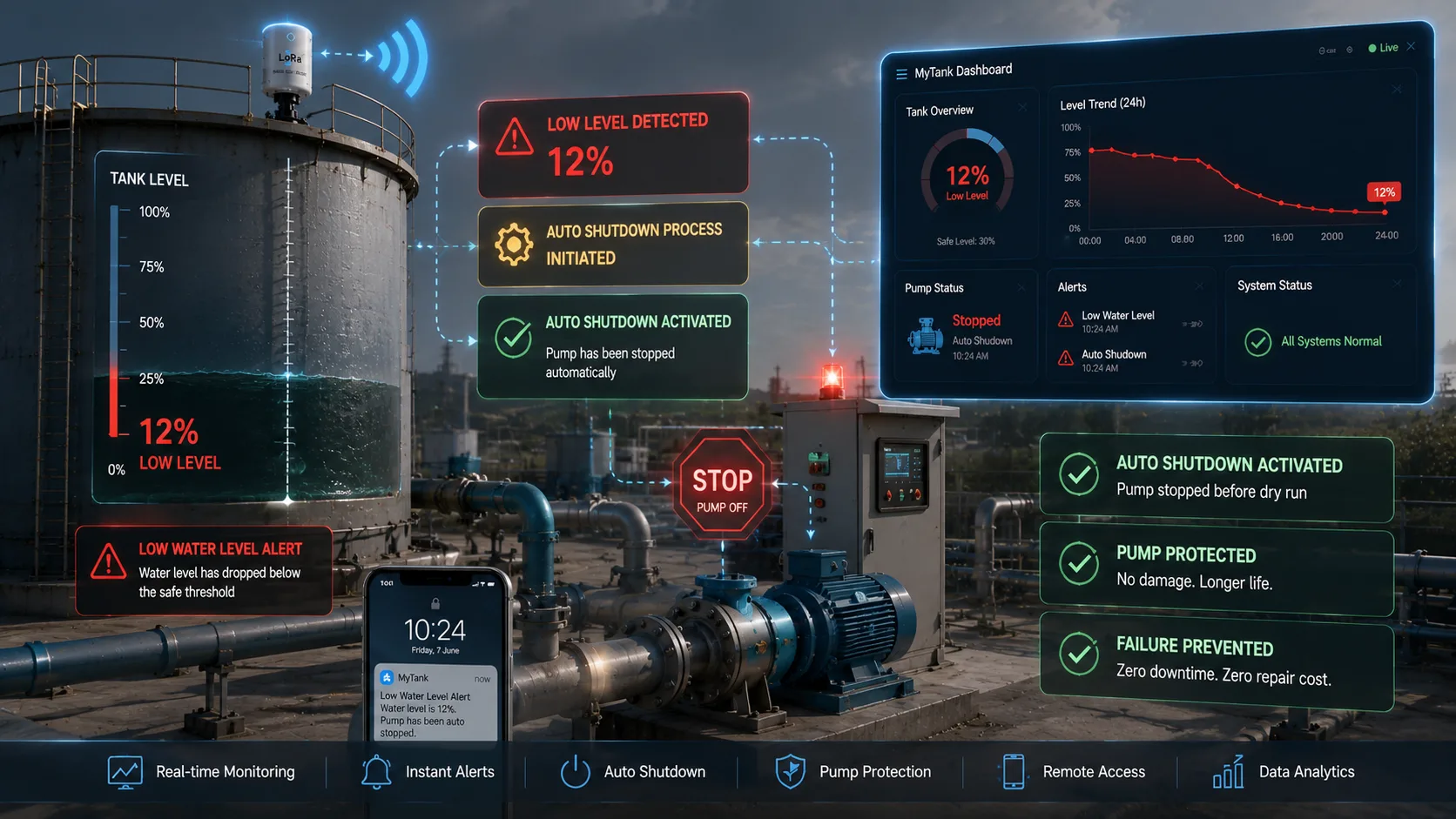
The good news is that these failures are often preventable. With advanced solutions such as a LoRa radar level sensor and intelligent platforms like MyTank Water Monitoring, businesses can detect low water levels early and protect critical equipment.
Why Low Water Levels Damage Pumps
Pumps are designed to operate with adequate water flow. When water levels drop below safe operating thresholds, the pump may continue running without proper cooling or lubrication.
This condition, often called dry run, can cause:
- Motor overheating
- Seal damage
- Increased mechanical wear
- Reduced pump efficiency
- Complete pump failure
Even short periods of dry running can shorten pump lifespan and increase maintenance costs.
Common Reasons for Low Water Levels
Low water levels can occur for several reasons, many of which remain unnoticed without proper monitoring.
Unexpected High Consumption
Sudden spikes in water usage can drain tanks faster than expected.
Delayed Refilling
Refill systems may fail or respond too slowly, causing tank levels to fall.
Leakage
Hidden leaks can gradually reduce available water.
Poor Monitoring
Manual inspection often fails to detect low water conditions early enough.
Without real-time visibility, these problems can escalate quickly.
Why Early Detection Matters
Detecting low water levels early allows operators to take corrective action before pumps are affected.
Early detection helps businesses:
- Prevent dry run conditions
- Reduce emergency maintenance
- Extend pump lifespan
- Improve operational continuity
- Lower repair costs
Proactive monitoring transforms pump maintenance from reactive to preventive.
How a LoRa Radar Level Sensor Helps
A LoRa radar level sensor provides highly accurate, non-contact water level measurement, making it ideal for smart tank monitoring.
Unlike traditional sensors, radar technology uses electromagnetic waves to measure water levels without touching the liquid. This improves accuracy and reduces maintenance.
Key advantages of a LoRa radar level sensor include:
Accurate Level Measurement
Precise readings help identify low water levels before they become dangerous.
Non-Contact Monitoring
No direct contact reduces wear and improves long-term reliability.
Long-Range Connectivity
LoRa (Long Range) communication allows remote monitoring across large facilities and distant tanks.
Reliable Performance
Radar sensors perform well even in harsh environments with dust, humidity, or vapor.
These features make LoRa-based monitoring highly effective for pump protection.
How MyTank Water Monitoring Improves Pump Protection
Sensor data becomes far more useful when combined with an intelligent platform like MyTank Water Monitoring.
MyTank Water Monitoring provides real-time visibility into tank conditions through a centralized dashboard, enabling faster and smarter decision-making.
With MyTank Water Monitoring, users can:
- Monitor water levels in real time
- Receive instant low-level alerts
- Track usage trends and abnormal consumption
- Manage multiple tanks remotely
- Improve pump scheduling and automation
Instead of waiting for failures, teams can respond proactively.
Benefits of Smart Monitoring
Combining a LoRa radar level sensor with MyTank Water Monitoring provides major operational benefits.
Reduced Pump Failures
Early alerts prevent dry run damage.
Lower Maintenance Costs
Predictive monitoring reduces emergency repairs.
Better Operational Efficiency
Reliable pump performance supports uninterrupted water supply.
Improved Equipment Lifespan
Optimized operation reduces wear and tear.
These benefits directly improve productivity and cost efficiency.
Industries That Benefit Most
Pump protection through smart monitoring is valuable across many sectors, including:
- Commercial buildings
- Hotels and resorts
- Hospitals
- Industrial facilities
- Residential communities
- Utilities
Any facility that depends on continuous water availability benefits from early detection.
Final Thoughts
Low water levels are one of the leading causes of pump failure, but the problem is often preventable with better monitoring. Waiting until a pump fails leads to unnecessary downtime, repair costs, and operational disruption.
By using a LoRa radar level sensor along with MyTank Water Monitoring, businesses can detect low water conditions early, protect pumps, and ensure uninterrupted water supply.
Fixing the problem early is always cheaper than dealing with a costly pump failure later.