
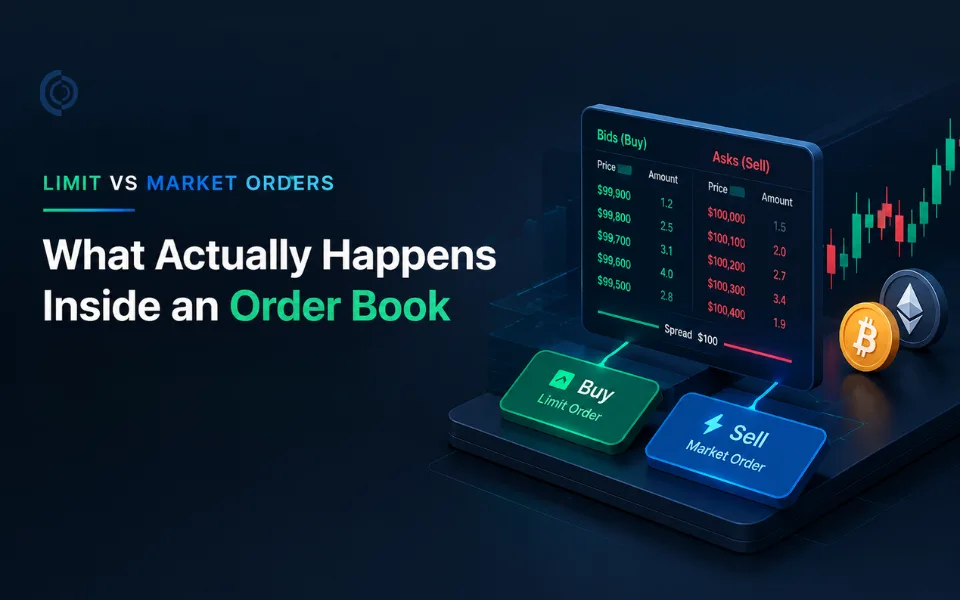
When a trader clicks Buy or Sell on a crypto exchange, the transaction may look instant, but several systems work behind the scenes. The order is validated, sent to the matching engine, checked against available liquidity, and eventually executed and settled.
The type of order plays an important role in how this process works.
Limit Orders: Price Control
A limit order allows traders to specify the price at which they are willing to buy or sell. If a matching order is not available, the order can remain in the order book until it is filled, canceled, or expires.
This gives traders greater price control, but execution is not guaranteed. A limit order can be fully filled, partially filled, or remain unfilled depending on market conditions and liquidity.
Market Orders: Execution Priority
A market order does not specify a fixed execution price. Instead, it is matched against the best available liquidity in the order book.
For larger orders, the matching engine may consume liquidity across multiple price levels. As a result, the final average execution price can differ from the price displayed when the order was submitted. This is where slippage and price impact become important.
Partial Fills and Multiple Executions
Not every order is completed in a single trade. A large limit order may find only part of its requested quantity at a matching price, leaving the remaining amount in the order book.
Market orders can also generate multiple executions when available liquidity is spread across different price levels. This becomes especially important in markets with low liquidity, large order sizes, wide spreads, or high volatility.
Maker vs Taker
Order execution also involves the distinction between makers and takers. A maker generally adds liquidity to the order book, while a taker consumes existing liquidity.
Interestingly, a limit order is not automatically a maker order. If a limit order immediately matches an existing order, it can act as a taker because it removes liquidity from the book. This distinction can also affect exchange fee structures.
What Happens Inside the Matching Engine?
A simplified execution flow looks like:
Order Submission → Validation → Matching Engine → Order Book → Trade Execution → Settlement
The matching engine checks the opposite side of the order book and applies the exchange's matching rules. Many order-book exchanges use price-time priority, where better-priced orders receive priority, followed by the earlier order when prices are equal.
Why Order Book Depth Matters
Execution quality depends heavily on available liquidity. A deep order book can absorb larger trades with less price impact, while a thin order book can cause an order to move through multiple price levels.
This makes order-book depth, liquidity, slippage, and matching-engine behavior important considerations for both traders and businesses building crypto exchange infrastructure.
In simple terms:
Limit orders prioritize price control, while market orders prioritize execution. Understanding how both interact with the order book helps explain what actually happens behind a crypto exchange trade.
Read the full article to explore the complete order execution process, matching-engine flow, partial fills, slippage, maker/taker behavior, and technical architecture.
Limit vs Market Orders: What Actually Happens Inside an Order Book