
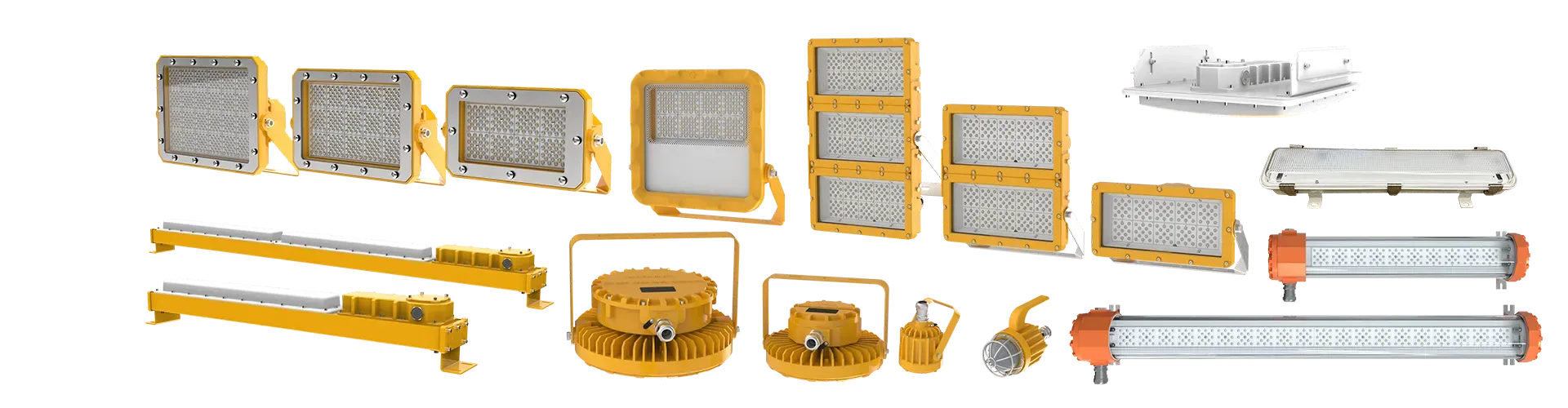
If you’ve spent enough time around fuel depots or solvent storage rooms, you stop thinking about lighting as “illumination.” It becomes part of the safety system. That shift is where led explosion-proof lights start to make sense—not as a product category, but as a risk control measure.
Here’s the straight answer first: led explosion-proof lights are purpose-built fixtures designed to prevent internal electrical faults from igniting external explosive atmospheres, while maintaining stable performance under heat, vibration, and corrosive exposure.
That sounds technical. In reality, it shows up in small details—details that only become obvious after months on site.
The moment things go wrong (and why it’s rarely dramatic)
One of the earliest retrofit projects I handled was in a mid-sized chemical blending plant. Nothing extreme—Zone 2 classification, mostly alcohol vapors. The existing LED high bays weren’t explosion-rated, but they had been “working fine” for years.
Until one didn’t.
No explosion, no fire. Just a failed driver that produced intermittent arcing. Maintenance caught it during inspection. That was enough for the plant to shut down the entire line for review.
Downtime cost more than the lighting upgrade would have.
That’s the part often missed in discussions about led explosion-proof lights—they’re not only about catastrophic failure. They’re about eliminating small, invisible ignition risks that accumulate over time.
Standards exist for a reason (and they’re stricter than most expect)
There’s a tendency in the market to treat certifications like marketing badges. CE, ATEX, IECEx—logos on a label.
But once you’ve sat through an actual compliance audit, you realize how granular these standards are.
Take IEC 60079, the global framework for explosive atmospheres. It doesn’t just define “safe” or “unsafe.” It breaks down:
- Gas groups (IIA, IIB, IIC) based on ignition energy
- Temperature classes (T1 to T6) defining maximum surface temperature
- Protection methods like Ex d (flameproof) and Ex e (increased safety)
For example, hydrogen (Group IIC) has one of the lowest ignition energies. A fixture suitable for propane won’t necessarily pass for hydrogen environments. That difference is not theoretical—it changes enclosure tolerances, flame path gaps, and testing protocols.
Proper led explosion-proof lights are engineered around these constraints from the start, not adapted afterward.
Heat behaves differently than most engineers expect
LEDs are marketed as “cool,” but in sealed explosion-proof enclosures, heat behaves differently.
I remember opening a fixture after a year of operation in a coastal refinery. Externally, everything looked intact. Internally, the driver compartment showed early signs of thermal stress—discoloration, slight insulation brittleness.
The issue wasn’t wattage. It was ambient temperature combined with enclosure design.
According to data published by the U.S. Department of Energy, LED lifespan is highly sensitive to junction temperature. Every 10°C increase can significantly accelerate lumen depreciation and component aging.
Now put that inside a sealed housing, mounted 12 meters high, exposed to sun and process heat.
That’s why well-designed led explosion-proof lights don’t just dissipate heat—they manage it deliberately:
- Physical separation between LED module and driver
- Thermal pathways optimized through the housing, not blocked by coatings
- Drivers rated for high ambient conditions (often ≥55°C)
You can feel the difference just by holding the fixture weight. Heavier usually means more thermal mass. Not always, but often.
Sealing is not just about IP ratings
IP66, IP67—these numbers get thrown around constantly. And yes, they matter.
But sealing in led explosion-proof lights is more complex than water and dust ingress.
In one offshore project, we tracked a failure pattern that didn’t match IP ratings at all. Fixtures remained water-tight, but internal humidity increased over time.
The cause? Pressure cycling.
Day-night temperature shifts create internal pressure changes. Without a proper breather valve system, the fixture “inhales” moist air through microscopic gaps. Over months, that moisture accumulates.
Better designs include controlled pressure equalization—allowing air exchange without letting flammable gases in. It’s a subtle feature, rarely highlighted in brochures, but critical in long-term reliability.
Installation: where theory meets reality
Even the best led explosion-proof lights can be compromised during installation.
I’ve seen certified fixtures fail inspection for reasons that had nothing to do with manufacturing:
- Incorrect cable glands replacing original certified components
- Thread damage during over-tightening
- Missing O-rings after maintenance
In hazardous environments, the system is only as strong as its weakest point. Certification applies to the entire assembly—not just the luminaire.
There’s a reason IEC guidelines emphasize installation practices as much as product design.
One plant manager told me bluntly:
“We don’t trust products. We trust procedures.”
He wasn’t wrong.
Longevity isn’t about brightness—it’s about consistency
Many buyers still compare fixtures based on lumens per watt. It’s understandable. Efficiency is measurable.
But in hazardous areas, consistency matters more.
I’ve worked on sites where slightly lower-efficiency led explosion-proof lights outperformed “high-efficiency” models simply because they maintained output over time.
No flicker. No driver drift. No unexpected shutdowns.
That stability reduces maintenance cycles, which in hazardous zones often require permits, shutdowns, and safety supervision. The indirect cost savings quickly outweigh initial efficiency gains.
What we’ve learned at SEEKINGLED (from actual deployments)
At SEEKINGLED, most design decisions didn’t come from labs—they came from feedback loops with installations.
One petrochemical client reported repeated gasket failures after 18 months. Not catastrophic, just gradual hardening. We switched to higher-grade silicone compounds. Problem disappeared in subsequent batches.
Another case involved driver failures in high-vibration environments. The fix wasn’t electrical—it was mechanical reinforcement of internal mounting points.
These are small adjustments, but over thousands of units, they define reliability.
Our internal data shows field failure rates below 0.3% over five years across multiple regions. That number doesn’t come from ideal conditions—it includes heat, humidity, dust, and inconsistent maintenance practices.
A quick note on global compliance
Most industrial buyers today require multi-region certification.
Typical expectations include:
- ATEX (Europe)
- IECEx (international)
- CE marking for electrical safety compliance
For led explosion-proof lights, this isn’t about paperwork—it’s about ensuring the same fixture can operate safely across different regulatory environments without modification.
In practice, this reduces project complexity, especially for multinational operations.
The part no one talks about: aging
New fixtures always perform well. The real test starts after 12–24 months.
UV exposure affects seals. Thermal cycling stresses solder joints. Corrosive atmospheres attack coatings.
That’s why we run extended aging tests before shipment—not just quick functional checks. It doesn’t eliminate failures, but it filters out early-life defects.
In one batch, we caught driver instability after 9 hours of continuous operation during testing. Without that process, those units would have failed on-site within weeks.
Closing thought (from too many site visits)
After enough time in hazardous environments, you stop asking, “How bright is this light?”
You start asking, “Will this still be working, quietly, a year from now?”
Because in these environments, silence—no flicker, no faults, no intervention—is the real benchmark.
And that’s ultimately what led explosion-proof lights are built for.


