
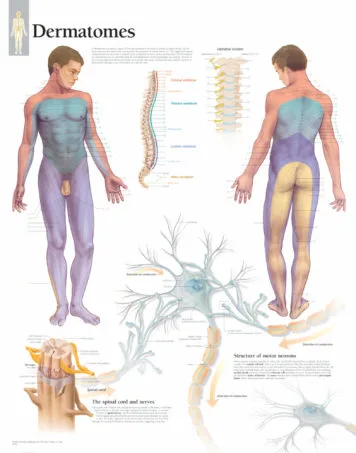
It can feel like trying to solve a giant, moving puzzle when you learn about the body. There are a lot of parts, like the little bones in your ear and the big muscles in your legs. For students, doctors, and even parents who are just interested, a visual guide is the best way to understand it all. This is when anatomy charts and an anatomy flip chart become very useful. These visual aids let you see exactly where everything goes instead of having to read page after page of heavy text.
A good chart shows you where everything is in your body. It shows different systems, like how we breathe or how our blood flows, with bright colors and clear labels. Using a human anatomy flip chart also helps you stay organized. You can look at different "layers" of the body, starting with the skin and ending with the skeleton. This way of learning helps the brain remember things much faster than just looking at a screen. These tools make the complicated world of biology easier to understand, whether you are putting up anatomy charts in a classroom or keeping a anatomy flip chart on your desk for quick reference. They make a hard topic easy for anyone to understand right away.
Why Visual Learning Tools Are Better for Everyone
Anatomy charts and other visual tools are not just for experts; they are meant to help everyone learn better. When we look at a picture of a muscle or an organ, our brains can make a "mental map" that lasts much longer than words alone. This is even easier with a human anatomy flip chart because it divides the body into small, easy-to-understand parts.
Here's why these tools are so useful:
They make complex medical ideas easy to understand by turning them into simple pictures. It's easy to see how a joint moves when it's drawn clearly on anatomy charts, so you don't need a degree to do it.
Teachers love using a human anatomy flip chart in the classroom because they can stand at the front of the room and show the whole class different body systems one at a time.
Quick Reference: Anatomy charts in a doctor's office help patients learn about their own health. A doctor can show you where an injury or treatment is by pointing to it.
High Detail: The drawings in a human anatomy flip chart are very accurate, even though the words are simple. They show things that books might not.
Durability: Most anatomy charts are made of thick paper or are laminated, so they won't get damaged or fade for years.
Having an anatomy flip chart nearby makes people want to learn more and ask questions about how their bodies work.
Using anatomy charts and a human anatomy flip chart makes learning fun and interactive for people of all ages.
Final Thoughts
To sum up, anatomy charts and a human anatomy flip chart are the best tools for learning about the body. They make difficult subjects easier to understand and give students and professionals a clear visual path. Scientific Publishing Ltd. has a great selection of detailed and long-lasting educational materials for people who want the best. With these tools, anyone can learn about the amazing things that happen in the human body with complete confidence.