If you asked ten people about where they learnt about the stock market, they would give you ten altogether different answers. Probably one would have learnt from a video on YouTube, another from "trial and error", others from books, and some from costly mistakes they wish they could undo.
In all these stories, one common element is missing: a structured learning roadmap.
The financial markets are a skill, discipline, and context reward system. However, numerous learners entered into them in a random manner, alternating between candlestick charts and options. The moment you are keen on mastering the markets, whether for investment or trading, the greatest trick lies within mastering knowledge in layers.
This is where a personal learning roadmap becomes invaluable.
Start with the basics, even if your desire is to move fast
"Every market participant starts in the same place, whether they'll admit that or not. " Knowledge and insight into market dynamics and the factors that affect risk are imperative and non-negotiable. Skipping this step will only lead to hubris and a lack of competence.
On the foundation level, learners should prioritize:
- How stock markets work and their fundamentals
- Various financial instruments and their structuring
- Ability to interpret simple finance information without being overwhelmed
- Comprehension of market vocabulary and terminology
This phase has nothing to do with making quick profits. This phase is all about developing market fluency. “Just like mastering a new language, the idea is to ‘stop thinking in your head’ and start thinking ‘in market language.” Once fundamentals are sound, the rest falls into place."
Resources to look into:
- Financial news sites such as Bloomberg, Reuters, or The Economic Times
- Beginner-friendly books like 'The Intelligent Investor' by Benjamin Graham or 'A Random Walk Down Wall Street' by Burton Malkiel
- Beginner courses on recognised sites.
Making a Choice: Trade, Investment, or Both?
With these foundations established, most people reach a point of divergence. Either they like speculating based on short-term market movements, using charts, and making quick decisions, while others like analyzing businesses, holding stocks for many years, and relying on the power of compounding.
However, it becomes a problem if this choice is not clear. Indeed, trading and investing are often considered synonymous, but they entail different levels of skills, time, and psychological control.
For Traders:
- Emphasis on price action and charts
- Master technical analysis techniques and indicators
- Derivatives and Leverage
- Formulate Risk Management Strategies
- Paper trade or start trading in small lots
For Investors:
- Analyze basic concepts in business and financial statements
- Develop an awareness of valuation techniques applied in practice, such as P/E ratios
- Learn About Portfolio Diversification
- Cultivate long-range thinking and patience
- Focus on quality rather than fast returns
Throughout this module, it would be possible to investigate both routes if learning were sequenced instead of distributed. Many successful traders will eventually involve aspects of strategies from both routes.
Moving on to Technicals and Derivatives
For those interested in trading, technical analysis and derivatives would come next. It is at this point that many students get lost. Things like indicators and options on their own can look incredibly powerful, yet out of context are often causing more problems than solutions.
“Every concept has its own place in a carefully ordered scheme, and a concept introduced too early can interfere with a student.”
- Understanding Price Action and Market Structure First
- Indicators, learning, basics
- Leveraging at a Young Age
- Understanding Probability and Expectancy
This applies mainly because learners following this sequence are able to avoid the pitfalls of diving into complex approaches before fully understanding their foundation. Simulated trading can assist learners in testing their approaches before using actual capital.
Thinking Beyond Stock Selection in Investing
For long-term investors, the journey does not end with picking good stocks. In reality, portfolio construction and behavioural discipline play a much larger role in long-term outcomes.
As investors progress, learning naturally shifts towards:
- Market cycles and macroeconomic indicators
- Sector rotation and industry performance
- Asset allocation across stocks, bonds, and other instruments
- Tax efficiency and portfolio rebalancing
Equally important is learning how to remain rational during periods of volatility. Studying historical market crashes and investor psychology can be extremely valuable in building emotional resilience.
Why Continuous Learning Is Important in the Markets
Markets do not stand still. Strategies evolve, regulations change, and what worked in one market phase may fail in another.
As a result, learning the markets is rarely a one-time process. Many experienced participants rely on:
- Updated courses aligned with current market realities
- Expert talks and live webinars
- Regular market analysis from credible sources
- Annual reports, financial journals, and research papers
- Engagement with investor communities (with healthy scepticism)
Learning becomes less about finishing a syllabus and more about staying aligned with how markets are actually behaving.
Selecting Appropriate Learning Resources
As learners move from basic to advanced stages, continuity becomes crucial.
Subscription-based platforms:
These offer access to a wide range of courses and expert sessions under one framework. Elearnmarkets provides this through offerings such as the Infinity Plan, which combines foundational learning, advanced topics, and webinars, making it suitable for learners who want ongoing access rather than one-off courses.
Free and supplementary resources:
- Investor education initiatives by SEBI
- NSE and BSE educational content
- Trusted YouTube educators
- Financial blogs, podcasts, and white papers
Books are timeless. A personal library of investment and trading classics often conveys timeless insights across market cycles.
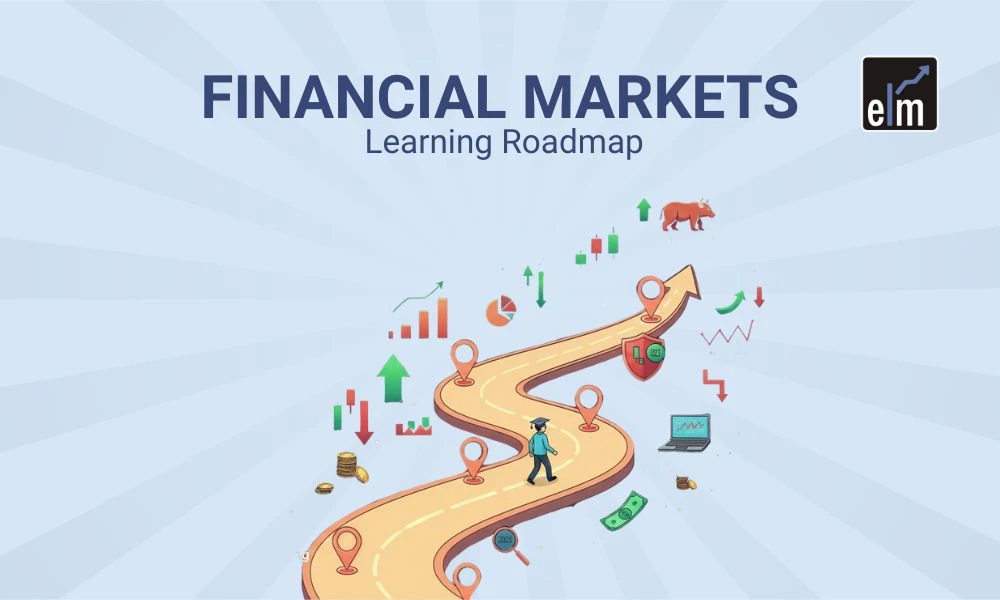
Creating Your Personal Roadmap
A pragmatic roadmap might look something like this:
Stage 1 (Months 1–3): Foundation
- Market fundamentals and terminology
- How Exchanges Work
- Basic financial statements
- Risk and return principles
- Track a practice portfolio
Stage 2 (Months 4–6): Direction
- Choose a focus: trading or investing
- Learn relevant analysis techniques
- Understanding risk management
- Begin with small, real-world applications.
Stage 3 (Months 7–12): Depth
- Learn difficult concepts gradually
- Review Decisions and Outcomes
- Analyzing mistakes and successes
Stage 4 (Year 2+): Mastery and Adaptation
- Define your personal strategy
- Explore complementary domains
- Keep pace with the market changes
- Diversify into new instruments or markets
This is a flexible timeline. Progress is more important than speed.
Conclusion:
Whether you rely on books, free material, paid platforms, or a mix of all three, the real differentiator is a systematic and continuous learning approach. This is where access to a structured learning ecosystem can make a meaningful difference. Elearnmarkets, through offerings such as the Infinity Plan, aligns well with this mindset by providing ongoing access to foundational concepts, advanced topics, and expert-led discussions under one framework.
Markets will always be around. The depth and consistency of the foundations you build today will ultimately decide how effectively you participate in them tomorrow.