Frozen embryo transfer (FET) has become an essential part of modern IVF treatment. With advances in embryo freezing techniques, success rates with frozen embryos are now comparable—and sometimes even better—than fresh transfers. However, in certain cases, doctors may recommend an additional step called laser-assisted hatching to improve implantation chances.
If you are planning or undergoing an FET cycle, understanding what laser hatching is, why it is suggested, and who may benefit from it can help you feel more confident about your treatment decisions—especially when guided by the Best IVF treatment in Bangalore.
What Is Laser-Assisted Hatching?
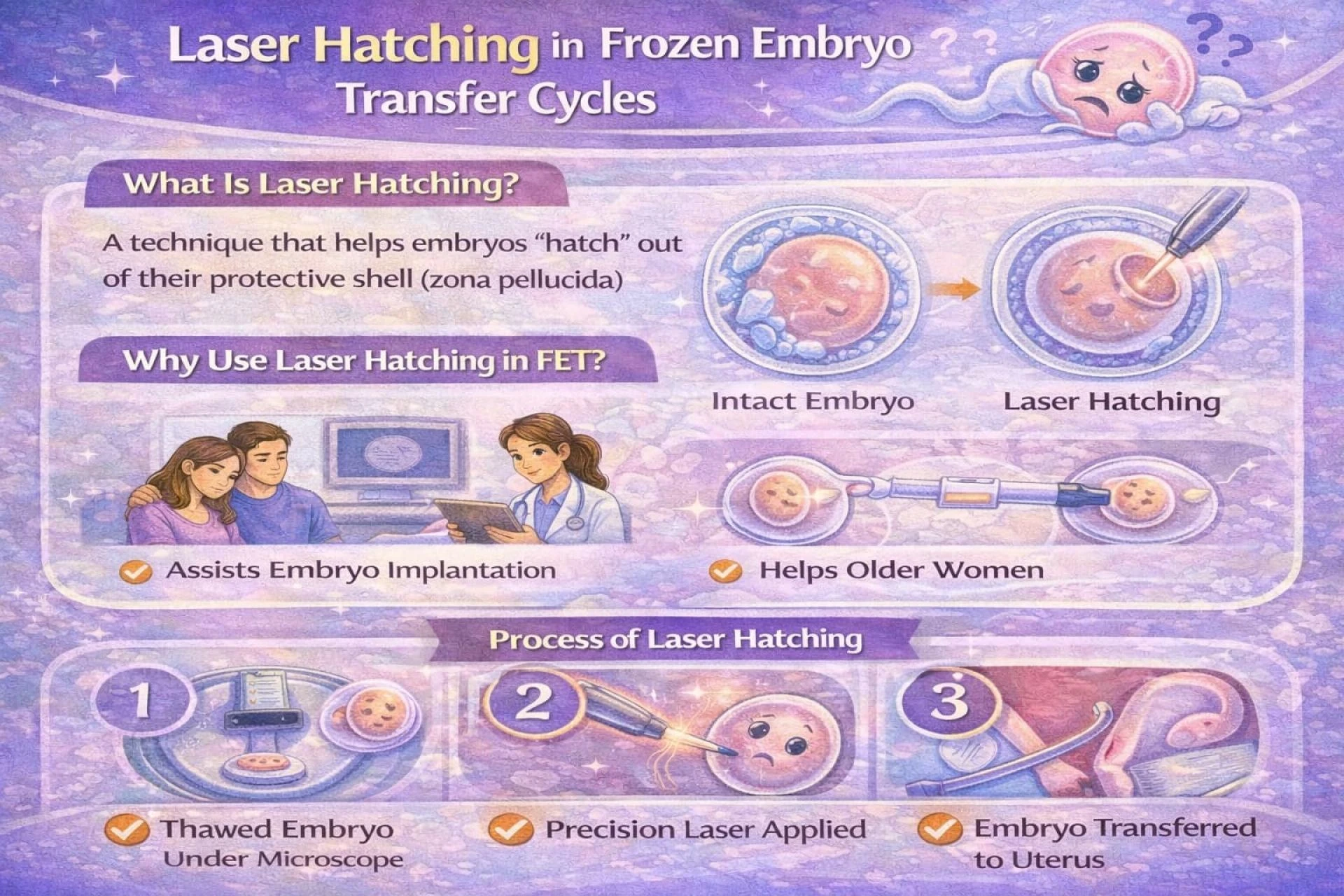
Every embryo is surrounded by a protective outer shell called the zona pellucida. For implantation to occur, the embryo must break free—or “hatch”—from this shell before attaching to the uterine lining.
Laser-assisted hatching is a laboratory technique where a very small opening is made in the zona pellucida using a precise laser. This does not harm the embryo. Instead, it helps the embryo hatch more easily once transferred into the uterus.
Why Is Hatching Important in FET Cycles?
In frozen embryo transfer cycles, embryos undergo freezing and thawing. Although vitrification (modern freezing) is extremely safe, the freezing process can sometimes cause the zona pellucida to become slightly harder or thicker.
A thicker shell may make it more difficult for the embryo to hatch naturally, which can affect implantation—especially in certain patients.
Laser hatching helps overcome this mechanical barrier, giving the embryo a better chance to implant.
Who May Benefit From Laser Hatching in FET?
Laser-assisted hatching is not recommended for every patient. It is suggested selectively, based on medical history and embryo characteristics.
Doctors at the Best IVF treatment in Bangalore may recommend laser hatching in frozen cycles for:
Women With Repeated IVF or FET Failures
If implantation has failed despite good-quality embryos and a healthy uterus, laser hatching may improve implantation potential.
Advanced Maternal Age
As age increases, changes in egg and embryo quality can affect the hatching process. Assisted hatching may support implantation in older women.
Thick Zona Pellucida
Some embryos naturally have a thicker outer shell, which can make hatching difficult.
Previously Frozen Embryos
Embryos that have undergone freezing and thawing may benefit from assisted hatching in selected cases.
How Laser Hatching Is Performed
Laser hatching is done in the embryology laboratory just before embryo transfer.
The process involves:
- Placing the embryo under a high-powered microscope
- Using a controlled laser to thin or open a small area of the zona pellucida
- Returning the embryo to the incubator until transfer
The procedure takes only a few seconds per embryo and does not involve the patient directly. It is painless and safe when performed by experienced embryologists.
Does Laser Hatching Improve Success Rates?
Laser-assisted hatching does not guarantee pregnancy, but studies suggest it can improve implantation rates in specific groups of patients, especially those with repeated failures or advanced age.
It is important to understand that implantation depends on multiple factors:
- Embryo quality
- Uterine receptivity
- Hormonal preparation
- Overall health
Laser hatching supports one part of this complex process—it does not replace other essential factors.
At a responsible Best IVF treatment in Bangalore, doctors explain clearly when laser hatching adds value and when it does not.
Common Concerns About Laser Hatching
Many patients worry whether laser hatching can damage the embryo. When done correctly, it is extremely safe. The laser used is highly precise and controlled, and only a tiny portion of the shell is affected.
Another concern is whether laser hatching increases the risk of twins. Assisted hatching itself does not cause multiple pregnancy. The number of embryos transferred determines that risk.
Patients also worry whether laser hatching is “extra” or unnecessary. Ethical IVF centers avoid routine use and recommend it only when there is a clear medical indication.
Laser Hatching vs Other Advanced Techniques
Laser hatching is different from techniques like PGT (genetic testing). While PGT checks chromosomal health, laser hatching supports the physical implantation process.
In some cases, both may be used together—but only when medically justified.
Emotional Reassurance for Patients
For couples who have experienced repeated disappointment, laser hatching often provides emotional reassurance. Knowing that the embryo has additional support to implant can restore confidence and hope—without adding physical burden to the patient.
However, doctors emphasize realistic expectations. Laser hatching improves chances, not certainty.
Importance of Lab Expertise
The success and safety of laser hatching depend heavily on embryology expertise. Incorrect technique can reduce embryo viability.
This is why choosing the Best IVF treatment in Bangalore matters—not just for advanced technology, but for the experience and judgment behind it.
Making an Informed Decision
Laser-assisted hatching in frozen embryo transfer cycles is a valuable tool—but only when used thoughtfully.
It is not about adding more procedures. It is about adding the right procedure for the right patient.
Final Thought
Frozen embryo transfer already offers excellent success rates. Laser hatching refines this process further for patients who truly need it.
When guided by experienced professionals, laser-assisted hatching becomes not an extra step—but a carefully chosen support for implantation.
At the Best IVF treatment in Bangalore, the focus is not on doing more—but on doing what truly helps bring hope closer to reality.