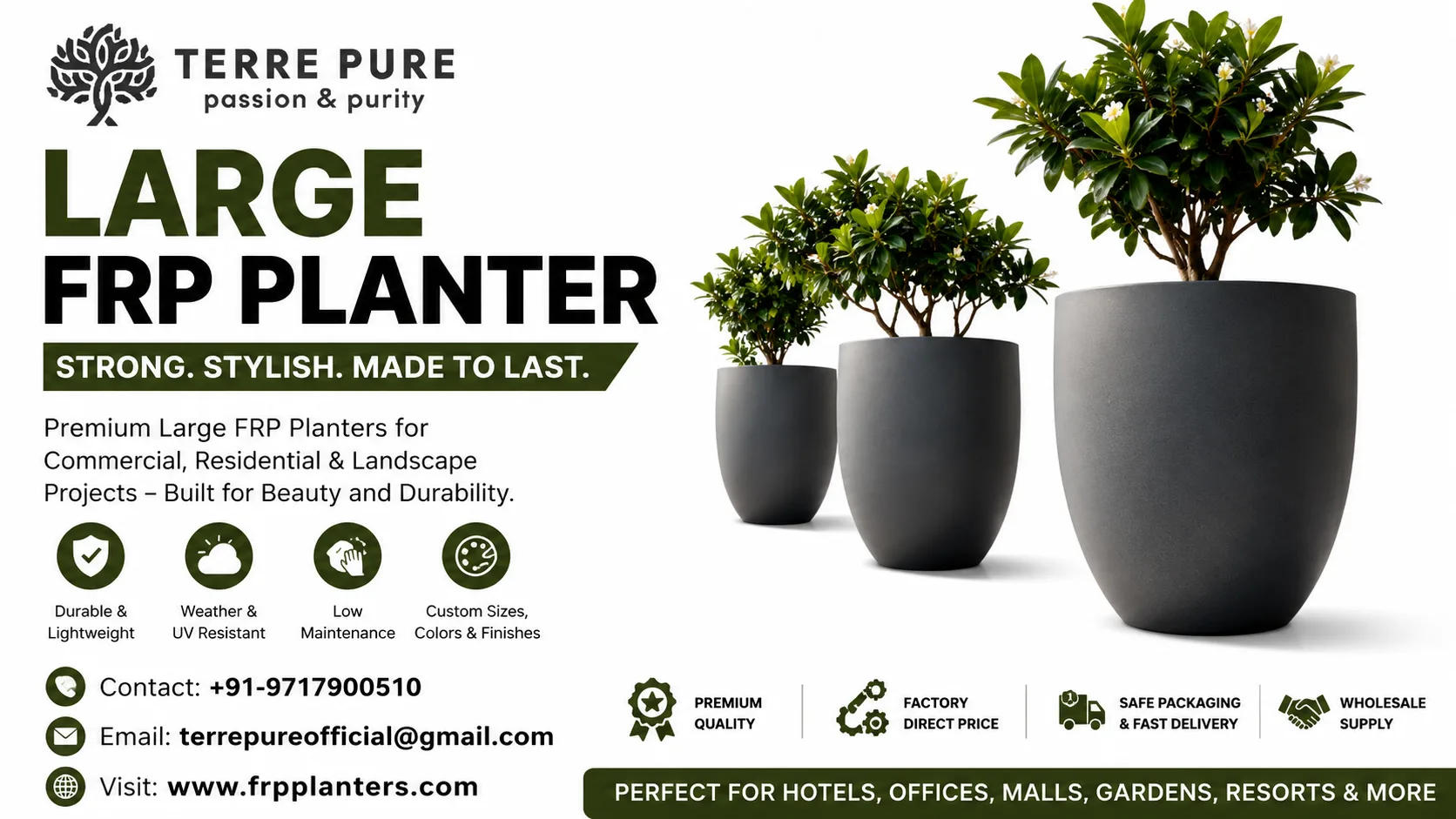
A mall management team in Hyderabad ordered 8 large planters for their main atrium; however, when they were being fit into place, they found that the freight elevator to the floor was incapable of handling the weight of the stone units when completed and filled. It took two weeks to find a lighter alternative. This is the sort of issue a Large FRP Planter overcomes, and it is exactly the sort of thing that is overlooked until it kicks off a huge onsite problem.
When it comes to large-format planters, their monumentality carries a lot of visual weight think about the impact they have in the atriums of office buildings, the entryways of hotels, or the open expanses of outdoor plazas. But all that resizing has to take into account the nuts and bolts of measuring for large scale weight, structural loads, installer requirements. Here is what it means to specify really big planters.
What Changes When a Planter Gets This Big
Small and mid-size FRP planters forgive a lot of design shortcuts. Large-format pieces don't.
Wall Thickness at Scale
A Large FRP Planter any planter generally over 36 inches in diameter requires significant thickening of the walls and reinforcement in the ribbing as a power scale up, not a natural extension of a small pot in a big one. Large production houses that hit their existing mold series with scaling factors tend to end up with something that sits well visually, but is considerably more livable when it‘s fully loaded.
Sectional or Single-Piece Construction
Extra-large planters could be built in multi-piece sections fastened together at the job site, like bolt-together, instead of one uninterrupted mold; this is because a one-piece mold larger than 60” is practically impossible to transport and get through normal freight elevator and door openings, although this should not be assumed in design; inquire about your supplier‘s standard practice.
Base Load Distribution
A load resistant planter, capable of carrying soil, root mass and a mature plant ; could have a mass of several hundred kilograms. The base should be designed for engineered load distribution ; not just a flat bottom, as the load focused on the walls close to floor level increase the loading over time.
The detail most buyers overlook at this scale: doorway and elevator clearance. A stunning 55-inch planter is useless if it can't physically get through the building's service entrance or freight lift, and that measurement needs to happen before the order ships, not during installation week.
Evaluating a Supplier for Large-Format Planter Orders
Sourcing large planters needs sharper questions than a standard-size order, because mistakes at this scale are expensive and hard to reverse.
- Have they actually manufactured planters at this diameter before? A bad answer assumes their standard mold process scales up without issue. A real manufacturer can show photos or references of large-format pieces they've actually produced and installed.
- Do they provide structural load calculations for the base? A bad supplier has no answer beyond "it's strong enough." A good one can explain how the base is reinforced relative to expected filled weight.
- Can they confirm transport dimensions against your site access points? A bad supplier ships and lets you figure out access problems on delivery day. A real one asks for your doorway, lift, and loading dock dimensions upfront.
- What's their process for on-site assembly if the piece is sectional? A bad answer glosses over this entirely. A good supplier explains bolt patterns, sealant use, and how visible the seam will be once assembled.
- How do they package large units to prevent transit cracking? A bad supplier uses standard packaging regardless of size. A real one custom-crates oversized pieces with reinforced corner protection specifically for larger, heavier units.
Why the Right Large FRP Planter Protects Your Installation Timeline
At this scale, a wrong planter choice doesn't just look bad — it delays a project and adds cost that wasn't in the original budget.
Because FRP weighs meaningfully less than an equivalent stone or concrete piece even at large diameters, freight elevator and crane requirements are often avoidable entirely, which protects installation timelines in buildings with load or access restrictions that would otherwise rule out heavy materials. Reinforced base engineering reduces the risk of stress cracking after installation, avoiding the far more expensive and disruptive process of replacing a planter that's already filled, planted, and positioned in a finished space.
Sectional construction, when done properly, allows large pieces to move through standard doorways and lifts without special equipment, protecting installation schedules that hospitality and retail projects often can't afford to slip. Custom crating for oversized units meaningfully cuts transit damage claims, which matters enormously when a single large planter represents a significant portion of a project's planter budget compared to a batch of smaller units.
And because properly manufactured large-format FRP resists UV fading and weathering as well as smaller pieces, the visual centerpiece a design team specified stays looking the way it was meant to for years, rather than becoming the one faded, chalky element in an otherwise well-maintained space.
Sourcing Large FRP Planters Across Indian Project Sites
Large-format planters add a transport variable that smaller orders don't have, and that changes which suppliers make sense for a given project location.
Buyers in Hyderabad, Chennai, and Bangalore working on hospitality or retail projects increasingly look for Large FRP Planter manufacturers in India who have direct experience shipping oversized, high-value pieces without relying on subcontracted logistics partners unfamiliar with fragile large-format cargo — a real risk factor worth asking about directly. Freight cost for oversized units also scales differently than smaller planters, since a single large piece often requires dedicated crate space rather than sharing pallet space with other items.
For projects with tight installation windows, working with Large FRP Planter suppliers in India who confirm site access dimensions before production begins avoids the expensive scenario of a finished piece arriving on-site and not fitting through the intended entry point.
About Us
We've built FRP planters since 2013, and large-format orders taught us lessons our standard catalogue sizes never did — mainly that scaling up a small design without re-engineering it is how you end up with a beautiful planter that cracks at the base within a year.
We started requiring site access measurements before quoting any planter over 48 inches in diameter after a Chennai hotel project arrived on-site and didn't fit through the service corridor, forcing an on-site sectional retrofit that neither of us had planned for. It cost us goodwill on that project. We changed our intake process the same month.
We manufacture both single-piece and sectional large-format planters depending on the project's access constraints, and we work directly with landscape architects and interior designers to confirm those constraints before production starts, not after.
Request a Large-Format Quote From FRP Planters
Send us your desired dimensions, site access measurements — doorways, lifts, loading docks — and installation timeline, and we'll respond with pricing and a realistic production schedule within 24 hours. Minimum order quantity is 4 units for large-format custom pieces, given the tooling investment involved. Reach out through frpplanters.com and send us your access measurements first; it's the detail that saves the most trouble later.
Conclusion
A Large FRP Planter can genuinely transform a commercial atrium, hotel entrance, or outdoor plaza, but only when the sourcing accounts for weight, structural reinforcement, and site access from the start. Get those three details right, and the planter becomes the centerpiece it was designed to be, without turning into an installation-day problem nobody planned for.
FAQs
How heavy is a Large FRP Planter compared to an equivalent stone piece?
Significantly lighter — often around a third of the weight of stone or concrete at the same diameter. That difference is frequently what makes a large-format piece feasible in buildings with freight elevator or floor-load restrictions.
Do Large FRP Planter manufacturers in India build oversized pieces in one solid mold?
It depends on size. Many pieces over roughly 60 inches are produced in sections that assemble on-site, mainly because single-piece units of that scale become difficult to transport through standard doorways or lifts.
What happens if a large planter doesn't fit through our building's entrance?
That's exactly why site access measurements need to happen before production, not after delivery. We'll be direct about this — it's a genuinely common and entirely avoidable failure point, and it's on both the buyer and supplier to confirm access before committing to a size.
How is a large FRP planter's base reinforced to handle the filled weight?
Through targeted rib reinforcement at the base rather than uniform wall thickness throughout. A planter filled with soil and a mature plant can exceed 200 kg, and the base needs to distribute that load evenly to avoid stress cracking near ground contact.
Can Large FRP Planter suppliers in India handle custom sizing beyond standard catalogue dimensions?
Yes, most can, though custom large-format molds involve meaningfully more tooling investment than standard sizes, which is usually reflected in a higher minimum order quantity — typically around 4 to 6 units to justify the cost.