
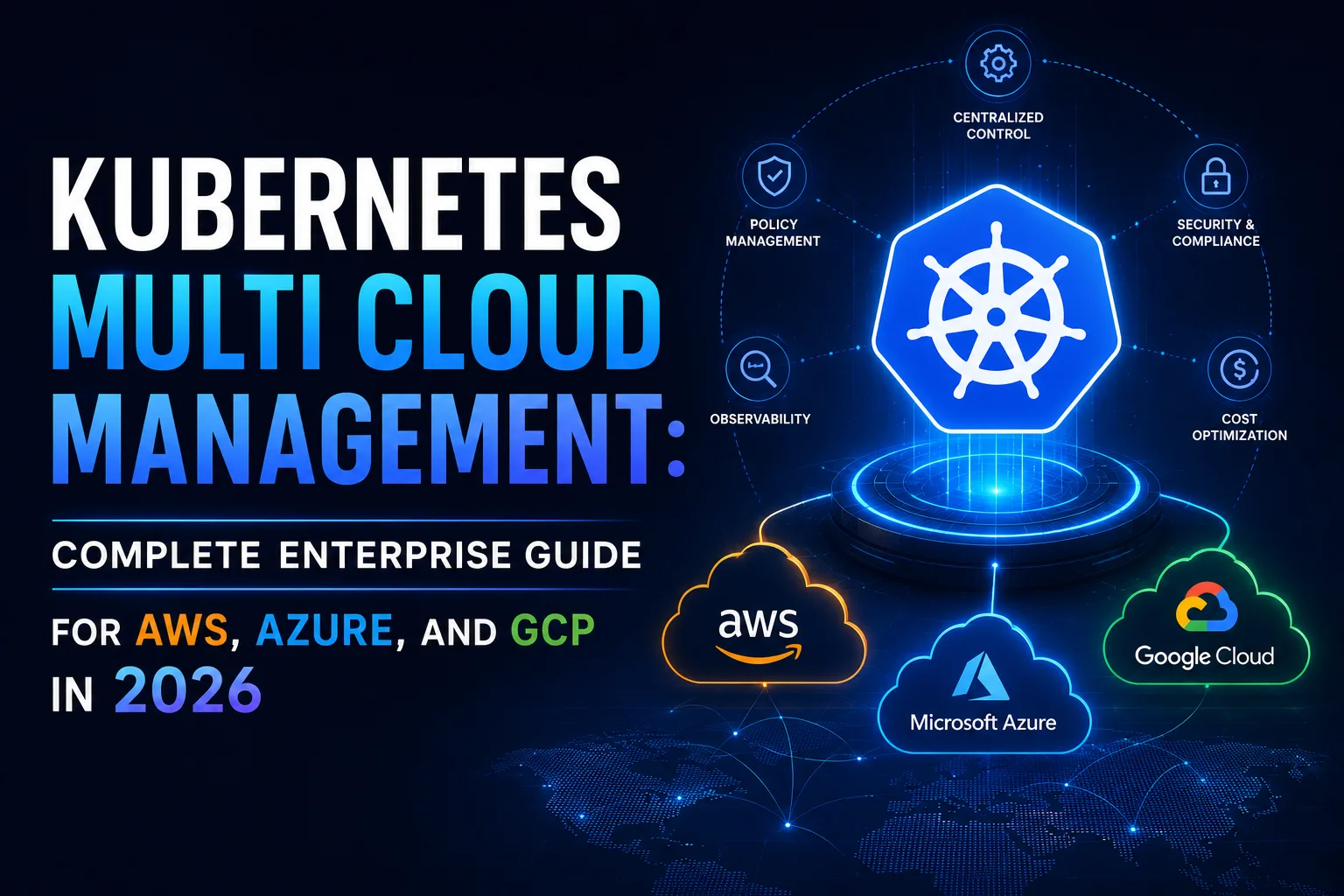
Kubernetes has become the operational foundation of modern cloud-native infrastructure. In 2026, enterprises across fintech, healthcare, SaaS, logistics, ecommerce, cybersecurity, and AI infrastructure increasingly rely on Kubernetes to orchestrate distributed workloads, automate deployments, and scale applications globally. However, as organizations expand across AWS, Microsoft Azure, and Google Cloud Platform, Kubernetes multi cloud management has emerged as one of the most important challenges in modern platform engineering.
Most enterprises no longer operate within a single cloud environment. Businesses now distribute workloads across multiple providers to improve resilience, avoid vendor lock-in, optimize costs, meet compliance requirements, and leverage specialized cloud-native services. This shift has accelerated the adoption of multi-cloud Kubernetes architectures that span AWS EKS, Azure AKS, and Google Kubernetes Engine environments simultaneously.
However, managing Kubernetes across multiple cloud providers introduces significant operational complexity. Organizations must now handle cluster orchestration, networking, observability, security policies, cost governance, CI/CD pipelines, workload portability, secrets management, and infrastructure automation across highly distributed environments. Modern enterprises are increasingly adopting federated multi-cluster architectures and centralized governance platforms to simplify these operations.
At the same time, Kubernetes infrastructure itself has evolved significantly. Enterprises are now managing AI workloads, distributed APIs, GitOps pipelines, autonomous deployment systems, edge computing infrastructure, and large-scale microservices across hybrid and multi-cloud ecosystems. This growing complexity has transformed Kubernetes multi cloud management from a DevOps concern into a strategic enterprise infrastructure challenge.
This guide explains how Kubernetes multi cloud management works in AWS, Azure, and GCP, why enterprises are adopting multi-cloud strategies, the biggest operational challenges organizations face, and the best practices businesses use to manage production-grade Kubernetes infrastructure at scale in 2026.
What Is Kubernetes Multi Cloud Management?
Kubernetes multi cloud management refers to the process of orchestrating, securing, monitoring, automating, and governing Kubernetes clusters running across multiple cloud providers simultaneously.
In most enterprise environments, this includes combinations of:
- AWS Elastic Kubernetes Service (EKS)
- Microsoft Azure Kubernetes Service (AKS)
- Google Kubernetes Engine (GKE)
Some organizations also extend these environments into:
- Hybrid cloud infrastructure
- Private cloud platforms
- Edge computing environments
- On-premise Kubernetes clusters
The goal of Kubernetes multi cloud management is to create a unified operational model across distributed cloud environments while maintaining:
- Consistent deployment workflows
- Centralized governance
- High availability
- Security compliance
- Cost optimization
- Operational scalability
Modern enterprises increasingly prefer federated multi-cluster architectures because they isolate failures while still enabling centralized governance and operational consistency.
Why Enterprises Are Adopting Multi Cloud Kubernetes Architectures
Several major factors are driving multi-cloud Kubernetes adoption in 2026.
Avoiding Vendor Lock-In
Vendor lock-in remains one of the biggest concerns in enterprise cloud strategy.
By deploying Kubernetes across AWS, Azure, and GCP, organizations gain:
- Infrastructure portability
- Greater negotiation leverage
- Reduced provider dependency
- Flexible workload placement
Kubernetes provides a consistent orchestration layer that allows workloads to move more easily across providers.
High Availability and Disaster Recovery
Multi-cloud Kubernetes environments improve resilience significantly.
Organizations can:
- Replicate workloads across providers
- Maintain active-active deployments
- Improve failover strategies
- Reduce downtime risk
This is especially important for:
- Financial platforms
- Healthcare systems
- Enterprise SaaS products
- AI infrastructure
- Real-time applications
Performance Optimization
Different cloud providers excel in different areas.
Organizations increasingly distribute workloads based on:
- Latency requirements
- Regional availability
- GPU infrastructure
- AI services
- Networking performance
- Compliance zones
This approach allows businesses to optimize application performance globally.
Regulatory and Compliance Requirements
Many enterprises must meet:
- Data residency laws
- Industry regulations
- Geographic restrictions
- Sovereign cloud requirements
Multi-cloud Kubernetes architectures help organizations align workloads with regional compliance obligations.
Cost Optimization
Cloud pricing differs substantially across:
- Compute resources
- GPU workloads
- Data transfer
- Storage systems
- Managed services
Multi-cloud Kubernetes management allows organizations to optimize infrastructure placement dynamically.
Core Components of Kubernetes Multi Cloud Management
Managing Kubernetes across AWS, Azure, and GCP requires several operational layers.
Cluster Management
The foundation of multi-cloud Kubernetes is centralized cluster management.
Organizations must manage:
- Cluster provisioning
- Node scaling
- Kubernetes upgrades
- Configuration consistency
- Cluster lifecycle automation
Modern enterprises increasingly rely on centralized Kubernetes management platforms to simplify multi-cluster operations across distributed environments.
Networking and Service Connectivity
Networking becomes significantly more complex in multi-cloud environments.
Organizations must handle:
- Cross-cloud communication
- Service discovery
- DNS management
- Traffic routing
- Load balancing
- Network security
- Inter-cloud latency
Modern multi-cloud strategies increasingly depend on distributed networking and cross-cloud connectivity architectures.
CI/CD and GitOps
Modern Kubernetes operations rely heavily on GitOps and automated CI/CD pipelines.
Multi-cloud deployment workflows typically include:
- Infrastructure-as-code
- Automated rollouts
- Canary deployments
- Blue-green deployments
- Drift detection
- Rollback automation
GitOps platforms like ArgoCD and Flux are increasingly central to multi-cloud Kubernetes operations.
Observability and Monitoring
Observability is one of the biggest challenges in Kubernetes multi cloud management.
Organizations need:
- Centralized logging
- Distributed tracing
- Metrics aggregation
- Cross-cluster visibility
- AI-assisted observability
- Incident response automation
Modern Kubernetes management increasingly focuses on unified observability across distributed clusters and regions.
Security and Governance
Security becomes significantly more difficult across multi-cloud environments.
Organizations must manage:
- RBAC consistency
- Identity federation
- Secrets management
- Compliance enforcement
- Policy-as-code
- Runtime security
- Network segmentation
Modern enterprises increasingly adopt Zero Trust and centralized governance models for multi-cloud Kubernetes security.
Kubernetes Multi Cloud Architecture Patterns
Organizations typically use one of two major architecture patterns.
Unified Multi-Cloud Clusters
In this model, a single Kubernetes cluster spans multiple cloud providers.
Advantages include:
- Centralized orchestration
- Simplified application deployment
- Unified scheduling
However, this approach introduces:
- Complex networking
- Cross-cloud latency
- Failure propagation risks
- Operational overhead
Unified clusters are less common in enterprise environments because of their complexity.
Federated Multi-Cluster Architecture
This is the preferred enterprise model in 2026.
Each cloud provider runs independent Kubernetes clusters while centralized management layers coordinate:
- Policies
- Deployments
- Governance
- Observability
- Security
Federated architectures provide:
- Better fault isolation
- Improved scalability
- Operational flexibility
- Easier governance
Modern enterprises increasingly prefer federated multi-cluster architectures for production-scale environments.
Key Challenges in Kubernetes Multi Cloud Management
Despite its benefits, multi-cloud Kubernetes management introduces substantial operational complexity.
Configuration Drift
Managing configurations across multiple environments often creates inconsistencies.
Common issues include:
- Different Kubernetes versions
- Provider-specific settings
- Inconsistent policies
- Environment drift
Infrastructure-as-code and GitOps help reduce these risks significantly.
Security Complexity
Security models differ substantially across AWS, Azure, and GCP.
Organizations must manage:
- Different IAM systems
- Cloud-native security tools
- Compliance policies
- Access controls
Multi-cloud environments can create fragmented security architectures if governance is inconsistent.
Networking and Latency
Cross-cloud communication introduces:
- Increased latency
- Routing complexity
- DNS challenges
- Traffic management overhead
Service meshes increasingly help solve these challenges.
Cost Visibility
Tracking cloud spending across multiple providers is difficult.
Organizations need:
- FinOps practices
- Centralized cost visibility
- Resource optimization
- Usage analytics
Cloud cost management remains one of the largest Kubernetes operational challenges globally.
Operational Complexity
As clusters multiply, operational overhead increases rapidly.
Modern enterprises often manage:
- Multiple regions
- Multiple providers
- Hundreds of workloads
- Distributed teams
- AI infrastructure
- Edge environments
Industry analysis shows enterprises commonly operate between 5 and 50 Kubernetes clusters simultaneously.
Best Practices for Kubernetes Multi Cloud Management
Organizations successfully managing multi-cloud Kubernetes environments typically follow several key practices.
Use GitOps for Consistency
GitOps improves:
- Deployment consistency
- Drift prevention
- Rollback automation
- Auditability
Modern enterprises increasingly standardize Kubernetes operations around GitOps workflows.
Standardize Infrastructure-as-Code
IaC tools help automate:
- Cluster provisioning
- Networking
- Security policies
- Scaling configurations
Popular tools include:
- Terraform
- Pulumi
- Crossplane
Centralize Observability
Organizations should aggregate:
- Metrics
- Logs
- Traces
- Security events
Unified observability reduces troubleshooting complexity significantly.
Implement Policy-as-Code
Policy-as-code frameworks enforce:
- Security standards
- Compliance requirements
- Resource controls
- Governance rules
Modern Kubernetes environments increasingly rely on:
- Open Policy Agent
- Kyverno
- Gatekeeper
Use Service Mesh Architectures
Service meshes improve:
- Traffic management
- Service discovery
- Cross-cloud communication
- Security
- Observability
Istio and Linkerd remain popular service mesh solutions.
Adopt Zero Trust Security
Modern multi-cloud Kubernetes environments increasingly implement:
- Least privilege access
- Identity-aware policies
- Continuous verification
- Mutual TLS
- Workload identity systems
Popular Kubernetes Multi Cloud Management Tools
Several platforms help enterprises manage Kubernetes across AWS, Azure, and GCP.
Common tools include:
- Rancher
- Azure Arc
- Google Anthos
- Red Hat OpenShift
- VMware Tanzu
- Platform9
- Kubermatic
Modern Kubernetes management platforms increasingly combine:
- Multi-cluster management
- Security governance
- CI/CD integration
- Cost optimization
- Observability
- Policy enforcement
Enterprise Kubernetes management tools are becoming critical for sustainable operations at scale.
AI and the Future of Kubernetes Multi Cloud Management
AI is increasingly transforming Kubernetes operations.
Modern AI-assisted platform engineering now supports:
- Predictive scaling
- Cost optimization
- Incident detection
- Anomaly analysis
- Automated remediation
- Intelligent scheduling
AI-driven observability and automation systems are becoming increasingly important because Kubernetes environments generate massive operational telemetry volumes.
AI workloads themselves are also accelerating Kubernetes adoption across:
- GPU clusters
- Distributed inference systems
- MLOps pipelines
- Edge AI infrastructure
Future Trends in Kubernetes Multi Cloud Management
Several major trends are shaping the future of multi-cloud Kubernetes.
Platform Engineering Expansion
Internal developer platforms are becoming central to enterprise Kubernetes strategies.
AI-Assisted Operations
AI-powered automation is reducing operational overhead significantly.
Edge and Hybrid Cloud Growth
Organizations increasingly extend Kubernetes beyond centralized cloud infrastructure.
Policy-Driven Governance
Policy-as-code and automated governance continue expanding rapidly.
Unified Multi-Cloud Operations
Modern cloud strategies increasingly emphasize centralized governance and intent-driven operations across distributed infrastructure.
Final Thoughts
Kubernetes multi cloud management has become one of the most important components of enterprise cloud infrastructure in 2026. Organizations are no longer operating isolated Kubernetes clusters within single-provider environments. Instead, businesses now manage highly distributed ecosystems spanning AWS, Azure, GCP, hybrid infrastructure, AI workloads, edge computing systems, and production-scale automation platforms.
This growing complexity requires modern enterprises to rethink how they manage cloud-native infrastructure. Successful multi-cloud Kubernetes strategies now combine GitOps, centralized observability, policy-as-code, Zero Trust security, service mesh architectures, AI-assisted operations, and unified governance into scalable operational frameworks.
Organizations that successfully implement Kubernetes multi cloud management gain substantial advantages in resilience, operational flexibility, scalability, disaster recovery, vendor independence, cost optimization, and long-term infrastructure agility.