
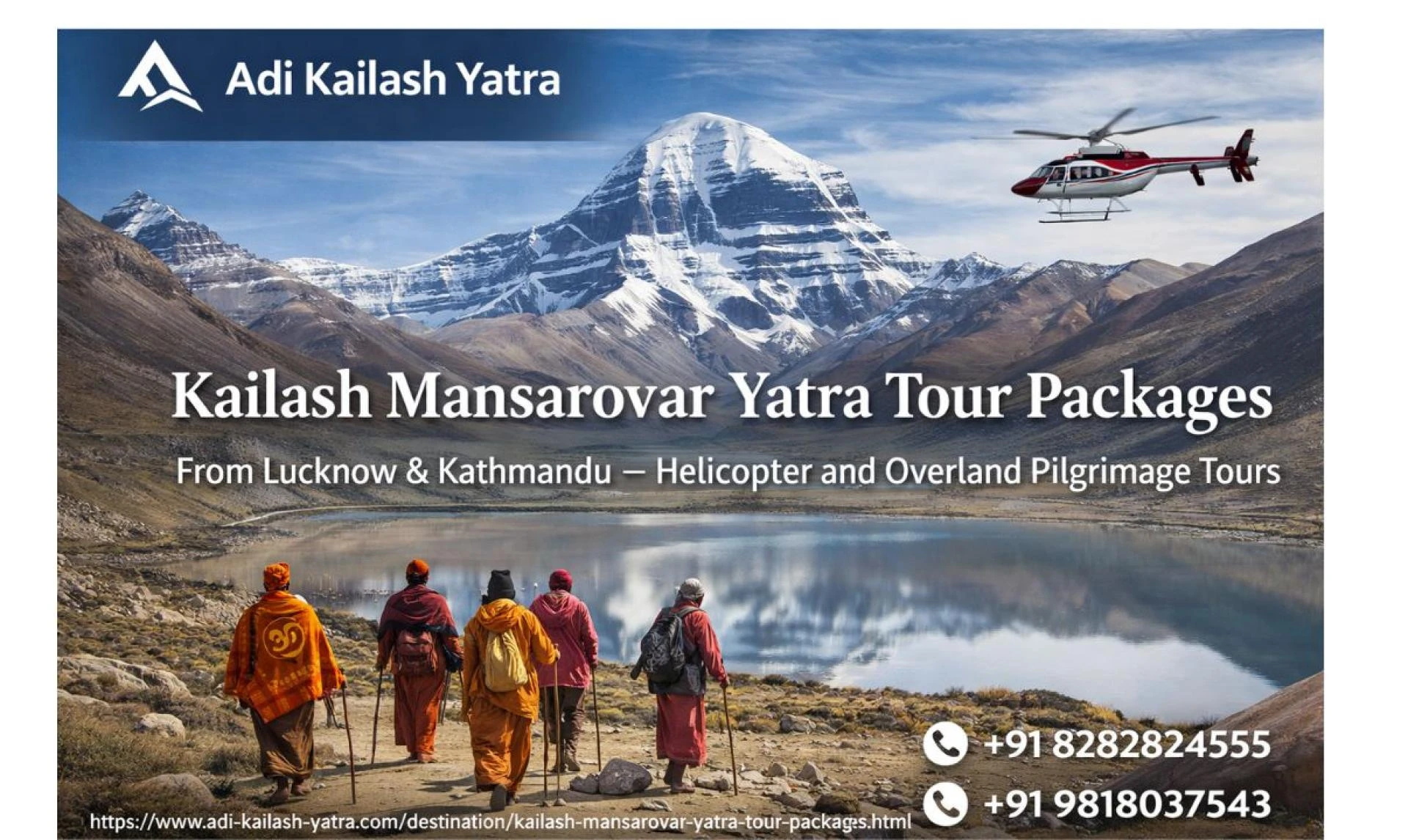
Helicopter and Overland Pilgrimage Tours to the Abode of Lord Shiva
My grandfather used to say that Kailash does not wait for you to be ready. It calls you when it is ready for you. I did not understand that as a child. I do now.
There are people in Lucknow who have wanted to do this yatra for twenty years. And there are people in Kathmandu who have grown up within sight of the Himalayan range their whole lives and still feel that standing at the base of Mount Kailash would be something they could not fully prepare for. Both of them are right. No amount of reading, no number of photographs, and no secondhand account really prepares you for what it feels like to arrive there.
What I can tell you is this -- the journey from Lucknow to Kailash, and the journey from Kathmandu to Kailash, are two very different experiences. The routes are different. The approach is different. The landscapes you pass through are different. But they end at the same place. And that place changes people.
This piece covers both departure points in detail -- the helicopter routes, the overland options, what to expect, what is included, and how to choose between them. If you have been sitting on this decision for a while, maybe this is the thing that finally moves it.
Why Lucknow and Kathmandu? Understanding the Two Main Departure Points
Most pilgrims from North India -- particularly from Uttar Pradesh, Bihar, Madhya Pradesh, and the surrounding states -- start their Kailash journey from Lucknow. It is a natural gateway. Good flight connectivity, a large pilgrim community, and a deep cultural familiarity with Shaivite tradition make Lucknow one of the most popular starting points for the Kailash Mansarovar Yatra in the entire country.
Kathmandu, on the other hand, is a different kind of starting point. Nepal shares a border with Tibet that makes it a geographically closer approach to Kailash in several ways. The air in Kathmandu already carries a different quality -- Buddhist prayer flags, the sound of temple bells, a city that has lived with the Himalayas so long it treats them as neighbours. For pilgrims who want to absorb the full spiritual context of this journey before reaching the mountain, starting from Kathmandu adds something that a direct flight to Lucknow simply cannot provide.
Both departure points feed into excellent pilgrimage packages. The question is which one fits your situation -- geographically, logistically, and personally.
Kailash Mansarovar Yatra from Lucknow -- What the Route Actually Looks Like
The Lucknow-based Kailash Mansarovar Yatra package runs 9 days by helicopter, and it is built for people who understand the value of that darshan but cannot give the journey four weeks of their life. Let me walk through what actually happens.
You fly from Lucknow to Kathmandu. From Kathmandu, you fly onward by helicopter toward the Kailash region -- typically via Simikot or Hilsa, depending on weather and route conditions. The helicopter does not drop you at the base of Kailash and leave. There is a structured progression -- acclimatisation stops, guided movement through the pilgrimage route, time at Lake Mansarovar, and the circumambulation itself.
Nine days sounds short. And compared to the old overland routes that took three to four weeks each way, it is. But within those nine days, if the package is properly designed -- and the right operator designs it properly -- you get the full experience. The darshan. The dip. The Parikrama, weather permitting. The mornings at Mansarovar. The views.
The reason people from Lucknow specifically choose this package is partly practical and partly something harder to name. Lucknow has a long, deep Shaivite tradition. Maha Shivratri here is not just a festival -- it is something the whole city participates in, from households to the banks of the Gomti. For a Lucknow pilgrim, Kailash is not an abstract destination. It is the source. The helicopter package makes that source reachable within a week and a half.
Key Details -- Kailash Mansarovar Yatra from Lucknow by Helicopter
• Duration: 9 Days / 8 Nights
• Route: Lucknow -- Kathmandu -- Simikot/Hilsa (by helicopter) -- Kailash and Mansarovar -- Return
• Package cost: Rs. 2,68,900/- per person
• Inclusions: Meals, accommodation, all transfers, sightseeing, permits, guide support, oxygen
• Best for: Working professionals, elderly pilgrims, families with time constraints
• Season: May to October
Kailash Mansarovar Yatra from Kathmandu -- Two Ways to Make the Journey
From Kathmandu, there are two strong options. One by helicopter, one overland. They are completely different experiences, and the right choice depends on who you are and what you want from this pilgrimage.
By Helicopter from Kathmandu -- 11 Days
The Kailash Mansarovar Yatra from Kathmandu by helicopter is an 11-day package, and the extra two days compared to the Lucknow departure are worth paying attention to. Kathmandu itself is part of what you are buying here.
You arrive in Kathmandu and spend time in a city that has been a pilgrimage centre in its own right for centuries. Pashupatinath temple -- one of the most sacred Shiva temples in the world -- sits on the banks of the Bagmati river. The Boudhanath stupa, one of the largest in the world, rises out of the city like a question directed at the sky. These are not tourist stops. They are spiritual preparation for what comes next.
From Kathmandu, the helicopter takes you toward the Kailash region. The approach from Nepal gives you a particular angle on the Himalayan landscape that is genuinely different from the Tibetan Plateau approach. You are flying alongside one of the great mountain ranges of the world before you arrive at the one mountain that stands apart from all of them.
The 11-day structure gives more breathing room than the 9-day Lucknow package. A little more time to acclimatise. A little more time at Mansarovar. For first-time pilgrims especially, that extra space makes a real difference.
Key Details -- Kailash Mansarovar Yatra from Kathmandu by Helicopter
• Duration: 11 Days / 10 Nights
• Route: Kathmandu -- Simikot/Hilsa (by helicopter) -- Kailash and Mansarovar -- Kathmandu
• Package cost: Rs. 2,99,890/- per person
• Inclusions: Meals, hotels, all transfers, sightseeing, permits, Sherpa support
• Best for: Pilgrims who want a fuller spiritual context; international visitors; those with 10-11 days
• Season: May to October
By Overland from Kathmandu -- 14 Days
The overland option from Kathmandu is a different kind of commitment. You are not flying over the landscape -- you are driving through it. Day by day, the scenery changes. The altitude rises slowly. Your body adjusts in the way that bodies are meant to adjust -- gradually, with time.
The 14-day Kailash Mansarovar Yatra by Overland takes you from Kathmandu through the Nepal-Tibet border crossing at Kyirong, then northeast across the Tibetan Plateau toward Kailash. The Tibetan Plateau is a world unto itself. People who have crossed it describe the experience as something between driving on the moon and driving through a landscape that feels ancient in a way that goes beyond geology. Wide, open, silent. Prayer flags at every pass. Monasteries that cling to cliffsides and have been there for 700 years.
You reach Kailash having already been changed by the journey to it. That is not a small thing. The Parikrama hits differently when you have earned the arrival.
Key Details -- Kailash Mansarovar Yatra by Overland
• Duration: 14 Days / 13 Nights
• Route: Kathmandu -- Kyirong Border -- Tibetan Plateau -- Kailash and Mansarovar -- Return
• Package cost: Rs. 2,20,000/- per person
• Inclusions: Meals, accommodation, jeep transfers, all permits, experienced guide and Sherpa
• Best for: Physically fit pilgrims, adventure seekers, those with 2 full weeks available
• Season: May to October
Helicopter vs Overland -- Honestly, Which One Should You Choose?
This is the question everyone asks, and the honest answer is: it depends on you, not on the package.
If you are over 60, if you have any cardiac or respiratory history, if you only have 9 or 10 days -- take the helicopter. The experience at Kailash itself is identical. You will still stand at the same mountain, take a dip in the same lake, walk the same Parikrama route. The helicopter just removes the parts of the journey that carry genuine physical risk for people with health constraints. There is no shame in this. The darshan is the point. How you get there is logistics.
If you are physically fit, if you have two full weeks available, and if you want the version of this pilgrimage that your grandchildren will still be hearing about at family dinners twenty years from now -- do the overland. The Tibetan Plateau is one of the most singular landscapes on earth. The border crossing at Kyirong, the monasteries along the route, the slow dawning awareness that you are genuinely far from anywhere familiar -- all of that is part of the pilgrimage. It feeds the experience at Kailash rather than being separate from it.
A few people split the difference -- helicopter one way, overland the other. It is not a standard package offering but worth asking your operator about if that appeals to you.
What the Kailash Parikrama Actually Involves
People ask about the Parikrama more than almost anything else, so it is worth being specific about what it actually is.
The circumambulation of Mount Kailash is 52 kilometres long. Most pilgrims complete it over two to three days. The route is not flat -- it climbs steadily on the first day, reaches the Dolma Pass on the second day, and descends on the third. The Dolma Pass sits at 5,636 metres. That is high. Higher than most people have ever been in their lives. The air is noticeably thin. Walking at that altitude is slow work even for fit people.
And yet -- almost everyone who has done it says the Dolma Pass is the moment they remember most clearly, years later. The view from the top covers an enormous sweep of terrain. Gauri Kund, a sacred glacial lake, sits below to one side. Kailash itself is visible. There is a quality to the light at that altitude that is hard to describe -- brighter than normal light, flatter, without the haze that softens everything at lower elevations. Everything looks very real. Very present.
Horses and yaks are available on the Parikrama route for those who need them, and Sherpas walk alongside pilgrims throughout. Nobody is left behind or expected to manage the route alone.
Lake Mansarovar -- The Part That Stays With People Longest
Ask Kailash returnees what they think about most, and a surprising number of them do not say the mountain. They say the lake.
Lake Mansarovar at dawn is something else entirely. The surface is completely still in the early morning hours. The reflection of the sky in the water is so accurate that it becomes disorienting -- you genuinely cannot tell where the water ends. Around the edges of the lake, prayer flags run in long lines from pole to pole, and the sound of them in the morning wind is the only sound there is. No traffic. No voices. No machinery. Just that soft, constant movement.
The ritual dip in Mansarovar is one of the most significant acts of the entire Yatra. The water temperature is around 2 to 4 degrees Celsius even in summer. Pilgrims go in anyway, usually at dawn or early morning when the mountain is reflected most clearly in the water. The cold stops your breath on contact -- really stops it, in a way that demands your full attention. And then, in the seconds after the initial shock, most people describe a kind of stillness inside that is not like anything else they have experienced. Whether that is the spiritual significance of the lake, the physiological shock of very cold water, or something else entirely is not really the point. The feeling is real.
Practical Things Worth Knowing Before You Book
A few things people often ask about, answered honestly.
Physical Fitness Requirements
For helicopter packages, a basic level of fitness is sufficient. You will still be walking on the Parikrama route, which involves 52 kilometres over two to three days at altitude. A fitness certificate from a doctor is required by most operators, and for good reason. If you have any cardiac, blood pressure, or respiratory conditions, discuss them openly with your operator before booking. They have handled these conversations many times.
For overland packages, you need to be genuinely fit. Not marathon-runner fit -- but regularly active, comfortable walking for several hours a day, and able to manage the physical variability of a two-week journey at altitude.
Documents Required
• Valid Indian passport (or passport of country of residence)
• Chinese travel permit -- arranged completely by your tour operator
• Tibet Travel Permit and Alien Travel Permit -- also handled by your operator
• Government-issued ID and two to four passport-size photographs
• Medical fitness certificate from a registered doctor
• Photocopies of all of the above, stored separately from originals
What to Pack
• Thermal base layers and fleece mid-layer
• Windproof and waterproof outer jacket -- this is not optional at these altitudes
• Hiking boots, properly broken in before the trip
• High-SPF sunscreen and UV-protective sunglasses -- the altitude magnifies sun exposure severely
• Personal medication, including AMS (altitude mountain sickness) tablets
• Water purification tablets or a personal filter bottle
• Trekking poles for the Parikrama -- knees will thank you on the descent
• Light daypack for the Parikrama route
Best Time to Go
May to October. June is popular and manageable. September and October offer the best visibility and the most extraordinary light. July and August bring some monsoon conditions to the lower Nepal routes but the Tibetan Plateau generally stays dry. December through April -- the passes are closed and the journey is not possible.
To Wrap Up -- A Word on Adi Kailash Yatra
I have covered a lot of ground here -- two departure points, three distinct packages, the route specifics, the Parikrama, the lake, the practical details. But all of it only matters if the operator handling your package is actually good at this.
Bad Kailash yatra planning is not just inconvenient. At these altitudes, in restricted border zones, with permits that need to be exactly right -- bad planning is dangerous. I have heard enough stories of trips falling apart mid-route to know that choosing your operator is genuinely the most important decision in this whole process.
Adi Kailash Yatra -- adi-kailash-yatra.com -- is a specialist pilgrimage operator based out of Delhi-NCR. They do not offer general tourism packages. They do Kailash. That is their focus. Their guides and Sherpas have walked every route described in this piece many times over. Their permit process is tight -- they have done it enough times that clearance problems, which can derail an entire group, simply do not happen on their watch. Oxygen support is standard across packages. Emergency medical protocols are in place from day one, not assembled after something goes wrong.
Their packages for Lucknow and Kathmandu departures -- helicopter and overland both -- are specifically designed to match the pilgrim who walks in the door, not just to fill seats on a tour bus. If you have specific health considerations, a tight timeline, or particular requirements around accommodation and privacy, they will adjust the itinerary around you.
Fifteen packages in total, covering helicopter tours, overland routes, inner Parikrama expeditions, aerial darshan options, combination tours to Everest Base Camp and Ashtapad, and fully private VIP arrangements. Whatever version of this yatra fits your life right now, the package exists.
Get in touch with their team at +91 8282824555 or write to [email protected]. You can go through all available packages at adi-kailash-yatra.com.
The journey from Lucknow to Kailash is somewhere around 2,400 kilometres. The journey from Kathmandu is shorter in distance but equally significant in weight. Both of them end at the same mountain, the same lake, the same silence.
At some point, the distance stops being the reason not to go and starts being the whole point of going.
Har Har Mahadev
www.adi-kailash-yatra.com | +91 8282824555 | [email protected]