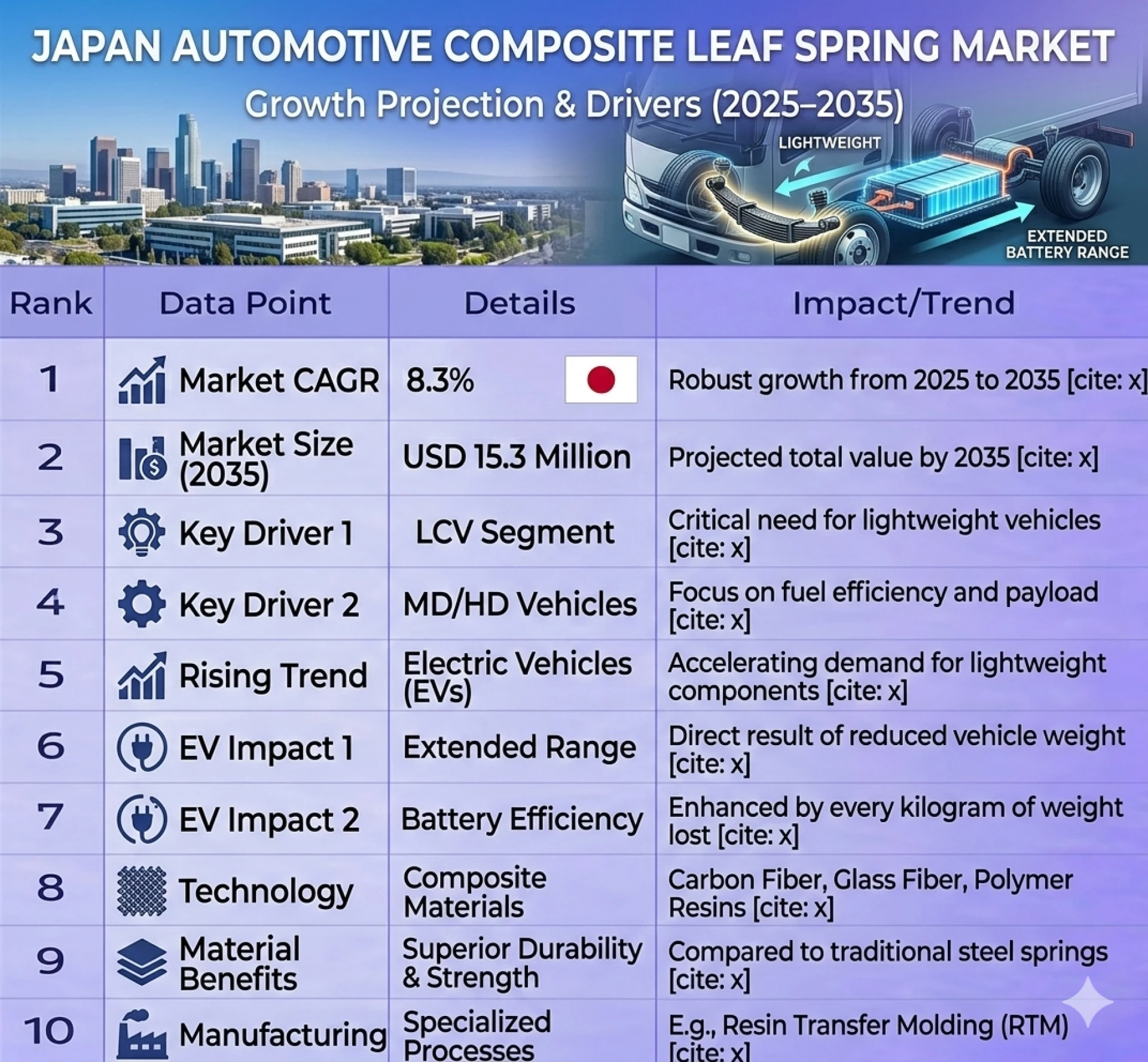
The Japan automotive composite leaf springs market is projected to experience steady growth over the next decade, driven by rising demand for lightweight vehicle components and improved fuel efficiency standards. According to the latest analysis by Future Market Insights (FMI), the market is expected to expand at a healthy CAGR throughout the 2026–2036 forecast period, supported by technological advancements and increasing adoption of composite materials in the automotive sector.
Market growth is being shaped by Japan’s strong automotive manufacturing ecosystem, regulatory emphasis on carbon emission reduction, and the transition toward electric and hybrid vehicles. Composite leaf springs, known for their superior strength-to-weight ratio and corrosion resistance, are increasingly replacing traditional steel leaf springs to enhance vehicle performance and durability.
Explore In-Depth Analysis-Click Here to Access the Report!
https://www.futuremarketinsights.com/reports/sample/rep-gb-20056
Japan Automotive Composite Leaf Springs Market Snapshot (2026–2036)
- Forecast period: 2026–2036
- Market growth rate: Steady CAGR expansion (2026–2036)
- Key material type: Glass Fiber Reinforced Polymer (GFRP)
- Leading vehicle segment: Passenger Vehicles
- Major growth drivers: Lightweighting initiatives, EV production growth, fuel efficiency regulations
Momentum in the Market
The Japan automotive composite leaf springs market is gaining momentum as automakers intensify efforts to reduce overall vehicle weight. Lightweight components play a critical role in improving fuel efficiency, extending electric vehicle range, and meeting Japan’s stringent emission standards.
Between 2026 and 2030, increasing investments in advanced suspension systems and next-generation vehicle platforms are expected to strengthen demand. From 2030 to 2036, further technological advancements in composite materials—particularly enhanced fatigue resistance and load-bearing capabilities—will support continued adoption across passenger and commercial vehicle segments.
OEMs are actively collaborating with material suppliers to integrate high-performance composite suspension components into mass production vehicle models.
The Reasons Behind the Market’s Growth
1. Lightweight Vehicle Demand
Composite leaf springs are significantly lighter than conventional steel springs, reducing overall vehicle mass and contributing to improved fuel economy and battery efficiency in electric vehicles.
2. Growing Electric Vehicle Production
Japan’s expanding EV and hybrid vehicle manufacturing sector is a key driver. Lightweight suspension components enhance driving range, which is a critical performance parameter for electric mobility.
3. Durability and Corrosion Resistance
Composite materials offer superior resistance to corrosion and fatigue, resulting in longer service life and lower maintenance requirements.
4. Sustainability Focus
Automotive manufacturers are increasingly focusing on sustainable material solutions. Composite leaf springs align with lifecycle efficiency and long-term durability objectives.
Top Segment Analysis
Vehicle Type: Passenger Vehicles Lead Market Demand
Passenger vehicles represent the dominant segment in Japan’s automotive composite leaf springs market. The segment benefits from high production volumes and strong demand for lightweight, high-performance suspension systems in sedans, SUVs, and hybrid models.
Material Type: Glass Fiber Reinforced Polymer (GFRP) Dominates
GFRP remains the most widely used material type due to its cost-effectiveness, high tensile strength, and favorable fatigue properties. Continuous advancements in fiber reinforcement technologies are further enhancing performance capabilities.
Regional Outlook: Japan’s Advanced Automotive Ecosystem Drives Growth
Japan’s position as a global automotive innovation hub significantly supports the market. Strong R&D infrastructure, leading OEM presence, and government-backed environmental regulations collectively create favorable conditions for composite component adoption.
Domestic production capabilities and export-oriented manufacturing also contribute to sustained demand across vehicle categories.
Drivers, Opportunities, Trends, and Challenges
Drivers
- Rising demand for lightweight automotive components
- Increasing EV and hybrid vehicle production
- Stringent emission and fuel-efficiency regulations
- Advancements in composite material engineering
Opportunities
- Development of high-performance carbon fiber composites
- Integration into next-generation electric vehicle platforms
- Expansion into light commercial vehicle applications
- Strategic OEM–supplier partnerships
Trends
- Transition from steel to composite suspension systems
- Growing use of mono-leaf composite spring designs
- Increased focus on lifecycle durability and sustainability
- Adoption of advanced manufacturing processes
Challenges
- Higher initial production costs compared to steel
- Complex manufacturing processes
- Need for extensive performance validation
- Supply chain constraints for advanced composite materials
Competitive Environment
The competitive landscape in Japan’s automotive composite leaf springs market is characterized by technological innovation and strategic collaborations. Companies are focusing on advanced material development, cost optimization, and expanding production capacity to gain competitive advantages.
Market participants are investing in R&D to enhance load-bearing capacity, reduce manufacturing complexity, and improve fatigue resistance. Strategic partnerships with automotive OEMs remain critical for long-term growth and product commercialization.
Outlook Through 2036
Over the forecast period, the Japan automotive composite leaf springs market is expected to benefit from Japan’s continued leadership in automotive engineering and sustainability-driven manufacturing practices. As electric vehicle adoption accelerates and lightweighting remains a top industry priority, composite suspension components are likely to witness expanding integration across vehicle platforms.
For a comprehensive strategic outlook and detailed insights into technological advancements shaping this industry through 2036, readers can explore the full report on the official Future Market Insights website - https://www.futuremarketinsights.com/reports/japan-automotive-composite-leaf-springs-market