
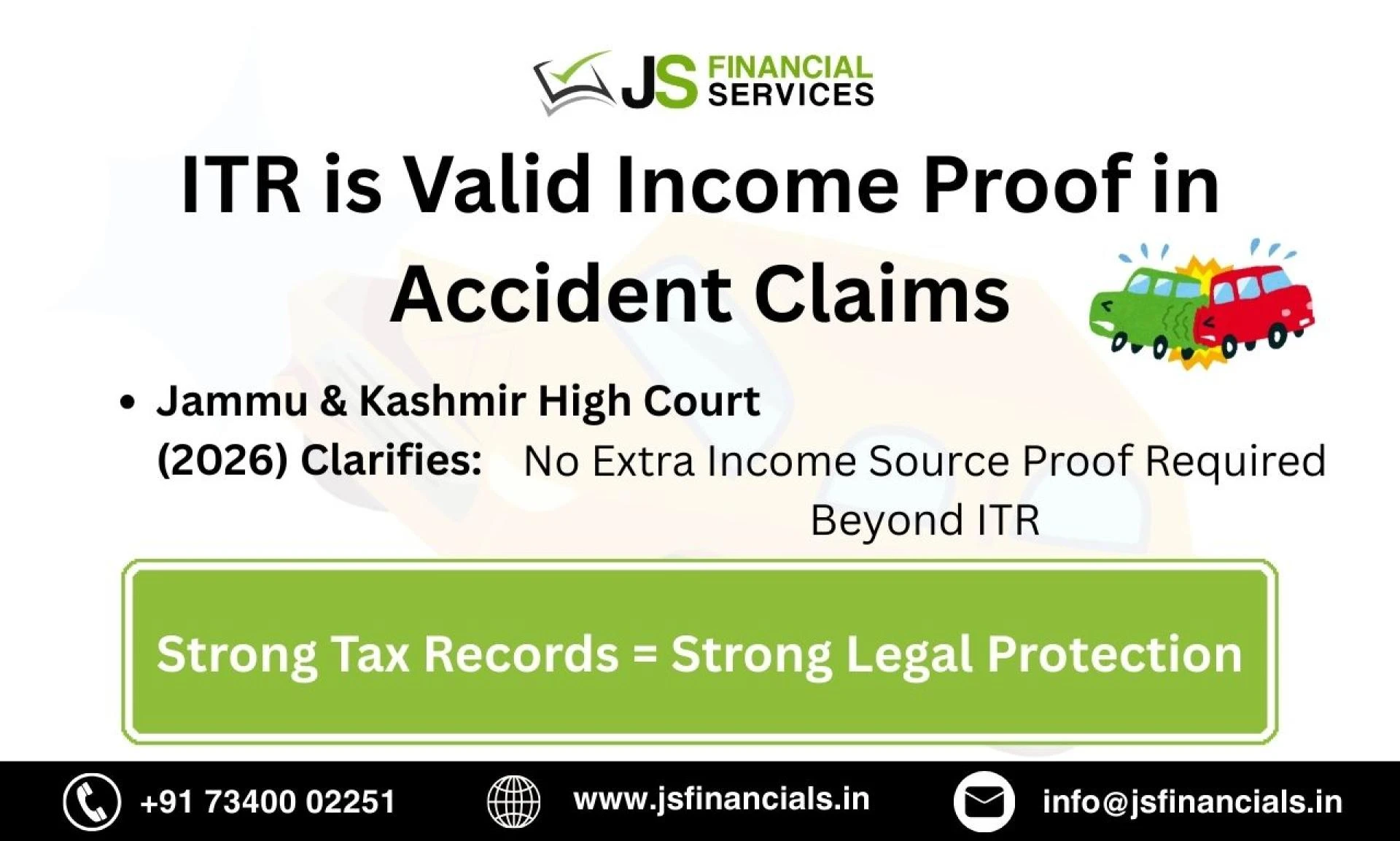
In a significant development for taxpayers and claimants, the Jammu & Kashmir High Court (February 2026) has reaffirmed that a duly filed Income Tax Return (ITR) is sufficient proof of income in Motor Accident Compensation Claims. Insurance companies cannot demand additional evidence to prove the source of income, unless they produce material to challenge the authenticity of the ITR.
This ruling strengthens the legal standing of properly filed tax returns and brings clarity to proceedings before the Motor Accident Claims Tribunal (MACT).
ITR Recognised as Primary and Statutory Evidence
Courts across India, including the Supreme Court, have consistently held that an ITR is a statutory document. Once income is disclosed in a return filed before tax authorities:
- It becomes the primary basis for determining annual income.
- The burden shifts to the insurer to disprove it.
- MACT is not required to conduct a separate inquiry into the income source.
This prevents unnecessary litigation and protects genuine claimants from prolonged disputes.
No Separate Proof of Income Source Required
The Court clearly stated that once income is reflected in a properly filed Income Tax Return, the insurance company cannot insist on additional documentation explaining how the income was earned.
Unless rebuttal evidence is provided:
- The ITR must be accepted.
- The Tribunal cannot question the declared income.
- Claim proceedings cannot be converted into tax investigations.
This ruling ensures smoother and fairer compensation processes.
Even Post-Accident ITR Can Be Considered
Recent judicial trends confirm that even an ITR filed after the accident or death may be considered valid for compensation purposes, provided it reflects genuine earnings and is not fabricated.
Additionally, courts have clarified that:
- A standard ITR is sufficient.
- There is no requirement for a “consolidated” return.
- Properly documented tax filings carry strong evidentiary value.
Updated Compensation Calculation Standards (2025–2026)
Courts continue to apply principles laid down in landmark cases such as:
- National Insurance Co. Ltd. v. Pranay Sethi
- Sarla Verma v. Delhi Transport Corporation
Key standards include:
1. Addition for Future Prospects
An additional 25% to 50% of income is added depending on age and employment status.
2. Minimum Wage as Default Income
If actual income cannot be proven (for example, in the case of minors or informal workers), compensation is calculated based on the state minimum wage for skilled workers.
3. Proposed Tax Exemption (Effective April 2026)
Proposed amendments suggest that:
- Motor Accident Compensation may be fully exempt from Income Tax.
- Interest awarded on compensation may also be tax-free.
If implemented, this will significantly benefit claimants and their families.
Why Proper ITR Filing is Now More Important Than Ever
This ruling highlights a crucial point:
An Income Tax Return is not just a compliance document — it is legal financial evidence.
Accurate and timely filing ensures:
- Strong legal credibility
- Protection of family’s financial rights
- Proper calculation of compensation
- Reduced dispute with insurers
- Compliance with tax regulations
Conclusion
The February 2026 clarification by the Jammu & Kashmir High Court marks a progressive step in protecting taxpayers and accident claimants. By reaffirming the legal validity of ITR as income proof, the judiciary has ensured fairness, transparency, and efficiency in compensation claims.
For individuals and businesses, this is a reminder that proper tax compliance today can safeguard your family’s financial security tomorrow.
For expert ITR filing, tax advisory, and compliance support,
JS Financial Services
Website: www.jsfinancials.in
Phone: +91 73400 02251
Our Expertise, Your Success
Go beyond the ordinary