Ask about warranty and spare parts too. A beautiful imported kitchen is only as good as the service available in your city five years later.
Italian or German kitchen? A practical comparison of design, build quality, cost and Indian cooking needs, so you can choose without regret.
Walk into any high-end showroom and the same debate starts within five minutes. One designer swears by German engineering. Another runs a hand over an Italian lacquer door and says nothing else comes close. Both are right, and that’s exactly why it’s confusing.
We’ve planned a lot of kitchens, and the honest answer is this: neither is better in general. One is better for you. This guide breaks down how they really differ, so you can decide with confidence.
The Short Answer
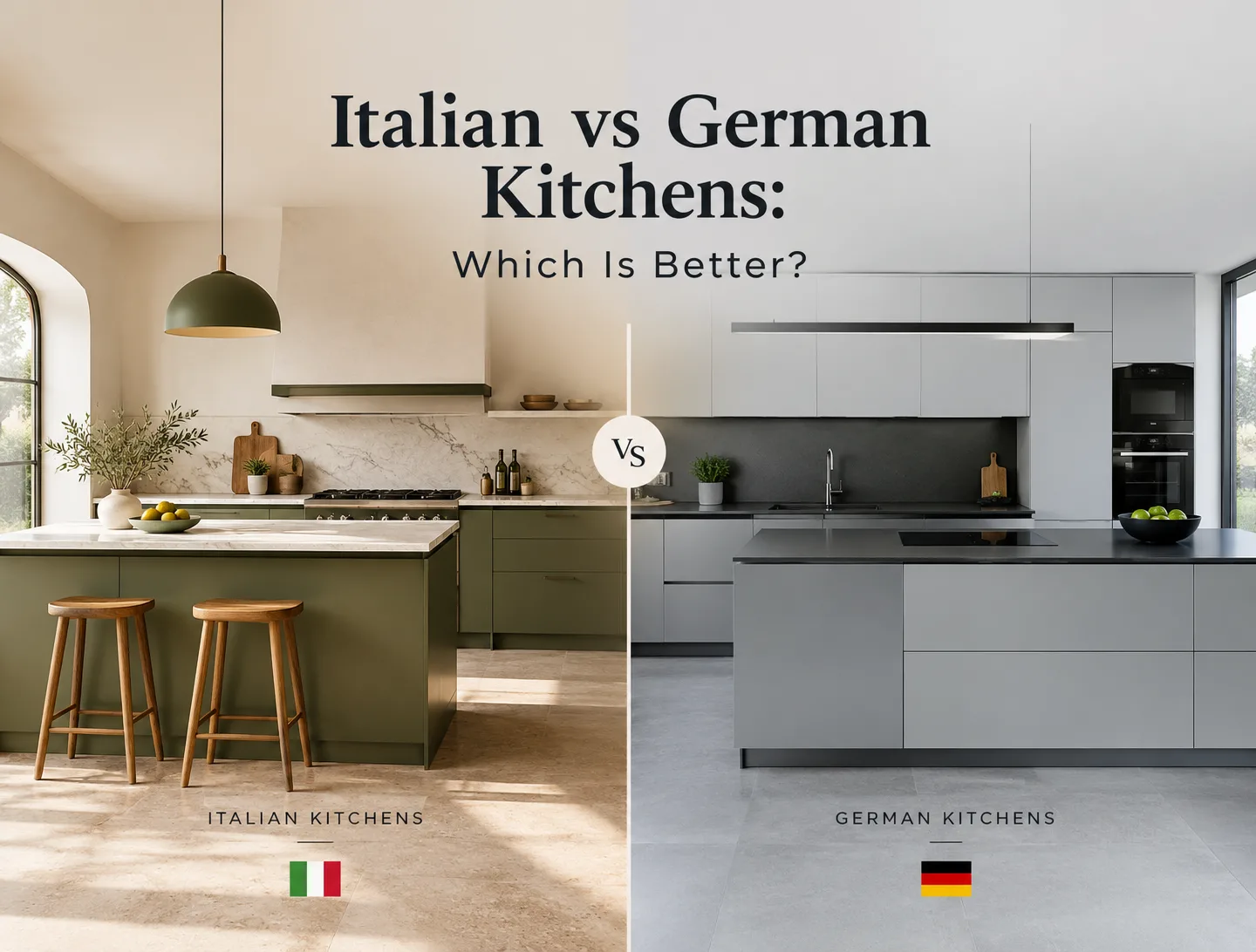
German kitchens win on engineering. Italian kitchens win on design.
If you cook every day and want a kitchen that works the same in year ten as it did on day one, lean German. If the kitchen is the centrepiece of an open-plan home and you want guests to notice it, lean Italian. The rest of this article explains why, and where the two overlap.
The German Approach: Function First
A German kitchen starts from the inside. Before anyone talks about colours, the conversation is about drawer runners, hinge tolerance, soft-close mechanisms and how the cabinet is put together. The country’s kitchen industry grew out of a manufacturing culture that values consistency, and it shows. Doors line up to the millimetre. Drawers glide the same way every time. A 600 mm cabinet really is 600 mm.
What you typically get:
- Very tight tolerances and uniform quality across every module
- Smart internal fittings: pull-out larders, corner solutions, cutlery and spice organisers
- Standard sizing, which makes adding or replacing a unit later easy
Clean, handleless, matte looks that stay understated
The best-known german kitchen brands include Poggenpohl, SieMatic, Bulthaup, Leicht and Next125 at the premium end, with Nolte and Häcker covering a wider price range. What sets the leading german kitchen design brands apart is system thinking.
Everything is designed to work together, from the carcass to the last accessory.
The downside: it can feel restrained. If you want drama, unusual materials or a kitchen that looks like a piece of furniture, a German range may feel a bit too tidy.
The Italian Approach: Design First
An Italian kitchen starts from the outside. Italy’s kitchen makers come from a furniture and design tradition, so the focus is on proportion, material and how the space feels when you walk in. Expect lacquers with real depth, glass, stone, wood veneers, metal accents and colour combinations that feel considered rather than safe.
Luxury Italian kitchen design behaves more like furniture-making than cabinetry. Islands look sculpted, tall units become feature walls, and the kitchen often blends into the living space instead of announcing itself as a work area. Names worth knowing include Boffi, Arclinea, Valcucine, Snaidero, Scavolini and Varenna by Poliform.
An Italian modular kitchen is also more flexible than most people assume. You keep the practicality of modules but get more freedom with finishes, heights, depths and proportions than standard ranges usually allow.
The downside: more choice means more decisions, and bespoke work can mean longer lead times. Build quality is excellent at the top end but varies more from maker to maker, so ask questions instead of assuming. The good news is that premium Italian makers often use the same respected European hardware, so the gap is smaller than the internet makes it sound.
Side-by-Side Comparison
GermanItalianDesign personalityClean, functional, understatedExpressive, material-rich, statement-makingBuild consistencyVery high across brandsExcellent at the top end, varies by makerCustomisationWide, within a defined systemMore freedom in finishes and proportionsTypical finishesMatte lacquer, fine laminate, woodGlass, stone, veneer, metallic, texturedLead timeUsually predictableCan be longer for bespoke workBest forDaily heavy cooking, long-term useOpen-plan homes, design-led interiorsUpkeepSimple surfaces, easy to wipeDepends on finish, delicate ones need careWhich One Handles Indian Cooking Better?
This is where brochures rarely help, and where it matters most. Indian cooking is heavy. Tadka, deep frying, grinding, long simmering, and oil-laden air all hit your surfaces far harder than a typical European kitchen would. Add Mumbai’s humidity and salt air, and moisture becomes a real risk for boards and edges.
A few honest points:
- German build logic suits this well. Sealed edges, sturdy hardware and simple, wipeable surfaces are a natural fit for daily heavy use. But this depends on the specific brand, not the country on the label.
- High-gloss Italian finishes show oil and fingerprints quickly. Matte, textured or fine-grain Italian options hold up much better.
- Whichever you choose, insist on moisture-resistant carcass material, properly sealed edges and a powerful chimney.
Consider a wet and dry kitchen split. Keep the heavy tempering in a separate area and the showpiece kitchen stays cleaner.
For anyone planning a luxury kitchen Mumbai conditions demand, these practical details matter more than the logo on the door.
What About Cost?
A common belief is that Italian always costs more. It doesn’t. At the entry end of imported kitchens, some German ranges are actually cheaper. At the top end, both are priced like fine furniture.
What really moves the number is the size of the kitchen, appliances, stone countertops, hardware, shipping, lead time and installation. When you compare luxury kitchen brands, always ask for a full quote including delivery and fitting. A low cabinet price can hide a large installation bill.
Design Trends Worth Knowing
Luxury modern kitchen designs right now share a few things, whichever country they come from:
- Fewer visible handles and cleaner fronts
- Stone slabs running up the wall as a backsplash
- Fully integrated appliances hidden behind panels
- Warm wood paired with matte dark colours
- Islands that double as dining or work spaces
Trends move on, but good proportions and quality hardware don’t. Spend your budget on the second.
Don’t Forget Who Designs It
Honestly, the brand matters less than the person planning your kitchen. Even the best cabinets look average if the layout is wrong. Good luxury kitchen designers start with how you cook: how many people use the kitchen, where the stove sits relative to the sink, how much storage you need, and what your daily routine looks like. Finishes come later.
Great luxury kitchen interiors feel effortless because someone sweated the small decisions, like where the bin goes, how far the chimney hangs and whether you can open the dishwasher while someone stands at the hob.
The Best Answer Is Sometimes Both
Many of the best projects don’t pick a side. They pair Italian-style shutters and finishes with German-style internal organisation and hardware. You get the look of luxury Italian kitchen design with the day-to-day reliability people love about German engineering. Some of the most beautiful luxury modern kitchen designs we’ve seen use exactly this mix.
If a designer insists you must choose one country, ask why.
Quick Decision Guide
Choose German if:
- You cook heavily every day
- You want predictable quality and easy upkeep
- You prefer a clean, understated look
- You like the idea of adding or changing modules later
Choose Italian if:
- Your kitchen is part of the living area and needs to look striking
- You want unusual materials and finishes
- You’re happy to invest time in design decisions
- Proportion and detail matter more to you than standardisation
Frequently Asked Questions
Is a German or Italian kitchen more durable?Neither wins by country alone. Durability depends on the board used, edge sealing, hardware and installation. German brands have a reputation for consistency, but a well-made Italian kitchen lasts just as long.
Which is better for a small kitchen?
German standard modules make smart use of every centimetre. An Italian modular kitchen can also work very well when the units are custom-sized to fit awkward corners.
Are Italian kitchens harder to maintain?
Only if you choose delicate finishes. Matte and textured Italian surfaces are as easy to live with as any other.
Can imported kitchens be serviced in India?
They can, but ask before you buy. Confirm warranty terms, spare parts availability and who handles installation and after-sales support.
Final Thoughts
There’s no single winner in the Italian vs German debate. A German kitchen gives you precision and peace of mind. An Italian kitchen gives you character and a sense of occasion. The right choice depends on how you cook, how you live and what you want to feel every time you walk in.
If you’d like help working through it, you can explore our kitchen work at Grandeur Interiors or speak to our team. We’ll look at your space, your cooking habits and your budget, and help you build a kitchen that looks great and keeps working for years. For a luxury kitchen Mumbai homeowners can be proud of, that mix of design and everyday practicality is what we aim for.