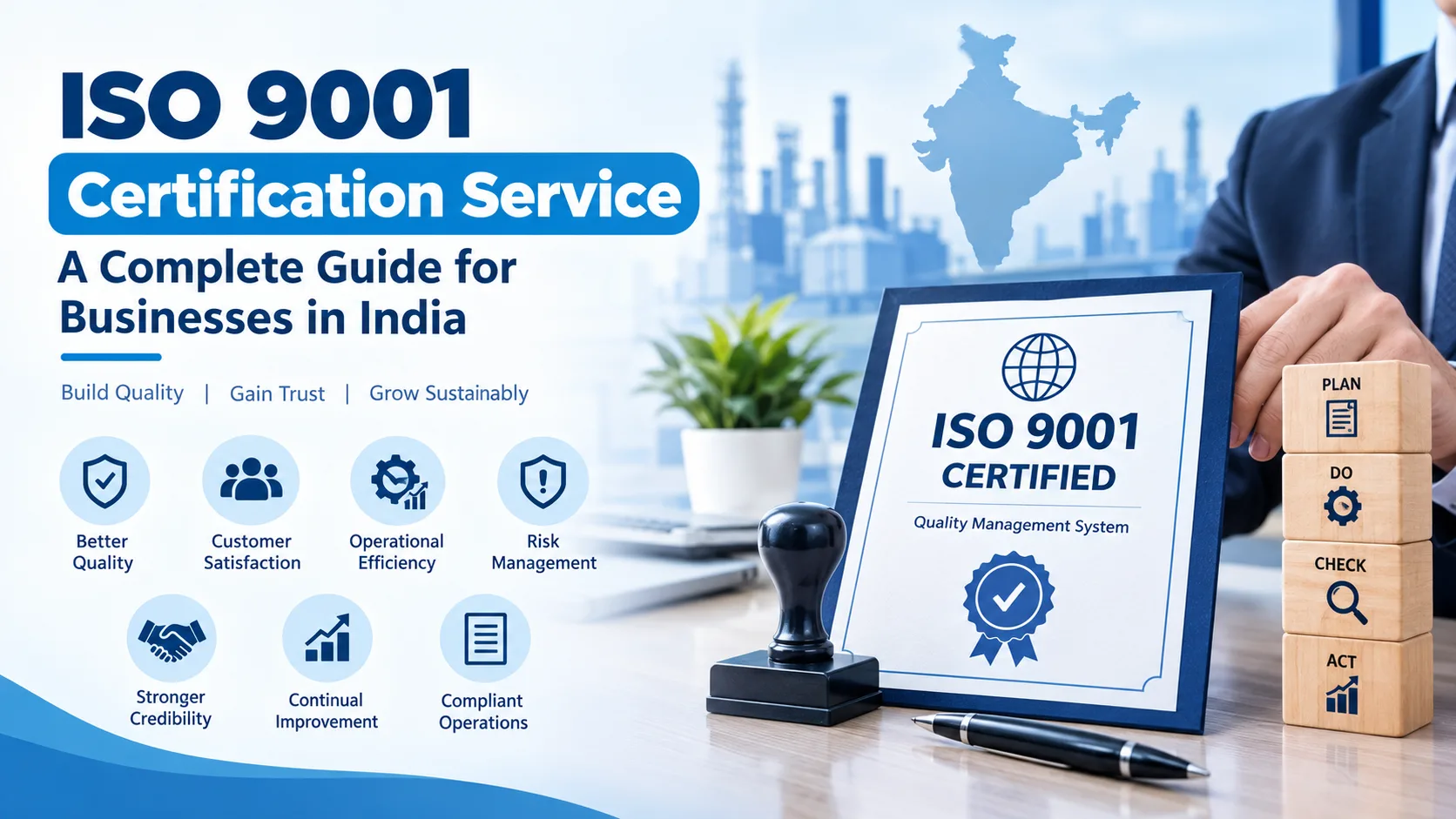
In today's competitive business environment, maintaining consistent product and service quality is essential for long-term success. Customers expect reliable products, timely delivery, effective communication, and professional service. To meet these expectations, businesses need structured processes that help them control quality, reduce errors, and continuously improve their operations.
An ISO 9001 Certification Service helps businesses understand and implement a Quality Management System (QMS) based on the internationally recognized ISO 9001 standard. It can support organizations in identifying quality-related risks, documenting procedures, improving operational efficiency, and preparing for an independent certification audit.
In India, ISO 9001 certification is relevant to manufacturers, service providers, IT companies, construction businesses, healthcare organizations, educational institutions, logistics companies, and small and medium-sized enterprises (SMEs). The standard can be applied to organizations of different sizes and across a wide range of industries.
This guide explains ISO 9001 certification, its benefits, eligibility, documentation, implementation process, costs, and important factors to consider when selecting a certification service.
What Is ISO 9001 Certification?
ISO 9001 is an international standard that specifies requirements for a Quality Management System. It is published by the International Organization for Standardization (ISO) and provides a framework for organizations to consistently meet customer requirements and applicable regulatory obligations.
A QMS defines how an organization manages its processes, responsibilities, resources, records, and quality objectives. Rather than focusing only on inspecting finished products, ISO 9001 encourages businesses to build quality into their everyday operations.
For example, a manufacturing company may use a QMS to control raw materials, monitor production, inspect finished products, manage customer complaints, and prevent recurring defects. A service-based company may use it to standardize customer onboarding, manage service delivery, track complaints, and measure customer satisfaction.
ISO 9001 certification is generally issued after an independent certification body evaluates the organization's QMS and determines that it meets the applicable requirements. Certification is not the same as purchasing a certificate or simply preparing a set of documents.
What Is an ISO 9001 Certification Service?
An ISO 9001 certification service provides guidance and support to organizations seeking to establish, implement, or certify their Quality Management System.
The term can cover two distinct activities: consultancy and certification. Understanding the difference is important when selecting a provider.
1. ISO 9001 consultancy services
Consultants help an organization understand the standard and implement the required processes. Depending on the agreed scope, their work may include:
- Reviewing existing business processes and identifying gaps.
- Helping develop quality policies, objectives, and procedures.
- Assisting with risk assessment and process controls.
- Training employees on quality management requirements.
- Supporting internal audits and management reviews.
- Helping prepare for an external certification audit.
Consultants provide implementation support, but they do not independently award ISO 9001 certification unless they operate through a separately qualified and appropriately accredited certification arrangement.
2. ISO 9001 certification services
A certification body conducts an independent assessment of the organization's Quality Management System. If the audit demonstrates conformity with the standard and the certification body's requirements, certification may be granted.
A responsible certification process should include an appropriate audit, documented findings, resolution of required corrective actions, and a formal certification decision.
Businesses should confirm whether a provider offers consultancy, independent certification, or both through clearly separated arrangements.
Why Is ISO 9001 Certification Important for Indian Businesses?
Indian businesses operate in markets where customers increasingly expect consistent quality, traceability, dependable delivery, and effective complaint handling. A well-implemented QMS can help organizations manage these expectations systematically.
The importance of ISO 9001 varies by sector, customer requirements, and business objectives. Some buyers may specifically request certification as part of their supplier qualification process, while others may value the operational improvements associated with the standard.
ISO 9001 can be particularly useful for organizations that are expanding, introducing new products, managing multiple locations, or supplying larger businesses. It creates a common framework for monitoring performance and improving how work is carried out.
Certification does not automatically guarantee new contracts, higher profits, or regulatory approval. Its value depends on how effectively the system is implemented and maintained.
Key Benefits of ISO 9001 Certification
1. Improved product and service quality
A structured QMS helps organizations define quality requirements, establish process controls, and monitor whether products or services meet expectations. This can reduce inconsistency and improve reliability.
2. Greater customer satisfaction
Organizations can establish processes for receiving feedback, handling complaints, monitoring service quality, and addressing recurring issues. These practices help businesses understand customer expectations and respond more effectively.
3. Better operational efficiency
Documented processes and clearly assigned responsibilities can reduce confusion, duplication of work, delays, and avoidable mistakes. Over time, process improvements may also reduce waste and rework.
4. Stronger risk management
ISO 9001 encourages organizations to consider risks and opportunities that could affect their ability to achieve intended results. Identifying potential problems early can help businesses establish suitable controls and contingency measures.
5. Improved employee accountability
Defined roles, appropriate training, and clear procedures help employees understand their responsibilities. This can improve coordination between departments and make daily operations more consistent.
6. Support for supplier qualification
Some customers and procurement departments require suppliers to maintain an ISO 9001-certified QMS. Certification can help demonstrate that an organization follows a recognized quality management framework, although individual buyers may impose additional requirements.
7. Continuous improvement
ISO 9001 emphasizes performance evaluation, corrective action, and ongoing improvement. Organizations can use audit findings, customer feedback, process data, and management reviews to identify opportunities for better results.
Who Can Apply for ISO 9001 Certification in India?
ISO 9001 is designed for organizations of different sizes and types. There is no general requirement that an organization must be a large company or operate a manufacturing facility.
Businesses that may benefit include:
- Manufacturing units and industrial suppliers.
- Small and medium-sized enterprises.
- Information technology and software service companies.
- Construction and engineering firms.
- Logistics, warehousing, and transportation providers.
- Consulting and professional service organizations.
- Educational and training institutions.
- Healthcare support and administrative service providers.
- Exporters and organizations participating in supply chains.
The QMS scope should reflect the organization's actual activities, locations, products, and services. The certification body evaluates whether the proposed scope is appropriate and adequately supported by the implemented system.
Organizations should also understand that ISO 9001 is a quality management standard. It does not replace industry-specific licences, statutory approvals, product certifications, or other regulatory obligations.
Documents Required for ISO 9001 Certification
The exact documented information depends on the organization's activities, risks, size, and applicable requirements. ISO 9001:2015 does not require every business to use an identical set of manuals and forms.
Commonly relevant documents and records include:
- QMS scope: Defines the activities and organizational boundaries covered by the system.
- Quality policy: Describes the organization's overall commitment and direction regarding quality.
- Quality objectives: Identifies measurable goals relevant to quality performance.
- Process documentation: Explains how important activities are managed and controlled.
- Risk and opportunity records: Documents relevant risks, opportunities, and planned actions where appropriate.
- Competence and training records: Demonstrates that personnel performing relevant work have suitable competence.
- Operational records: Provides evidence that processes are carried out as planned.
- Supplier evaluation records: Shows how externally provided products and services are controlled where relevant.
- Monitoring and measurement results: Records performance against established requirements.
- Internal audit records: Documents the audit programme, findings, and follow-up actions.
- Management review records: Shows that leadership reviews QMS performance and improvement needs.
- Corrective action records: Tracks nonconformities, their causes, and the actions taken to prevent recurrence.
A business should maintain records that are useful, accurate, accessible, and appropriate to its processes rather than creating unnecessary paperwork solely for an audit.
ISO 9001 Certification Process in India
The certification process typically follows several stages. The duration depends on the organization's size, complexity, locations, workforce, and readiness.
Step 1: Define the scope
Identify the products, services, locations, and business activities that the Quality Management System will cover. The scope should accurately reflect the organization's operations.
Step 2: Conduct a gap analysis
Compare existing practices with ISO 9001 requirements. This helps identify missing processes, weak controls, documentation gaps, and areas requiring improvement.
Step 3: Develop the QMS
Establish appropriate policies, procedures, process controls, quality objectives, and records. The system should reflect how the business actually operates.
Step 4: Implement the system
Communicate the requirements to employees, provide necessary training, assign responsibilities, and begin using the established processes. Retain evidence that the system is operating effectively.
Step 5: Conduct an internal audit
Evaluate whether the QMS conforms to the applicable requirements and is being implemented as planned. Record findings and address identified problems.
Step 6: Hold a management review
Leadership reviews relevant information, including audit results, customer feedback, quality objectives, process performance, risks, and improvement opportunities.
Step 7: Complete the certification audit
The selected certification body assesses the QMS. Certification audits commonly include two stages:
- Stage 1: Reviews readiness, scope, key documented information, and other relevant aspects of the QMS.
- Stage 2: Evaluates implementation and effectiveness through evidence, interviews, and examination of relevant processes and records.
The precise audit arrangements depend on the certification body's procedures and applicable accreditation requirements.
Step 8: Address nonconformities
If auditors identify nonconformities, the organization must respond appropriately. This may involve correcting the issue, investigating its cause, implementing corrective action, and providing evidence for review.
Step 9: Certification decision
Once applicable certification requirements have been met and the required review is complete, the certification body makes the certification decision.
Step 10: Maintain certification
Certification is not a one-time exercise. Organizations are generally subject to periodic surveillance audits and subsequent recertification according to the certification scheme and applicable rules. The QMS should remain active and support continual improvement.
How Much Does ISO 9001 Certification Cost in India?
There is no single price that applies to every organization. The total cost depends on factors such as:
- Organization size and employee count.
- Number of locations and operational complexity.
- Scope of products, services, and activities.
- Current level of QMS implementation.
- Consultancy and employee training requirements.
- Certification audit duration and travel expenses.
- Additional costs for addressing gaps or maintaining the system.
Consultancy fees and certification-body fees are separate cost components, although some providers may offer combined packages.
When comparing quotations, businesses should request a clear breakdown of included services, audit arrangements, taxes, travel charges, surveillance audits, and any additional fees. Extremely low prices should be assessed carefully if they appear to exclude meaningful auditing or ongoing certification obligations.
The best choice is not necessarily the cheapest provider, but the one offering an appropriate, transparent, and credible process for the organization's needs.
How to Choose an ISO 9001 Certification Service Provider
Selecting the right provider is important for ensuring that the certification process is reliable and useful.
Check accreditation and credibility
Verify the certification body's accreditation status, scope, and recognition for the relevant activities. In India, organizations may consult the National Accreditation Board for Certification Bodies (NABCB) and relevant international accreditation arrangements when evaluating certification credentials.
Do not assume that every company offering ISO documentation or consultancy is authorized to issue accredited certificates.
Understand the service being offered
Ask whether the quotation covers consultancy, training, internal audit support, certification audits, or ongoing maintenance. These services are different and should be clearly explained.
Evaluate industry experience
A provider familiar with the organization's sector may better understand its operational processes, customer requirements, and relevant risks. However, sector experience should not replace verification of competence and credibility.
Request a transparent quotation
Review the complete cost structure, expected timelines, scope of work, audit requirements, and post-certification obligations before making a decision.
Avoid unrealistic promises
No ethical provider can guarantee certification without evaluating the organization's QMS and addressing applicable requirements. Be cautious of claims offering certificates without a meaningful audit.
Businesses researching providers, including JS Certification, should independently verify the relevant service scope, credentials, fees, and certification arrangements before proceeding.
Common Mistakes to Avoid During ISO 9001 Certification
Organizations can make the process less effective when they treat certification as a paperwork exercise rather than an operational improvement initiative.
Common mistakes include:
- Preparing documents without implementing the procedures.
- Setting vague or unmeasurable quality objectives.
- Failing to train employees on relevant processes.
- Ignoring customer complaints and recurring problems.
- Conducting internal audits only to satisfy a formal requirement.
- Failing to investigate the causes of nonconformities.
- Selecting a certification provider without checking its credentials.
- Neglecting surveillance audits and ongoing QMS maintenance.
Avoiding these mistakes helps ensure that the management system remains relevant to business operations and continues to deliver practical value.
Conclusion
An ISO 9001 Certification Service can help Indian businesses establish a structured approach to quality management, improve process consistency, address risks, and strengthen customer confidence. The process involves defining the QMS scope, implementing suitable controls, maintaining relevant records, conducting internal audits, and undergoing an independent certification assessment.
Before selecting a provider, organizations should understand the difference between consultancy and certification, verify accreditation where applicable, compare complete quotations, and assess their own readiness.
Most importantly, ISO 9001 should be treated as a management framework for improving business performance rather than simply a certificate to display. When implemented effectively and maintained over time, it can support better decision-making, consistent service delivery, and continuous improvement.
Frequently Asked Questions (FAQs)
1. What is an ISO 9001 Certification Service?
It refers to services that help organizations implement a Quality Management System and obtain ISO 9001 certification. These services may include consultancy, training, documentation support, audits, and independent certification, depending on the provider.
2. Is ISO 9001 certification mandatory in India?
ISO 9001 certification is not universally mandatory for every business in India. However, certain customers, tenders, contracts, or supplier qualification processes may require it. Organizations should check the specific requirements that apply to their activities.
3. How long does ISO 9001 certification take?
The timeline varies according to the organization's size, complexity, existing processes, and readiness. A business with established quality controls may be ready sooner than one that needs substantial changes. Audit scheduling and corrective actions also affect the overall duration.
4. What documents are required for ISO 9001 certification?
Common examples include the QMS scope, quality policy, quality objectives, operational records, competence records, internal audit results, management review records, and corrective action evidence. The exact documentation depends on the organization's circumstances and the standard's requirements.
5. Can a small business obtain ISO 9001 certification?
Yes. ISO 9001 can be applied to small businesses, startups, and larger organizations. The QMS should be appropriate to the business's size, activities, risks, and operational complexity.
6. Is ISO 9001 certification the same as ISO consultancy?
No. Consultancy supports the implementation and improvement of a QMS, whereas certification involves an independent assessment by a certification body. Businesses should clarify which service they are purchasing.
7. How often does ISO 9001 certification need to be renewed?
Under common certification arrangements, the certification cycle is three years, with periodic surveillance audits and a recertification audit before the cycle expires. Organizations should confirm the exact schedule with their certification body.
8. Does ISO 9001 certification guarantee better product quality?
No. Certification demonstrates that the organization's QMS has been assessed against the applicable requirements. Actual results depend on effective implementation, employee involvement, process control, monitoring, and continual improvement.
9. How can a business verify an ISO 9001 certificate?
Check the certificate's validity, issuing certification body, scope, applicable standard, and relevant accreditation details. Where applicable, confirm the certification body's status through the relevant accreditation body or official certification verification system.
10. What should businesses compare before choosing an ISO 9001 service provider?
Compare credentials, scope of services, industry experience, audit arrangements, pricing transparency, expected timelines, and ongoing support. Verify whether the provider offers consultancy or independent certification, and avoid promises of certification without a proper assessment.