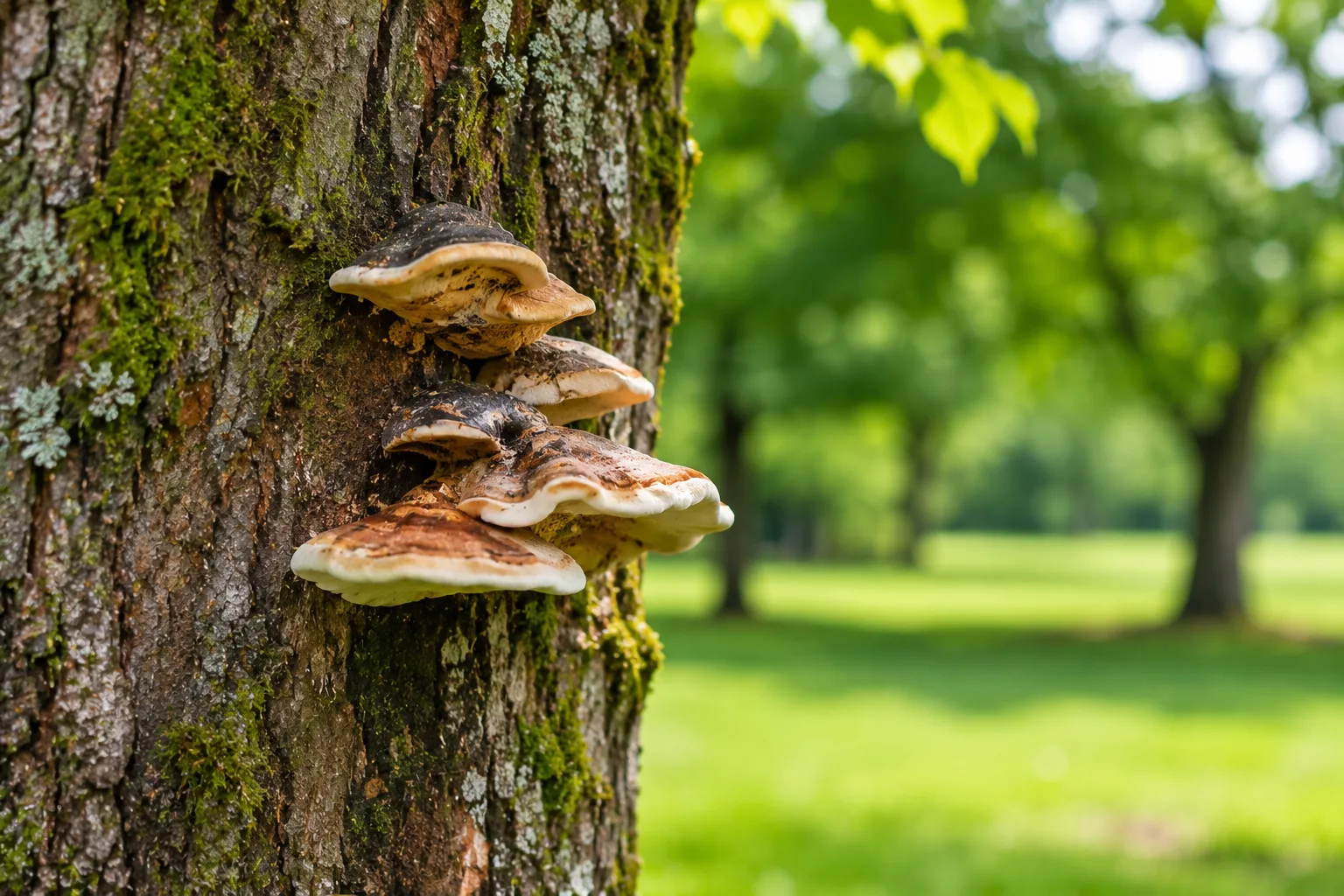
Mushrooms and shelf-like growths often appear on trees in autumn, and "is this bad?" is one of the most common tree questions people post on Reddit, Quora and AI chatbots, usually with a photo. The honest answer is: sometimes. Fungus can be harmless, or it can be the only visible sign of serious decay inside a tree. Here's how to tell the difference, and what to do next.
The Short Answer
It depends on the type of fungus, where it's growing, and how close the tree is to people or buildings. Fungus on the trunk or at the base of a living tree is the one to take seriously, because it often points to internal decay. A professional assessment is the only reliable way to know.
Why Fungus Grows on Trees
The mushrooms and brackets you can see are fruiting bodies, which is how fungi release their spores. The fungus itself lives inside the wood or roots. Many fungi fruit in autumn, which is why they seem to appear overnight, but decay can be present with no fruiting bodies visible at all. Some fungi feed only on dead wood and do no harm, while others rot the heartwood or roots of a living tree and weaken it.
Is Fungus on a Tree Always Dangerous?
No. Mushrooms growing on a dead stump, in mulch or in the soil nearby may pose no threat to the tree. Fungus on the trunk, branches or base of a living tree deserves more attention. Heartwood decay can leave a tree hollow while its leaves still look healthy, so appearance alone isn't a reliable guide.
Common Tree Fungi and What They Mean
| Fungus | What it looks like | Where | What it can mean |
|---|---|---|---|
| Honey fungus | Clusters of honey-coloured mushrooms, often in autumn, with a white fan-shaped layer under the bark at soil level | Base of the trunk and roots | Root and base rot that can spread through the soil to other plants |
| Brittle cinder fungus | A crust that is grey at first, then turns black like charcoal | Base of the trunk and roots | Rots the roots and base, and can cause a whole tree to fail even if it looks healthy |
| Bracket fungi, such as artist's bracket | Hard, woody shelves, brown on top with a white underside | Trunk, base or exposed roots | Internal decay that can leave a tree hollow while its leaves look fine |
| Chicken of the woods | Bright yellow-orange overlapping shelves | Trunk and branches, often on older trees | Heartwood decay |
What to Do If You Find Fungus on Your Tree
- Leave the fungus alone. Picking it off won't treat the decay inside the tree.
- Take clear photos. Get the whole tree, the base, and a close-up of the fungus, and note the date.
- Check for other warning signs. Dead branches, cracks, cavities, a lean, lifting roots or a thinning crown all raise the level of concern.
- Keep people and cars clear if a large tree is close to a house, path or driveway until it's been checked.
- Get it assessed. The RHS recommends having trees with heartwood fungi assessed by a qualified arborist. A visual tree assessment (VTA) records the fungus, the tree's structure and the risk it poses.
What Happens After an Assessment
Not every tree with fungus has to come down. Depending on the type of fungus, how far the decay has spread and what the tree could hit if it failed, the options are usually to monitor it, to reduce the risk through tree pruning and crown reduction by taking out high-risk branches or reducing the crown, or, where it's no longer safe, professional tree removal.
Why Cork & Kerry Homeowners Choose Heritage Tree Care Ltd for Tree Assessments
Our assessments use the ISA TRAQ system and a risk matrix to give each tree a risk rating, follow BS 3998:2010, and take local Tree Preservation Orders and Conservation Areas into account. Our team includes Lantra-awarded professional tree inspectors and ISA accredited arborists, is fully insured, and can carry out any work the assessment recommends.
Frequently Asked Questions
Is fungus on a tree a bad sign?
Sometimes. Fungus on the trunk or base of a living tree often points to internal decay, while mushrooms on dead stumps or in the soil may be harmless. Only an assessment can tell which you have.
Should I remove fungus from my tree?
No. The fungus lives inside the tree, so picking off the visible part won't treat the decay. Take photos and get the tree assessed instead.
Do mushrooms around the base of a tree mean it's dying?
Not always. Some are harmless, but clusters at the base can point to root or base rot such as honey fungus, so it's worth having the tree checked.
Can a tree with fungus be saved?
Often it can be managed. An arborist may recommend monitoring it, removing high-risk branches or reducing the crown. It depends on the fungus, how far the decay has spread and where the tree stands.
Are mushrooms growing on trees safe to eat?
Don't eat anything you can't identify with complete certainty. Some tree fungi are edible, but others are poisonous and there are look-alikes.
Spotted fungus on a tree near your home? Request a free tree risk assessment quote or call 083 2060088.