For businesses serving the gardening, nursery, and horticultural markets, flower pots may appear to be simple products. However, producing them consistently, efficiently, and at a competitive cost requires careful planning. As demand changes and buyers expect reliable quality, manufacturers must consider whether their existing production methods can keep pace.
A flower pot making machine can help businesses move from labor-intensive production toward a more controlled manufacturing process. Depending on the type of machine and material used, it may produce pots in different sizes, shapes, and designs for nurseries, garden centers, landscapers, and retailers. Nevertheless, buying equipment is a significant commitment. The machine’s purchase price is only one part of the decision; material costs, molds, utilities, maintenance, labor, and market demand also affect the outcome.
What Is a Flower Pot Making Machine?
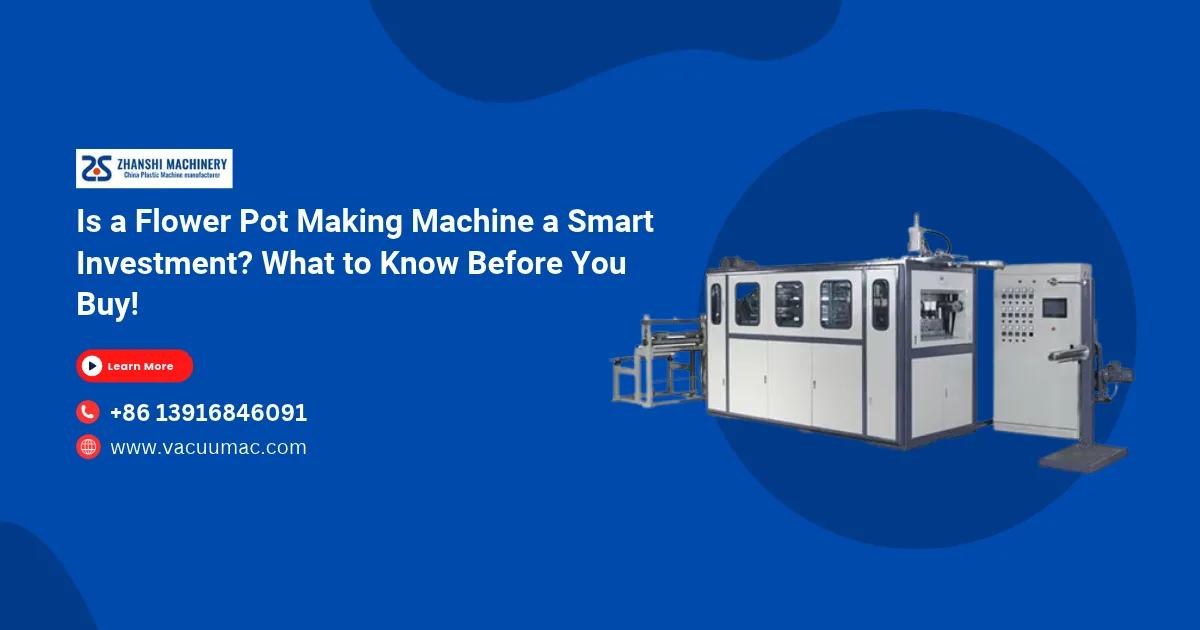
A flower pot making machine is equipment used to manufacture pots and containers for plants. The term covers several production technologies rather than one universal machine. Therefore, the right choice depends first on the material you intend to process and the type of pot you want to sell.
Common flower pot materials include:
- Plastic: Often used for lightweight nursery pots and retail plant containers.
- Biodegradable or fiber-based materials: Used for products designed to break down under specified conditions.
- Cement or concrete: Common for heavier decorative and outdoor pots.
- Clay: Used for traditional pottery and ceramic-style containers.
A machine intended for one material may not be suitable for another. For example, a plastic thermoforming machine works differently from equipment designed to form concrete or clay pots. Consequently, buyers should define their material and product requirements before comparing machine models.
Plastic flower pots can also be produced using different methods. Two common approaches are thermoforming and injection molding. Each has its own equipment, tooling, and production considerations.
How Does a Plastic Flower Pot Making Machine Work?
The manufacturing process depends on the equipment selected. In a thermoforming process, a plastic sheet is heated until it becomes pliable. The softened sheet is then formed over or into a mold using vacuum, pressure, or a combination of forming methods. After cooling, the formed pots are trimmed and separated.
By contrast, injection molding generally involves melting plastic material and injecting it into a closed mold. Once the material cools and solidifies, the finished pot is ejected.
Both approaches can be suitable for certain plastic pot applications. However, the choice depends on factors such as wall thickness, product design, production volume, tooling costs, and material requirements. Before selecting a process, discuss a sample pot or detailed drawing with potential equipment suppliers.
Why Businesses Consider Investing in a Flower Pot Making Machine
The primary reason to invest in production equipment is to meet a business need more effectively. That need might be increasing capacity, improving consistency, reducing reliance on outside suppliers, or adding a new product line.
1. Greater control over production
Producing pots in-house can give a business more control over scheduling, product specifications, and inventory planning. For example, a nursery supplier that regularly purchases pots may want to evaluate whether manufacturing certain high-volume sizes internally would improve supply reliability.
However, greater control also brings greater responsibility. The business must manage materials, machine operation, maintenance, quality checks, and production scheduling.
2. Potential for more consistent output
A suitable machine, combined with properly designed molds and controlled operating conditions, can help produce pots with consistent dimensions and appearance. This matters when customers use automated filling, planting, stacking, or handling systems.
Nevertheless, a machine alone does not guarantee quality. Material variation, mold condition, heating, cooling, and operator practices can all influence finished products.
3. Opportunities to serve different markets
Flower pots are used in commercial nurseries, home gardening, landscaping, retail displays, and greenhouse operations. As a result, manufacturers may be able to target different customer groups with appropriate products.
For instance, one buyer may prioritize low-cost nursery pots, while another may seek a particular color, finish, or decorative shape. The equipment and tooling must support the products your target customers actually want.
4. Potential to reduce some production costs
Automation may reduce the amount of manual work required for certain tasks. In addition, a well-planned process may help control material usage and waste.
However, savings are not automatic. Electricity, material prices, labor, machine utilization, and maintenance all affect the cost per pot. Therefore, it is important to calculate the expected economics rather than assume that automation will always be cheaper.
Key Factors to Consider Before You Buy
1. Your target product and material
Start by defining the pot you want to make. A supplier will generally need more than a broad description such as “plastic flower pot” to recommend suitable equipment.
Prepare as much of the following information as possible:
- Pot diameter, height, and approximate weight
- Wall thickness and desired strength
- Shape, rim design, and base configuration
- Drainage hole requirements
- Material type and any recycled-content requirements
- Color, surface finish, and appearance standards
- Expected stacking and packaging method
- Sample product or technical drawing, if available
In addition, consider how the pot will be used. A small seedling pot may have different performance requirements from a large outdoor planter. Likewise, a pot intended for automated nursery handling may need tighter dimensional control than a decorative container.
2. Required production capacity
The capacity you need depends on actual sales expectations, not just the largest number a machine can theoretically produce. Estimate your daily, weekly, and seasonal demand, and then account for downtime and product changes.
For example, if your customers order most heavily before the growing season, you may need to build inventory in advance. Alternatively, if orders vary throughout the year, a flexible production setup may be more valuable than maximum output.
When comparing machines, ask suppliers to clarify whether their quoted output is based on a specific pot size, mold layout, material, and operating condition. Actual production can differ because of setup time, maintenance, quality checks, material handling, and other interruptions.
3. Mold and tooling requirements
The mold has a major influence on pot shape, dimensions, appearance, and production efficiency. Consequently, the machine price should never be considered separately from the cost of the molds needed for your product range.
Ask potential suppliers:
- How many molds will be needed for the planned pot sizes?
- Are drainage holes formed or added in a separate operation?
- How long does a mold change typically take?
- What information is needed to design the mold?
- Are replacement mold components available?
- What are the estimated tooling lead times?
Furthermore, review whether your product designs are likely to change. If you expect frequent changes in size or style, mold flexibility and changeover time may be especially important.
4. Automation and labor needs
A flower pot making machine may be part of a production line that includes material feeding, forming, trimming, stacking, and other operations. Some tasks may be automated, while others require manual handling.
More automation can help reduce repetitive work, but it may also increase the initial investment and require additional technical skills. Therefore, assess the entire workflow rather than focusing only on the forming machine.
For example, a machine may form pots quickly, but production could still be limited by manual stacking or packaging. Similarly, operators may need training to adjust settings, inspect products, and perform routine maintenance.
5. Factory space and utilities
Before ordering equipment, confirm that your facility can support it. The machine footprint is only one part of the space requirement. You may also need room for:
- Raw material storage and movement
- Molds and spare parts
- Finished goods and packaging
- Operator access and safety clearances
- Maintenance work
- Supporting equipment
In addition, request the machine’s utility specifications. Depending on the system, requirements may include electrical supply, compressed air, cooling water, ventilation, and other services. Installation costs can rise if your factory needs upgrades.
6. Maintenance and technical support
Production equipment requires ongoing care. Heating components, moving parts, cutting systems, sensors, and molds may all need inspection or servicing over time.
Before buying, ask what routine maintenance is recommended, which spare parts are most likely to be needed, and how technical support is provided. Also, clarify warranty terms and what is included in installation or operator training.
A lower initial price may not represent the best value if replacement parts are difficult to obtain or downtime becomes expensive. Conversely, a higher-priced system may be worthwhile if its capabilities and support align with your production needs.
Also Read: How a Flower Pot Making Machine Can Transform Your Gardening Business!
Understanding the Total Cost of Ownership
The purchase price is important, but it does not show the full cost of owning and operating a flower pot making machine. A more useful assessment includes both upfront and ongoing expenses.
Upfront costs
Depending on the project, initial costs may include:
1. The machine and related equipment
2. Molds and tooling
3. Shipping, insurance, duties, and taxes
4. Installation and commissioning
5. Utility upgrades
6. Operator training
7. Initial spare parts and materials
Ongoing costs
After installation, budget for:
1. Plastic or other raw materials
2. Electricity and other utilities
3. Operator and supervisory labor
4. Maintenance and replacement parts
5. Mold servicing
6. Packaging and internal material handling
7. Scrap, rejects, and quality control
8. Financing costs, if applicable
Additionally, account for production time that does not generate saleable pots. Setup, cleaning, adjustments, and product changeovers can all affect the actual cost per unit.
Should You Make Flower Pots In-House or Outsource?
In-house production offers potential control, but outsourcing may remain the better option in some situations.
In-house manufacturing may be worth considering when:
- You have stable demand for defined pot sizes.
- Outside supply delays frequently affect your operations.
- Your business has the capital and technical resources to run equipment.
- Your projected production volume supports a reasonable cost per pot.
- Product customization is important to your customers.
Outsourcing may be more suitable when:
- Demand is uncertain or highly seasonal.
- You need only small quantities of many different designs.
- Your facility lacks space or necessary utilities.
- Tooling and equipment costs are difficult to justify.
- Your team cannot currently support production and maintenance.
A hybrid approach is also possible. For example, a business might manufacture its highest-volume pot sizes in-house while outsourcing less common designs. As a result, it can evaluate production performance without immediately bringing every product under one roof.
Common Buying Mistakes to Avoid
One common mistake is selecting a machine solely on advertised output. High capacity is useful only if you have the orders, materials, staffing, and downstream equipment to support it.
Another is underestimating tooling. A business planning to sell several pot sizes should include all required molds in its budget from the beginning. Otherwise, the initial equipment quotation may represent only part of the investment.
Buyers should also avoid assuming that every plastic material will perform the same way. Material grade, sheet properties, product design, and processing conditions can influence quality. Therefore, discuss material requirements and, where appropriate, arrange suitable production trials.
Finally, do not overlook the route to market. Even an efficient production line needs customers. Before buying, validate expected demand, pricing, delivery requirements, and the competitive position of your proposed pots.
A flower pot making machine can be a smart investment when it addresses a clear production need and is supported by realistic demand. It may offer greater control over output, product consistency, and supply planning. However, the financial result depends on much more than the machine’s purchase price.
Before committing, define your product, compare suitable manufacturing processes, calculate total ownership costs, and evaluate molds, utilities, labor, and technical support. Most importantly, test your business case under more than one sales and cost scenario.
Frequently Asked Questions
Is a flower pot making machine profitable?
It can be profitable when production volume, selling prices, operating costs, and equipment utilization support a positive return. However, profitability is not guaranteed. Prepare a cost-per-pot estimate and compare several demand scenarios before investing.
Which is better for plastic flower pots: thermoforming or injection molding?
Neither process is universally better. Thermoforming may be suitable for certain thin-walled pot designs, while injection molding may be appropriate for other shapes or performance requirements. Compare the processes using your specific design, material, production volume, tooling budget, and quality expectations.
How much does a flower pot making machine cost?
Costs vary significantly according to production technology, capacity, automation, molds, and supporting equipment. In addition to the machine price, request estimates for tooling, shipping, installation, utilities, training, and spare parts.
Can one machine produce different sizes of flower pots?
Some systems can produce different sizes using different molds, but the available size range depends on the machine and tooling specifications. Before purchase, provide the supplier with the dimensions of all pots you intend to make and ask about mold changes and any limitations.
Can recycled plastic be used to make flower pots?
Some plastic pot production processes can use recycled material, depending on the machine, material specification, product requirements, and applicable customer or regulatory requirements. Material consistency can affect processing and finished quality, so confirm suitability with the equipment and material suppliers.
What affects the production speed of a flower pot making machine?
Factors may include pot dimensions, material, mold design, forming and cooling time, trimming, stacking, operator practices, and equipment configuration. Therefore, compare capacity estimates using the same product specifications and assumptions.
How much space is needed for a production line?
The space required depends on the machine, auxiliary equipment, material storage, finished-product handling, and access for operators and maintenance. Ask for a layout and utility plan before preparing your factory floor.
What maintenance should I plan for?
Maintenance needs vary by machine. Generally, buyers should plan for regular cleaning, inspection, lubrication where required, mold care, and replacement of wear parts. Follow the supplier’s maintenance instructions and train operators to identify problems early.
How can I assess whether the equipment is right for my business?
Start with a defined product, realistic sales forecast, and complete cost estimate. Then compare equipment options against your capacity, quality, staffing, space, and support requirements. Finally, discuss your specifications and acceptance criteria with potential suppliers.