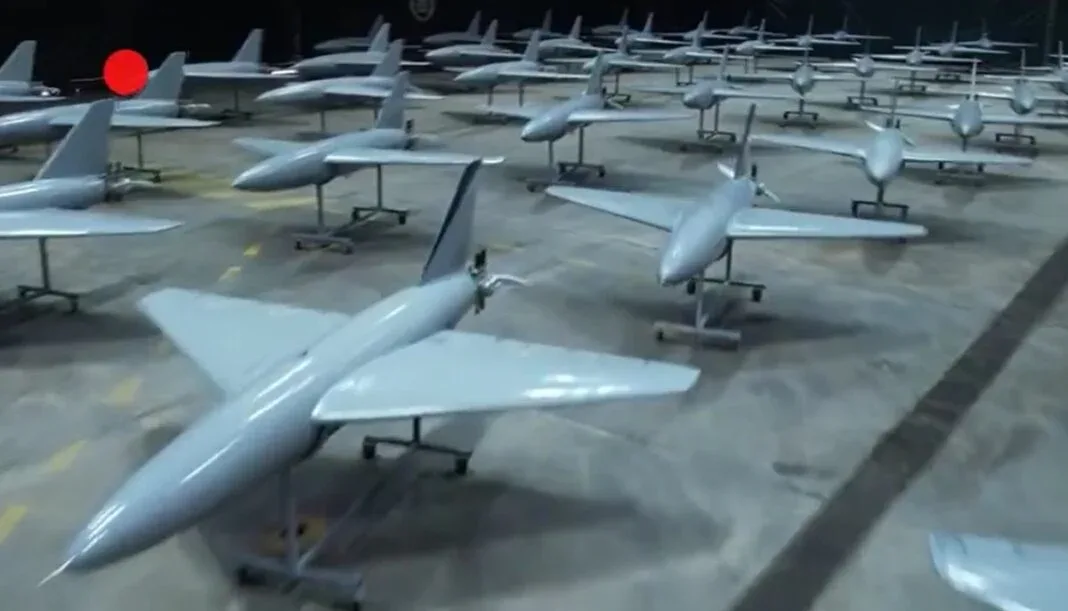
DefenceTalks has followed the growing international interest in Iran’s Arash drone programme after Iranian state media showed Army chief Amir Hatami visiting a facility described as a centre for unmanned-system production. The presentation placed the Arash family at the centre of discussion about Iran’s technical development and domestic manufacturing ambitions. It also highlighted the importance of distinguishing official claims from independently confirmed information.
What Is the Arash Family?
Arash is the name associated with a family of Iranian one-way unmanned systems. Public reporting has discussed different versions, including the Arash-2, while recent reports have used the name Arash-3 for a newer configuration.
The October footage attracted attention because it was presented alongside claims of continued manufacturing and technical development. Some media reports have described changes to payload and navigation features, but a complete set of specifications for the newest version has not been independently established.
Technical details should therefore be attributed to the sources reporting them rather than treated as confirmed performance measurements.
Why System Variants Matter
Military equipment often evolves through successive versions. Changes may involve materials, electronics, navigation, propulsion or manufacturing methods. A newer model may address limitations identified in an earlier design, but the significance of those changes depends on testing and actual operating conditions.
The same caution applies when comparing systems from different countries. Range, endurance, payload and reliability are meaningful only when the figures are based on comparable conditions and credible evidence.
Without verified specifications, it is difficult to assess how much the latest Arash variant differs from previous models.
The Industrial Network Behind Development
Iranian officials have described cooperation between the Army, the Ministry of Defence, universities and domestic technology companies. Such cooperation can help connect research with production and maintenance.
A programme that includes engineers, manufacturers and training organisations may be better placed to sustain equipment over time than one focused only on initial design. However, its effectiveness depends on production quality, component availability and the ability to address technical problems.
The public presentation did not provide a complete breakdown of the organisations involved or the production responsibilities assigned to each one.
Understanding the Limits of Public Announcements
Official demonstrations are useful for identifying stated priorities and observing visible equipment. They are less conclusive when assessing manufacturing output, technical reliability or operational readiness.
The location of the facility, its production capacity and the number of completed aircraft were not fully disclosed in the report. Those gaps limit independent conclusions about the programme’s overall scale.
Conclusion
The Arash programme illustrates Iran’s stated interest in developing and maintaining its own unmanned systems. The latest presentation has renewed attention to its production infrastructure, but important technical and industrial questions remain open. DefenceTalks’ coverage of the programme helps readers follow new developments while keeping reported specifications, official claims and independently verified facts clearly separated.