On July 8, 2026, Dalal Street saw a sharp single-day selloff, sending shockwaves through the domestic financial ecosystem. The benchmark BSE Sensex plunged 1,677.12 points, or 2.15%, to settle at 76,503.60, while the Nifty 50 slumped 516.65 points, or 2.12%, to close at 23,882.05, decisively sliding below the psychologically crucial 24,000 threshold.
The primary trigger behind this sudden stock market crash was a fracturing of global risk sentiment. Market confidence eroded rapidly following official comments indicating that the fragile US-Iran ceasefire arrangement was effectively "over." This geopolitical escalation caused an immediate knee-jerk reaction in energy markets, pushing Brent crude sharply higher. For an economy like India, which relies on imports for roughly 85% of its crude oil requirements, the macroeconomic implications of an energy shock instantly triggered widespread risk aversion.
The Mechanics: What is India VIX and Why Did it Surge?
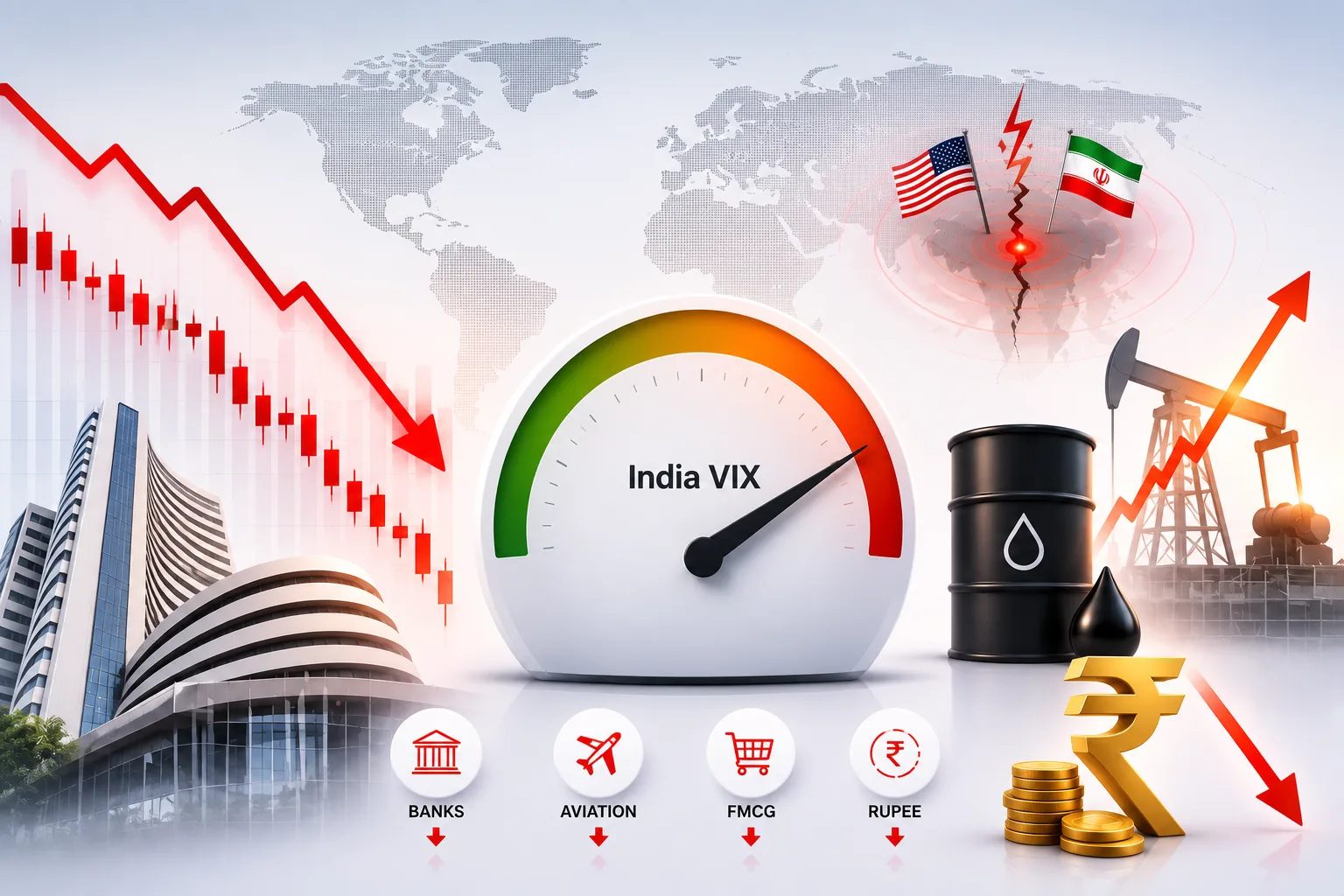
While equity benchmarks plummeted, the National Stock Exchange’s (NSE) Volatility Index, popularly known as the India VIX or the market's "fear gauge," skyrocketed by 26.03%. The index surged from a calm baseline of 11.65 up to 14.68 in a single trading session, a rise of 26.03%.
To understand why Nifty fell yesterday and how it connects to the volatility index, it is essential to understand the underlying mechanics of options pricing:
- A Forward-Looking Metric: Unlike traditional stock indices that track past price movements, India VIX is entirely forward-looking. It computes the market’s expectation of near-term volatility over the next 30 days.
- The Options Pricing Connection: The calculation of India VIX is derived from Nifty 50 option prices across near- and next-month out-of-the-money strike prices.
- The Hedging Rush: When the geopolitical shock hit the wires, institutional investors and portfolio managers rushed to buy Nifty put options to hedge their equity exposures against a deeper crash.
- Implied Volatility (IV) Expansion: This massive, concentrated demand for downside protection drove option premiums up. In options pricing mechanics, a sharp increase in premium values expands the Nifty options' implied volatility, which directly forces the aggregate India VIX computation upward.
- The Options Pricing Link: The 26% surge in India VIX reflected the mathematics of options pricing rather than just an emotional reaction. When sudden geopolitical friction arises, demand for out-of-the-money Nifty put options can rise, pushing option premiums higher and lifting implied volatility, which in turn drives the India VIX higher.
Sectoral Damage and the Macroeconomic Ripple Effect
The combination of spiking crude oil and a soaring fear gauge triggered systematic asset reallocation across major sectors on the NSE.The currency component acted as a compounding catalyst. Rupee weakness likely reinforced foreign investor caution, adding to equity selling pressure during the session.
The Oil and Currency Transmission Channel: Geopolitical instability involving Iran immediately triggers concerns over supply disruptions through the Strait of Hormuz, spiking global Brent crude prices. For an import-dependent economy like India, higher oil costs widen the current account deficit and exert pressure on the Indian Rupee (INR). Consequently, sectors highly sensitive to raw material costs such as paints, aviation, and OMCs (oil marketing companies) bore the brunt of the immediate equity sell-off, while defensive sectors like IT and pharma acted as relative cushions.The Next Day Reality: Contextualizing the Panic
Historically, a sudden 26% spike in the volatility index signals acute institutional distress, but perspective is vital when evaluating market health. On July 9, 2026, the market showed signs of stabilization after the headline-driven selloff As market participants digested the initial macroeconomic shock, the India VIX cooled down by roughly 8.9%, easing back toward 13.38.
Sector / Indicator | Market Performance (July 8, 2026) | Primary Vulnerability Trigger
- Nifty Bank | Decreased by 2.51% | Institutional selling pressure in heavyweights like HDFC Bank and ICICI Bank amid a macro-driven risk-off move.
- Aviation & Logistics | Significant downward pressure | Drastic margin squeeze projections driven by the sudden spike in Aviation Turbine Fuel (ATF) costs.
- FMCG Sector | Moderated performance | Expectations of rising raw material and packaging input costs tied to petroleum derivatives.
- Indian Rupee (INR) | Faced renewed depreciation pressure against the USD | Capital outflows and widening current account deficit worries accelerated domestic currency depreciation.
Key Informational Takeaway for Market Participants:
While an immediate double-digit spike in the market volatility index commands attention, keeping the absolute India VIX value under 15 suggests that the market is still in a relatively contained volatility regime. Historically, a transition into a structural bear market or prolonged corrective phase is often associated with VIX readings that move and remain meaningfully higher, although no single threshold is definitive. Yesterday's correction highlights how modern algorithmic trading and instant hedging mechanisms express immediate geopolitical risks through the lens of derivatives volatility.