
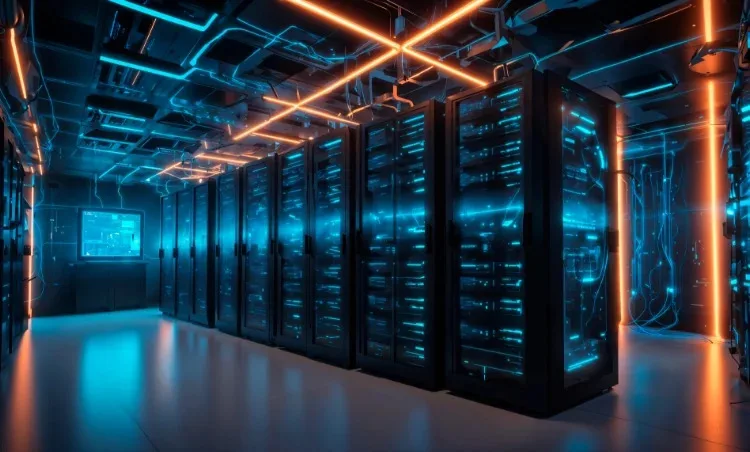
The data center industry is going through its biggest architectural shift in two decades, and AI is the reason. The facilities being designed today look almost nothing like the ones built five years ago, and the operators who figure out the transition fastest are the ones who will define the next phase of digital infrastructure in India.
What changes when AI moves in
A traditional enterprise data center is built around a fairly predictable load. Servers draw between 5 and 10 kilowatts per rack, cooling is straightforward, and the layout has not fundamentally changed in years.
An AI ready data center is a different animal. Training racks for large models can draw 40 to 100 kilowatts each. Air cooling stops working past a certain density, so liquid cooling, direct to chip, and even immersion cooling become necessary. Power delivery has to be redesigned. The network fabric inside the building needs to handle east west traffic at scale, because AI workloads are constantly shuffling data between GPUs rather than serving requests to end users.
In other words, AI does not just need more capacity. It needs a fundamentally different facility.
Why India's data center operators matter here
For a long time, the global narrative around AI infrastructure focused almost entirely on hyperscalers building gigawatt scale campuses in the United States. That story is shifting fast. India is now one of the largest data center growth markets in the world, and the Indian operators are quietly building AI ready capacity at pace.
Sify Technologies is one of the clearest examples of this shift. Sify has been operating data centers in India for over two decades, which means it understands the local power, land, and regulatory environment in a way newer entrants do not. More importantly, it has been actively investing in higher density facilities designed for AI and high performance workloads, with new builds in cities like Mumbai, Chennai, Hyderabad, Noida, and Kolkata.
What sets Sify apart in the AI conversation is not just the facilities themselves, but the surrounding ecosystem. The company operates its own network backbone connecting its data centers, runs cloud and managed services on top, and offers direct interconnects to every major hyperscaler. For an AI workload that needs to pull data from a regulated source, train on GPUs in a hyperscaler region, and serve inference back to Indian users, that integrated stack removes a lot of friction.
The infrastructure problems AI is forcing operators to solve
Power is the first and biggest one. AI workloads consume power at a scale that strains local grids and forces operators to think differently about renewables, on site generation, and long term power purchase agreements. India's grid mix is changing rapidly, and operators with strong relationships with state utilities and a clear sustainability strategy will have a structural advantage.
Cooling is the second. Liquid cooling is no longer experimental. It is becoming standard for any rack hosting AI training workloads. Retrofitting older facilities is expensive and often impossible, so new builds are increasingly designed liquid first.
Network architecture is the third. AI training generates enormous amounts of internal traffic between GPUs, which means the data center's internal network has to be radically faster and lower latency than what a traditional cloud workload needs. The operators investing in next generation network fabrics now are the ones who will be able to host serious AI customers in three years.
Land and location is the fourth. AI training tends to want to be wherever power is cheapest and most reliable, but inference wants to be close to the user. That is pushing Indian operators to think about a portfolio of facilities, with some optimized for training in tier two cities and others optimized for inference in metros. Sify's geographic spread across multiple Indian cities fits this pattern almost exactly.
Where this is heading
The next three years will separate the data center operators who simply added some GPU capacity from the ones who genuinely redesigned around AI. In India specifically, that distinction will matter even more, because the country is becoming a serious destination for AI workloads from both domestic enterprises and global players looking for regional capacity.
The operators who win will be the ones who combine three things. Modern AI ready facilities with the right power and cooling. A network and cloud layer that connects cleanly to hyperscalers and customer environments. And the local depth (regulatory, operational, geographic) that global players cannot easily replicate.
Sify is one of a small number of Indian operators that already has all three pieces in place, which is why it keeps showing up in serious conversations about AI infrastructure in India.
The bottom line
AI is not just another workload running inside existing data centers. It is rewriting what a data center has to be, and the operators who saw this coming early are the ones positioning themselves for the next decade. For anyone watching India's digital infrastructure story, the AI ready data center is where the most interesting moves are happening, and it is worth paying attention to who is making them.