Arsenic is one of the harder contaminants to deal with in drinking water. It has no taste, smell or color, so the only way to know it's there is to test for it. It's also more common than many people realize, especially in private wells.
For many homes, a compact inline filter at the kitchen tap is the most practical way to bring arsenic down in the water you drink. This guide explains how inline arsenic filters work, how they fit alongside carbon filters and RO systems, and what to check before you choose one.
How Common Is Arsenic in Well Water?
Arsenic occurs naturally in rock and soil in many parts of the country, and it dissolves into groundwater. A U.S. Geological Survey study estimated that about 2.1 million people in the US use private wells with arsenic above 10 micrograms per liter.
That figure matters because 10 micrograms per liter, or 10 parts per billion, is the EPA's drinking water limit for arsenic. As the EPA's history of the arsenic rule explains, public water systems have had to meet that standard since 2006. Private wells aren't covered by federal drinking water rules, so testing and treatment are up to the homeowner.
Arsenic III and Arsenic V: Why the Form Matters
Arsenic in water comes in two main forms:
- Arsenic V (arsenate) is more common in water with plenty of oxygen. It's easier to remove, and many treatment methods handle it well.
- Arsenic III (arsenite) is more common in deeper, low-oxygen groundwater. It's harder to remove, and many systems need an oxidation step first to convert it to arsenic V.
This is why a lab test should report the arsenic form, or at least total arsenic plus the water's chemistry. It's also why the media inside an arsenic filter matters so much.
How an Inline Arsenic Water Filter Works
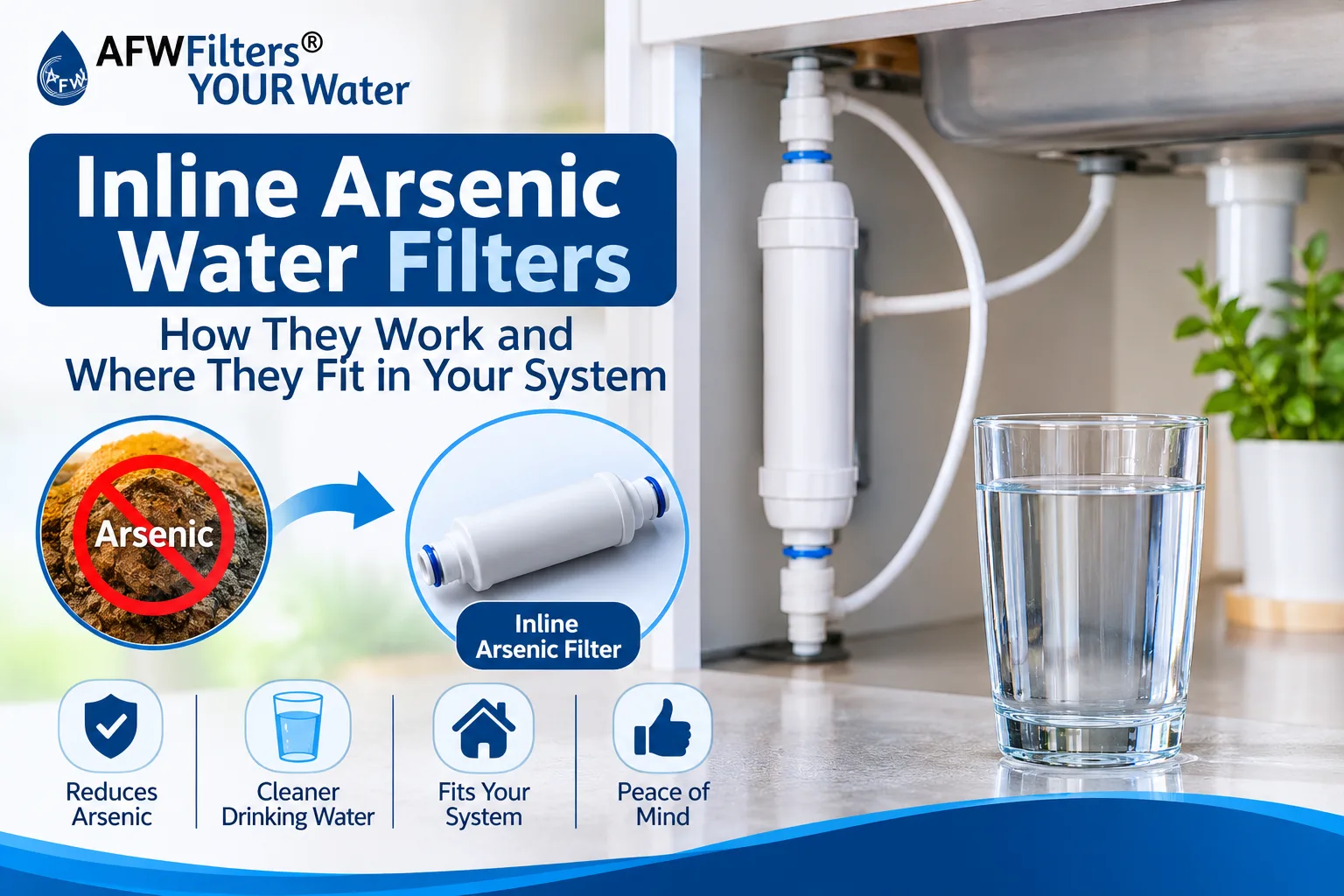
An inline arsenic water filter is a compact, sealed cartridge that fits into a 1/4-inch water line, usually under the kitchen sink. Water passes through specialized adsorptive media, often an iron-based material, that binds arsenic to its surface as the water flows through.
Some media can reduce both arsenic III and arsenic V in a single step, with no separate oxidation stage. AFW Filters, for example, carries an inline arsenic filter that uses Bayoxide E33 media to reduce both forms of arsenic, with quick-connect fittings that fit standard 1/4-inch tubing. For homes with arsenic throughout the plumbing, AFW also offers whole-house arsenic filters and arsenic removal media.
Inline filters suit several setups:
- A dedicated drinking water line at the kitchen sink
- A final stage after a reverse osmosis system, as a safeguard for drinking water
- A refrigerator or ice maker line
Where the Post Carbon Filter Fits
In many under-sink systems, the inline arsenic filter sits close to another inline stage: the post carbon filter.
A post carbon filter is the last stage before the faucet in most RO systems. Its job is polishing, which means removing any taste or odor the water picks up while sitting in the storage tank. It's usually a small in line carbon filter made with coconut shell carbon, and it typically gets changed along with the other filters.
When you combine stages, order matters:
- Sediment and carbon prefilters protect the RO membrane.
- The RO membrane removes most dissolved contaminants.
- The inline arsenic filter, where used, adds a dedicated arsenic stage.
- The post carbon filter finishes the water for taste just before the faucet.
If you add an arsenic stage to an existing RO system, follow the filter's instructions on placement and check that the tubing size and connections match.
In Line Carbon Filter vs. In Line Carbon Air Filter
The names cause plenty of confusion, so it's worth separating them.
An in line carbon filter for water is a sealed cartridge that improves taste and smell, reducing chlorine and some organic chemicals. On its own, it isn't an arsenic filter. Standard carbon does little for arsenic.
An in line carbon air filter is a completely different product. It's used in air ducts and ventilation, such as grow rooms or kitchens, to absorb odors from air. It has nothing to do with drinking water.
When shopping for water treatment, make sure the product is designed and rated for drinking water, and that it targets the contaminant you need to remove.
Choosing and Maintaining an Inline Arsenic Filter
Before buying:
- Test first. Use a certified lab to measure arsenic, ideally with its form, plus pH, iron and phosphate, which can all affect how well arsenic media performs.
- Match the media to your arsenic. If your water has arsenic III, choose media that handles it directly, or add an oxidation step.
- Check flow and connections. Make sure the filter suits your tubing size and the flow you need at the tap.
After installing:
- Replace the cartridge on the manufacturer's schedule, or sooner if your arsenic levels are high. Spent media can't hold any more arsenic, and an old filter gives a false sense of security.
- Retest the treated water after installation to confirm the filter is working, then periodically after that.
- Keep a note of installation and replacement dates under the sink.
The Bottom Line
Arsenic is invisible, common in some regions, and harmful over long-term exposure, but it's very treatable. Test your water, find out which form of arsenic you have, and choose an inline arsenic water filter with media suited to it. Paired with the right post-carbon filter, it's a compact, low-maintenance way to make sure the water you drink stays well below the EPA's 10 ppb limit.