
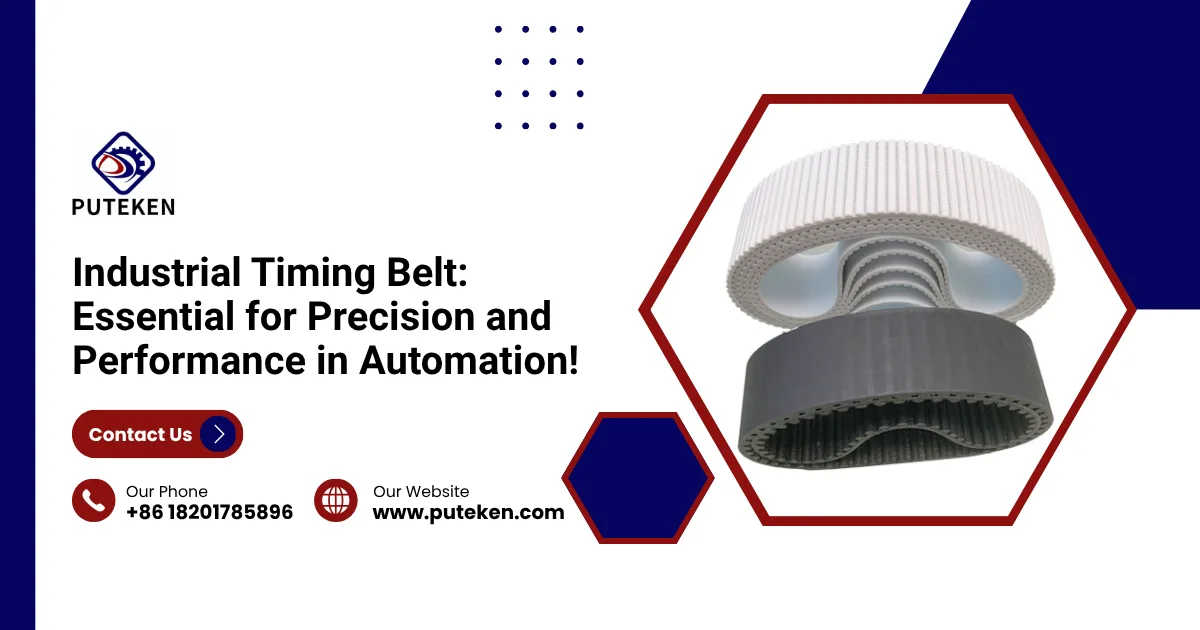
In the age of Industry 4.0, factories and facilities are smarter, faster, and more interconnected than ever. The backbone of these advancements isn't just the cutting-edge control software or high-speed servos—it's also the physical hardware that keeps everything synchronized, efficient, and resilient to shock or overload. One vital, often understated hero in this story is the industrial timing belt.
From advanced robotics and automotive lines to modern packaging plants and warehouse shuttles, the industrial timing belt ensures power and motion are transferred with absolute precision. While it may seem like a simple loop of rubber or polyurethane, this component is actually a marvel of engineering, designed for zero-slip engagement, impeccable tracking, and service intervals measured in years—not weeks.
What is an Industrial Timing Belt?
An industrial timing belt is a flexible, reinforced belt with molded teeth on one or both sides. The teeth interlock with grooves on the pulley, creating a positive, slip-free drive system.
Core components include:
- Body Material: Usually neoprene rubber or polyurethane for flexibility and wear resistance.
- Tensile Reinforcement: High-strength cords embedded within the belt, such as fiberglass, steel, or aramid, providing resistance to stretch.
- Teeth Profiling: Precisely molded (trapezoidal, curvilinear, double-sided, and more) for specific pulleys and load requirements.
Thanks to this design, timing belts offer several advantages:
- Predictable, repeatable transfer of power and motion
- Maintenance-free, grease-free operation (unlike roller chains)
- Operates without slippage, even at high acceleration or load
- Reduced vibration and quieter than chains or gears
- Lighter weight, less inertia—ideal for rapid stops and starts
The Science Behind Industrial Timing Belt Design
What distinguishes the modern timing belt from its simpler ancestors? The answer is both material innovation and advanced tooth profile modeling.
Key technical features include:
Tooth Design
-Classical trapezoidal (e.g., MXL, XL, L, H, XH, XXH): A long-time standard, suitable for moderate loads.
-Curvilinear (HTD, STD, RPP, S5M, S8M, T5, T10): Curved teeth reduce stress concentration and improve load distribution.
-Double-sided/duplex: Allows for complex, counter-rotating shaft systems.
-Custom pitches: Designed for unique machinery or system upgrades.
Body and Cord Synergy
-Neoprene Belts: Robust, general purpose, very resistant to oil, dirt, and atmospheric contaminants.
-Polyurethane Belts: Exceptionally precise, used where cleanliness or profile retention is critical (e.g., food, pharmaceuticals).
-Steel Cords: Maximum tensile strength; ideal for very heavy loads or long horizontal/vertical runs.
-Fiberglass/Aramid (Kevlar) Cords: Lighter applications or where resistance to flex-fatigue is essential.
Manufacturing Accuracy
Every belt from Shanghai Puteken is laser-profiled and quality-checked to micron-level standards for tooth spacing, thickness, and tension uniformity.
Core Advantages of Industrial Timing Belts in Automation
1. Absolute Synchronization
The biggest edge of a timing belt is zero slip, guaranteeing that multi-shaft systems operate with precise ratio control. This supports everything from exact conveyor indexing to high-speed multi-head robots.
2. Increased Speed and Throughput
Timing belts enable higher rotational speeds with less mass and inertia than chains, leading to faster system cycles, quick machine starts, and energy savings.
3. Maintenance-Free Operations
A properly chosen and installed industrial timing belt requires no lubrication, and its wear life, in clean conditions, vastly exceeds that of metal chains.
Also Read: Industrial Timing Belt: Key to Precision in High-Performance Machinery!
4. Cleaner and Quieter Running
No lubricants, no flying dust, and no chain slap or gear whine. Automated environments benefit from safer, quieter workplaces.
5. Protection for Sensitive Products
In food and pharmaceuticals, belts pose no risk of metal shavings or oil contamination. For electronics, ESD-safe materials prevent static discharge risks.
6. Flexibility and Space Savings
Because timing belts can be routed in nearly any direction and around small pulleys, designers can craft more compact, flexible, and efficient machines.
Major Applications: Where Timing Belts Reign Supreme
Industrial timing belts power mission-critical operations in every sector:
- Packaging Machinery: Cutters, stackers, pushers, and feed conveyors.
- Printing & Binding Lines: Sheet positioning, folding, collating.
- Electronics Assembly: Pick-and-place robots, chip mounters, conveyorized test stations.
- Textiles: Pattern stitching, synchronized spinning, fabric cutters.
- Automotive: Engine valve timing, painting robots, chassis assembly automation.
- Material Handling: Shuttle cars, automatic storage/retrieval, pallet-positioners.
- CNC and Machine Tools: X-Y-Z axis linear movement, spindle transmission.
- Food Processing: Dough cutting, weighing systems, portioning and filling.
- Medical Equipment: Packaging devices for pharmaceuticals, diagnostics, and more.
Any time you require precision movement or synced shaft operation—especially with frequent stops and starts—a properly specified timing belt outperforms friction, V, or flat belts.
Choosing the Right Industrial Timing Belt: Critical Considerations
To achieve maximum system performance and lifespan, review these requirements before specifying your belt:
1. Load and Torque
Estimate the maximum load during both acceleration and steady-state running. Heavy-duty applications may require steel or aramid corded belts, and high modulus materials.
2. Speed and Acceleration Profile
Higher speed or high-cycle operations put added stress on the teeth and belt core; profile and material selection matter.
3. Tooth Profile and Pitch
Match to pulley style, ratio, noise, and backlash requirements. Curvilinear and high-torque profiles may be required for dynamic or high-load systems.
4. Environmental Factors
Extreme heat/cold, oil or solvent exposure, dust, and high humidity may all play a role in belt selection. Polyurethane usually excels in clean, dry settings.
5. FDA/ESD/Antistatic Requirements
Certain plants require belts that are food safe, static dissipative, or flame retardant; we manufacture to all global standards.
6. Pulley Design
The precision of timing pulleys is critical. Always procure pulleys matched to belt pitch, profile, and width.
Shanghai Puteken Transmission System Co., Ltd. can review your entire line from drive to take-up and engineer the most reliable, cost-effective solution based on your process data.
Installation and Tensioning Best Practices
Proper installation is as vital as belt selection. Follow these best practices:
- Cleanliness: Wipe pulleys and belt to remove manufacturing dust or handling debris before installation.
- Alignment: Shafts and pulleys must be parallel, with grooves perfectly aligned; misalignment reduces belt life.
- Tension: Use a spring scale or tension meter to set the recommended force; over- or under-tensioning causes either wear or skip.
- Run-In Period: Check tracking during the first hour of operation; adjust tension if needed.
- Pulley Guarding: Keep foreign objects and contaminants clear of the belt to prevent accidental damage.
Shanghai Puteken provides installation support, documentation, and on-site supervision on request.
Maintenance, Inspection, and Troubleshooting
Regular audits ensure longevity and avoid sudden breakdowns.
Inspection Checklist
- Look for cracks, frayed cords, or missing teeth.
- Listen for squeaks, clicks, or slippage noise.
- Feel for heat build-up or uneven wear spots.
- Monitor for alignment drift or unusual tension changes.
Cleaning
- Use a soft brush, vacuum, or air jet; harsh solvents can degrade belt material. In food environments, use only approved cleaning products.
Replacement Strategy
- Proactive replacement schedules based on runtime hours, environment, and criticality—not just visible wear—are best practice for vital belts.
In modern automation, the industrial timing belt is more than a transmission device—it’s the key enabler of efficiency, accuracy, and longevity for any process built on synchronized movement. When the stakes are high, you need an engineering partner who understands timing, tension, and precision down to the micron.
Frequently Asked Questions (FAQ)
Q1: How do I increase my timing belt’s lifespan?
A: Correct tension, perfect alignment, correct pulley size, keeping the environment clean, and using the best material for your application.
Q2: My system is noisy after belt installation. Why?
A: Common causes are misalignment, incorrect tension, worn pulleys, or foreign material in the grooves.
Q3: Can timing belts be used in horizontal and vertical linear drives?
A: Yes! Provided guidelines for length, tension, and tensioners are followed, plus robust tooth engagement is maintained.
Q4: Are there “zero-backlash” or high-precision options?
A: Absolutely. We offer specialized HPL, GT, and curvilinear profiles for extremely low backlash in motion platforms and positioning systems.
Q5: How soon can replacement belts be delivered?
A: With our regional warehousing and domestic manufacturing, Shanghai Puteken delivers most belts in 24-72 hours for standard sizes.
Q6: What is the failure mode for most belts?
A: Typical failure is tooth shear (from overloads or improper tension), cord breakage (from flex fatigue or misrouting), or delamination (exposure to solvents or heat).
Q7: Can you manufacture custom profiles, widths, or teeth?
A: Yes, our engineering group routinely develops custom profiles and widths—even in low volumes or rapid development scenarios.