Below is an SEO-focused article with the primary keyword used exactly 5 times, while keeping the content technical, informative, and natural.
Industrial 12/16/25 Pin Waterproof Connectors | Subsea & Harsh Environment
Industrial electrical systems operating underwater, offshore, or in other demanding environments require connectors that can maintain reliable electrical and mechanical performance despite moisture, pressure, vibration, corrosion, and temperature changes. In these applications, connector selection is not simply about the number of contacts—it is about maintaining secure power and signal transmission under difficult operating conditions.
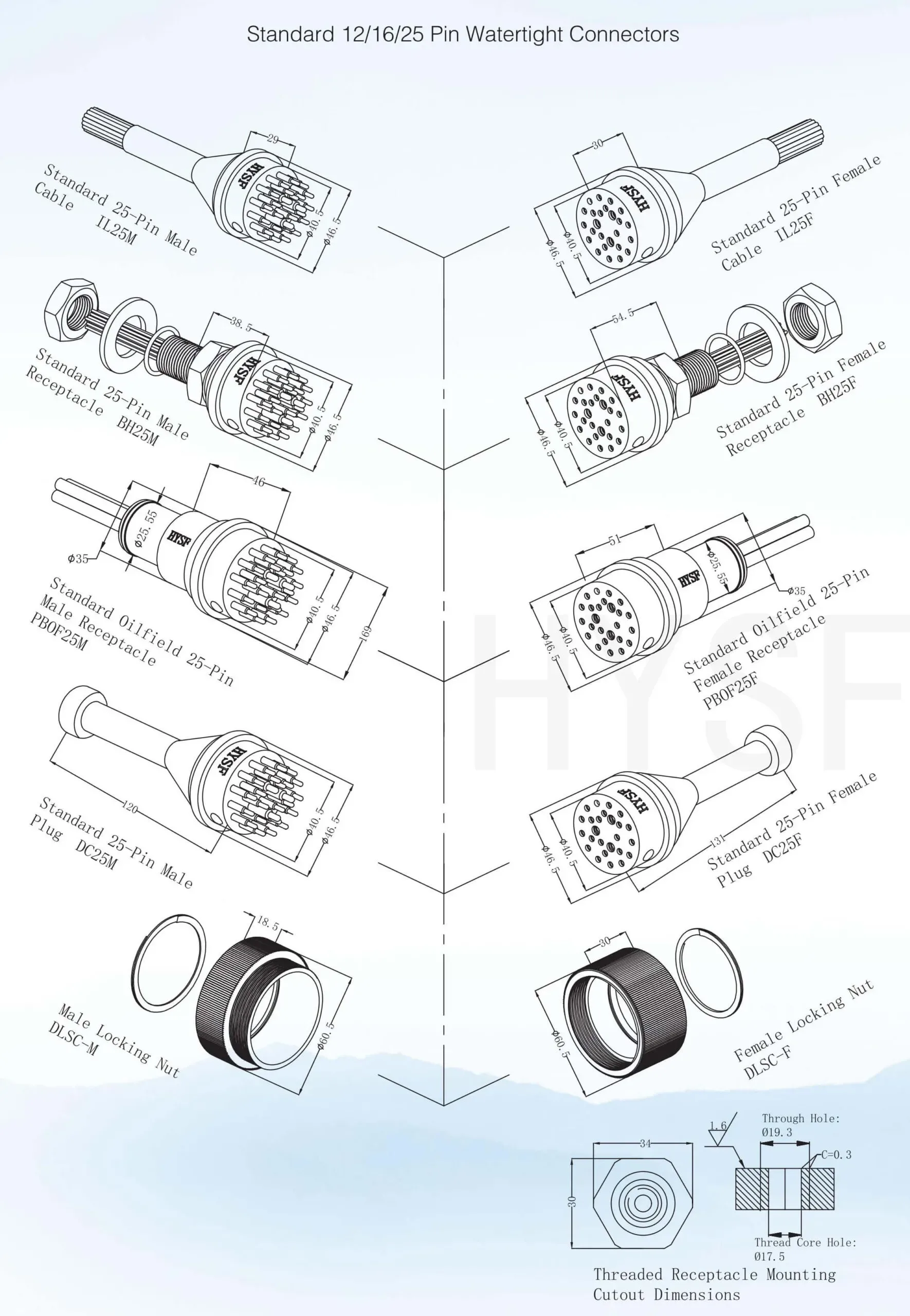
Standard 12/16/25 Pin Watertight Connectors are designed for applications where multiple electrical circuits need to be combined into a compact, environmentally protected connection. Their multi-pin configuration makes them suitable for subsea equipment, marine robotics, offshore systems, oceanographic instruments, and industrial machinery exposed to harsh environments.
What Are 12, 16, and 25 Pin Waterproof Connectors?
Multi-pin waterproof connectors provide multiple electrical contacts within a single sealed connector assembly. The 12-pin and 16-pin versions can support higher current per contact in many subsea designs, while 25-pin configurations are useful when a system requires a greater number of signal and power connections in a single interface.
For example, SubConn circular 12- and 16-contact connectors are specified for up to 10 A per contact, while their 25-contact configuration combines power and signal contacts with different current ratings.
This combination of high contact density and environmental protection can help reduce the number of separate connectors required inside compact equipment.
Why Watertight Protection Matters
Water ingress can cause corrosion, insulation problems, short circuits, and eventual connector failure. The risk becomes even greater in subsea applications where hydrostatic pressure increases significantly with depth.
Standard 12/16/25 Pin Watertight Connectors are therefore engineered with sealing systems and materials intended to prevent water from reaching sensitive electrical contacts. Depending on the connector design, features can include molded elastomer bodies, O-ring seals, sealed contact interfaces, and pressure-resistant bulkhead constructions.
Some subsea connector specifications demonstrate extremely high pressure capabilities. For instance, certain 12- and 16-contact SubConn circular configurations have a design depth rating of 1,400 bar, while the 25-contact version is rated to 700 bar.
Subsea Applications
One of the most important uses for these connectors is underwater equipment. Remotely operated vehicles (ROVs), autonomous underwater vehicles (AUVs), oceanographic instruments, subsea sensors, and underwater monitoring equipment require dependable electrical interfaces.
In an ROV, a multi-pin connector may carry power, control signals, sensor information, and communication circuits between different components. A consolidated connector arrangement can simplify system architecture while reducing the physical space needed for multiple interfaces.
Wet-mateable designs are particularly valuable because they can allow electrical connections to be made or disconnected underwater without first returning the equipment to a dry environment.
Industrial and Harsh-Environment Applications
Waterproof multi-pin connectors are not limited to deep-sea equipment. They can also be used in industrial environments where electrical systems are exposed to moisture, dust, vibration, chemicals, salt spray, or temperature fluctuations.
Typical applications include:
- Offshore energy equipment
- Marine instrumentation
- ROV and AUV systems
- Subsea sensors
- Oceanographic research equipment
- Industrial control systems
- Underwater cameras
- Hydraulic and electrical monitoring equipment
- Naval and defense systems
- Remote monitoring platforms
Industrial connector requirements can vary significantly depending on the application. Connectors designed for harsh environments may use sealed housings and corrosion-resistant materials to protect internal electrical connections from external conditions.
Electrical Performance and Contact Configuration
Choosing a connector requires more than checking the pin count. Engineers should evaluate voltage rating, current capacity, insulation resistance, contact resistance, and the intended combination of power and signal circuits.
For example, some established circular subsea connector specifications provide a 600 V AC/DC rating, insulation resistance above 200 MΩ, and contact resistance below 0.01 Ω. Their 12- and 16-contact configurations can support up to 10 A per contact, while 25-contact versions may combine power contacts with lower-current signal contacts.
These specifications demonstrate why connector selection should always be based on the actual electrical requirements of the equipment.
Materials Used in Waterproof Connectors
Material selection has a direct effect on connector durability. Subsea connectors commonly use elastomeric materials for the connector body combined with metals selected for electrical conductivity and resistance to marine conditions.
Depending on the design, bulkhead bodies may be manufactured from materials such as stainless steel, brass, titanium, anodized aluminum, or PEEK. Gold-plated contacts are also used in some designs to provide reliable electrical performance and help resist corrosion.
For demanding offshore installations, engineers should consider not only electrical specifications but also galvanic compatibility, mechanical strength, chemical exposure, and expected operating temperature.
Choosing the Right Pin Configuration
The choice between 12, 16, and 25 pins depends primarily on the number and type of circuits that must pass through the connector.
A 12-pin connector may be suitable for systems requiring a moderate number of power or signal connections. A 16-pin connector can provide additional circuit capacity while retaining a relatively compact interface. A 25-pin connector can be advantageous where high-density signal routing is required.
Standard 12/16/25 Pin Watertight Connectors can therefore provide flexibility across different equipment architectures, but engineers should verify current requirements, voltage, mating conditions, pressure rating, connector dimensions, and cable specifications before selecting a particular configuration.
Wet-Mateable vs. Dry-Mate Connectors
Another important consideration is whether the connector needs to be mated underwater.
Wet-mateable connectors are designed for environments where equipment may need to be connected while submerged. Their sealing geometry and contact arrangement are engineered to manage moisture during the mating process.
Dry-mate connectors, meanwhile, are generally connected in controlled, dry conditions and may be better suited to equipment that can be removed from the water before servicing.
For subsea equipment that requires frequent deployment or maintenance, wet-mate capability can significantly improve operational flexibility.
Installation and Maintenance Considerations
Even a high-quality waterproof connector can perform poorly if it is incorrectly installed or maintained. Before installation, engineers should inspect contact surfaces, sealing elements, cable jackets, locking mechanisms, and mating interfaces.
Connectors should be protected from unnecessary mechanical loads, excessive bending, contamination, and improper mating. Manufacturers may also specify particular handling procedures, torque requirements, storage conditions, and maintenance practices.
Regular inspection is especially important for equipment operating in saltwater because marine exposure can accelerate corrosion and degrade sealing components over time.
Conclusion
Reliable electrical connectivity is essential for industrial, marine, and subsea equipment operating in harsh environments. A properly selected multi-pin connector can provide dependable power and signal transmission while protecting electrical interfaces against water, pressure, vibration, and other environmental stresses.
Standard 12/16/25 Pin Watertight Connectors offer a practical solution for systems that require multiple electrical circuits within a compact, environmentally protected interface. By evaluating pin configuration, electrical ratings, pressure requirements, materials, mating method, and environmental conditions, engineers can select a connector that better matches the demands of their application.
The right connector is ultimately one that combines electrical performance, mechanical reliability, sealing capability, and long-term environmental resistance rather than simply matching the required number of pins.