
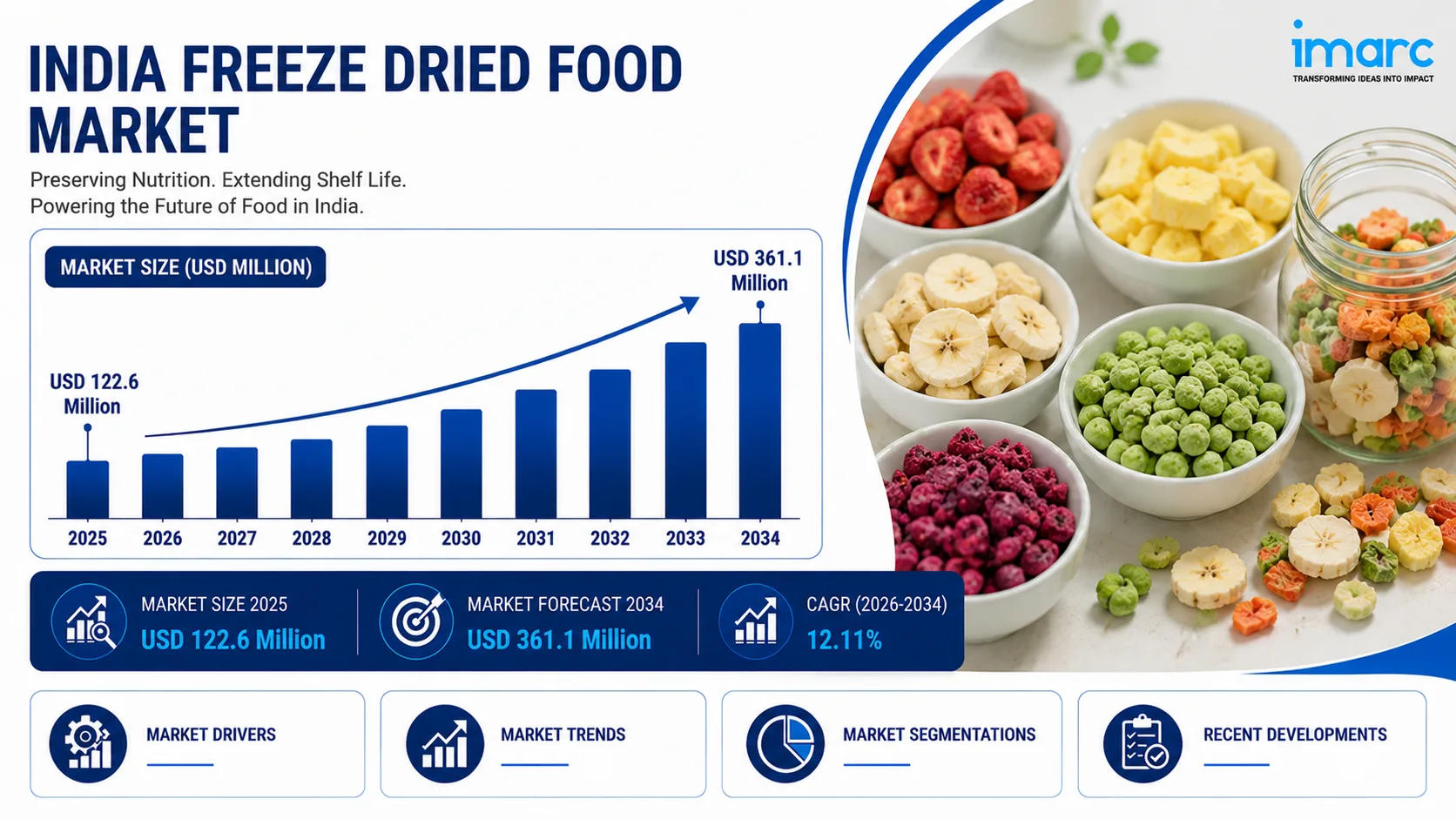
According to IMARC Group's report titled "India Freeze Dried Food Market Size, Share, Trends and Forecast by Type, Distribution Channel, End User, and Region, 2026-2034", the report offers a comprehensive analysis of the industry, including market share, forecast, growth, and regional insights.
India's freeze dried food market reached USD 122.6 Million in 2025 and is projected to reach USD 361.1 Million by 2034 nearly tripling in value at a CAGR of 12.11%. Busier urban lifestyles, growing health consciousness, expanding e-commerce infrastructure, and deepening food and beverage industry adoption of freeze-drying technology are collectively reshaping consumer and institutional demand for convenient, nutrient-retaining, long-shelf-life food products.
- Market scale: USD 122.6 Million in 2025 → USD 361.1 Million by 2034 at 12.11% CAGR.
- Urban convenience megatrend: Working professionals and millennials increasingly prefer ready-to-eat, easy-to-store alternatives with freeze-dried foods' ability to retain flavor, texture, and nutritional value without synthetic preservatives driving differentiated adoption over conventional packaged food categories.
- Sahyadri Farms USD 46 Million Series B (December 2024): GEF Capital Partners-led fundraise with FMO, Proparco, Incofin, and Korys as investors earmarking capital for improved packhouse facilities, freeze-dried food processing, IQF processing, and aseptic food processing across fruits, vegetables, and juice concentrates.
- Bowlful's lyophilization launch (July 2023): Freeze-dried ready-to-eat products using lyophilization to preserve original nutrition, flavor, and texture positioning freeze-dried meals as a portable, long-lasting healthy alternative to conventional preservation formats for time-constrained urban consumers.
- Swiggy-Confluent partnership (March 2025): Swiggy extended its real-time data processing capabilities through Confluent to guarantee timely deliveries and personalized services for millions of users reflecting how digital food delivery infrastructure is strengthening distribution velocity for innovative formats including freeze-dried products.
The Strategic Market Challenge: Navigating the Freeze Dried Food Market
Capital intensity of lyophilization infrastructure is the primary barrier with freeze-drying equipment demanding significant upfront investment that creates scale thresholds below which unit economics remain unfavorable for smaller manufacturers. Consumer awareness of freeze-dried food benefits versus conventional packaged alternatives is still developing outside metro cities, requiring sustained marketing and education investment. Raw material sourcing consistency particularly for premium freeze-dried fruits, vegetables, and proteins creates quality variability risk in a category where sensory consistency drives repeat purchase behavior among health-conscious urban consumers.
➤ Access Industry-Focused Insights and Future Forecasts - Request Sample Report
India's Strategic Vision for the Freeze Dried Food Market:
- FSSAI regulatory engagement: Ms. Inoshi Sharma, Executive Director of FSSAI, spoke at the 4th India Plant-Based Foods Show at AAHAR International Food and Hospitality Fair in March 2024 signaling active regulatory support for food innovation including clean-label and plant-based categories where freeze-drying plays a central preservation role.
- APEDA export development support: Abhishek Dev, Chairman of APEDA, participated in the same industry event reflecting government alignment between food processing innovation and agricultural export development, with freeze-dried fruits and vegetables representing a high-value export format for Indian producers.
- Food processing infrastructure investment: Government schemes supporting food processing enterprise development are enabling manufacturers to invest in value-added freeze-drying capability with Sahyadri Farms' December 2024 Series B directly allocating capital toward expanding processing facilities in a government-aligned farmer-led model.
- Plant-based and clean-label policy tailwinds: PBFIA's 4th India Plant-Based Foods Show convening 40-plus global startups and 35-plus industry speakers in March 2024 demonstrates organized institutional momentum behind plant-based food processing innovation creating demand for freeze-drying as a preservation method aligned with clean-label, minimally processed product positioning.
Why Invest in the India Freeze Dried Food Market: Key Growth Drivers & ROI
- Convenience and nutrition convergence creating structural demand: India's dual-income household expansion and time-constrained urban lifestyle normalization are driving consistent demand for food solutions that do not compromise nutritional integrity for convenience. Freeze-dried products preserving up to 98% of original nutrients through lyophilization while eliminating synthetic preservatives are uniquely positioned at this intersection, creating a premium yet health-aligned proposition that conventional packaged food cannot replicate.
- Food and beverage industry B2B adoption providing volume and margin stability: Bakery, confectionery, dairy, snack, quick-service restaurant, and cloud kitchen operators are incorporating freeze-dried ingredients for superior product quality, extended shelf life, and operational waste reduction providing manufacturers with predictable, volume-based B2B procurement revenue alongside more variable direct consumer retail sales.
- E-commerce and supermarket channel expansion democratizing access: Growing supermarket and hypermarket networks and rapidly expanding e-commerce grocery platforms are improving product visibility, consumer trial, and repeat purchase accessibility reducing the distribution barriers that previously limited category reach to premium metropolitan specialty retail channels.
- Sahyadri Farms' USD 46 Million investment confirming institutional confidence: Development finance institutions FMO and Proparco alongside private equity GEF Capital Partners investing USD 46 Million in a farmer-led freeze-dried food processing company in December 2024 signals that international impact capital views India's freeze-dried food sector as a structurally sound investment with both commercial returns and agricultural value-chain development credentials.
India Freeze Dried Food Market Trends & Future Outlook:
- Freeze-dried fruits lead type demand, driven by snacking applications, ingredient use in bakery and confectionery, and consumer preference for natural, whole-food format healthy snacks over synthetic vitamin-fortified alternatives.
- Food and beverage industry end-user segment is the highest-value B2B demand channel with quick-service restaurants and cloud kitchens leveraging freeze-dried ingredients for operational efficiency and consistent output quality across multiple locations.
- Supermarkets and hypermarkets lead distribution as organized retail cold-adjacent shelf space enables freeze-dried food product placement alongside fresh and frozen alternatives with specialist retailers adding premium channel access for health-conscious urban consumer segments.
- North, South, East, and West India regional markets each present distinct demand profiles with South India's health-conscious Bengaluru and Hyderabad consumer base and North India's large working professional urban population representing the highest near-term penetration opportunities.
- Lyophilization technology cost reduction is progressively improving unit economics enabling manufacturers to serve mid-market price points previously accessible only to premium segment consumers, expanding the total addressable freeze-dried food consumer base.
➤ Explore the Full Report with Charts, Table of Contents, and List of Figures
Regulatory Landscape & Policy Catalysts in India:
- FSSAI food safety and labeling framework governing freeze-dried product classification, shelf-life declaration, and nutritional claim standards creates the compliance infrastructure that organized manufacturers need for retail and institutional channel procurement rewarding certified brands over unregulated alternatives.
- APEDA export promotion schemes are supporting Indian freeze-dried fruit and vegetable producers in accessing international markets with high-value freeze-dried export formats commanding premium pricing that supplements domestic market revenue and sustains production scale investment.
- 4th India Plant-Based Foods Show ecosystem (March 2024) convening 40-plus global startups, FSSAI, and APEDA leadership created an organized platform for innovation and collaboration accelerating freeze-drying technology adoption within India's broader food processing modernization agenda.
- Food processing PLI and SAMPADA scheme support enabling manufacturer investment in lyophilization equipment and cold-chain adjacent processing infrastructure reducing the capital intensity barrier that limits freeze-dried food sector participation to well-capitalized players.
- E-commerce and digital retail policy expanding logistics network depth and digital payment infrastructure into Tier-2 cities is improving last-mile distribution reach for freeze-dried food brands enabling online-first distribution strategies that reduce dependence on physical specialty retail infrastructure.
- Agricultural value-chain development programs supporting farmer-linked food processing as exemplified by Sahyadri Farms' farmer-led model are creating institutional support structures that align freeze-dried food processing investment with government agricultural productivity and rural income development objectives.
Market Segmentations:
Type Insights:
- Freeze-Dried Fruits
- Freeze-Dried Vegetables
- Freeze-Dried Beverages
- Freeze-Dried Dairy Products
- Freeze-Dried Meat and Seafood
- Others
Distribution Channel Insights:
- Supermarkets and Hypermarkets
- Specialist Retailers
- Convenience Stores
- Others
End User Insights:
- Hotels and Restaurants
- Household
- Food and Beverage Industry
- Others
Regional Insights:
- North India
- South India
- East India
- West India
By the IMARC Group, the Top Competitive Landscape & their Positioning:
Covering an in-depth analysis of the competitive landscape, market structure, key player positioning, competitive dashboards, top winning strategies, and detailed profiles of all major industry participants you will gain access to all these exclusive insights within the full research report.
Note: If you need specific information that is not currently within the scope of the report, we can provide it to you as a part of the customization.
➤ Tailor the Research to Your Exact Business Needs - Request Customization
Frequently Asked Questions (FAQs):
Q1: What is the current value and projected growth of the India Freeze Dried Food Market?
According to IMARC Group, the India freeze dried food market reached USD 122.6 Million in 2025 and is projected to reach USD 361.1 Million by 2034, growing at a CAGR of 12.11%, driven by urban convenience demand, health awareness, food and beverage industry adoption, and expanding e-commerce distribution.
Q2: What types, distribution channels, and end users does the market cover?
Types include freeze-dried fruits, vegetables, beverages, dairy products, meat and seafood, and others. Distribution spans supermarkets and hypermarkets, specialist retailers, and convenience stores. End users cover hotels and restaurants, households, and the food and beverage industry with the food and beverage B2B segment providing the most volume-stable procurement demand.
Q3: What is lyophilization and why does it matter for this market?
Lyophilization or freeze-drying removes moisture through sublimation while preserving up to 98% of original nutritional content, flavor, and texture. Unlike conventional heat-based drying methods, lyophilization retains sensory and nutritional integrity making it the defining technology that differentiates freeze-dried products from commodity packaged food alternatives and justifies consumer and institutional premium pricing.
Q4: What recent developments signal India's freeze dried food market growth trajectory?
In December 2024, Sahyadri Farms raised USD 46 Million in a Series B round led by GEF Capital Partners to expand freeze-dried and IQF food processing facilities. In July 2023, Bowlful launched lyophilization-based ready-to-eat products for time-constrained urban consumers. In March 2025, Swiggy partnered with Confluent for real-time data processing deepening digital distribution infrastructure that benefits innovative food format categories.
Q5: What are the primary growth opportunities and constraints through 2034?
Opportunities include urban convenience and nutrition convergence, B2B food and beverage industry ingredient adoption, e-commerce geographic expansion, APEDA-supported export market development, and lyophilization technology cost reduction enabling mid-market pricing. Constraints are high lyophilization equipment capital intensity, limited consumer awareness outside metro cities, and raw material sourcing consistency challenges for premium product formats.
Strategic Insight & Verdict
India's freeze dried food market is at an early commercial inflection with institutional investor confidence from Sahyadri Farms' USD 46 Million Series B, FSSAI and APEDA regulatory engagement, and consumer lifestyle convergence creating aligned demand and supply-side growth signals simultaneously. Based on our analysis, we at IMARC Group have observed that manufacturers combining lyophilization technology capability, B2B food industry supply relationships, and e-commerce distribution reach are best placed to capture value as the market scales toward USD 361.1 Million by 2034.
Verified Data Source: India Freeze Dried Food Market Report by IMARC Group