
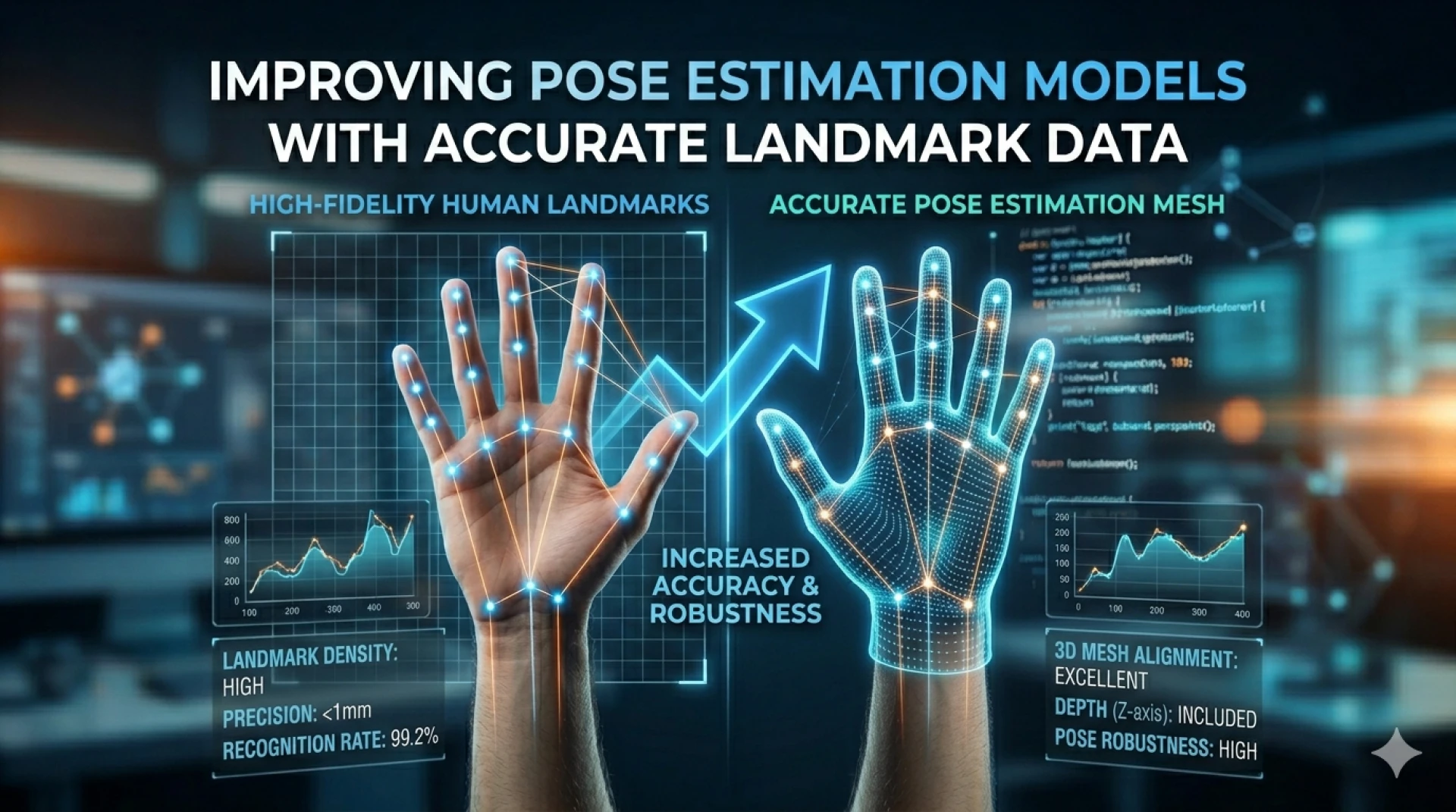
In the rapidly evolving field of computer vision, pose estimation has emerged as a foundational capability powering applications such as fitness tracking, gesture recognition, healthcare diagnostics, augmented reality, and autonomous systems. At the core of every high-performing pose estimation model lies one critical component: accurate landmark data. Without precise and consistent landmark annotation, even the most advanced algorithms struggle to deliver reliable results.
At Annotera, we understand that the quality of training data directly influences model performance. As a trusted data annotation company, we specialize in delivering high-precision landmark annotation services that enhance pose estimation accuracy across diverse use cases.
Understanding Pose Estimation and Landmark Data
Pose estimation refers to the process of detecting and tracking key points (landmarks) on a human body or object within an image or video. These landmarks typically represent joints such as elbows, knees, wrists, hips, and shoulders. By connecting these points, models can infer posture, movement, and spatial orientation.
Landmark annotation is the process of labeling these key points manually or semi-automatically to create structured datasets. These datasets are then used to train machine learning models to recognize similar patterns in unseen data.
However, the effectiveness of pose estimation models depends heavily on how accurately these landmarks are annotated. Poor-quality annotations can lead to incorrect predictions, reduced generalization, and ultimately, unreliable applications.
Why Accurate Landmark Annotation Matters
1. Enhances Model Precision
Accurate landmark data ensures that models learn the correct spatial relationships between body joints. When annotations are consistent and precise, models can better understand subtle variations in human movement, leading to improved prediction accuracy.
2. Reduces Model Bias
Inconsistent or poorly labeled datasets can introduce bias into pose estimation systems. High-quality landmark annotation minimizes discrepancies, ensuring that models perform well across different body types, poses, and environments.
3. Improves Generalization
Models trained on accurately annotated datasets are more robust and adaptable to real-world scenarios. This is especially important for applications such as sports analytics and healthcare, where precision is non-negotiable.
4. Enables Real-Time Performance
Efficient pose estimation systems rely on well-structured training data. Accurate annotations reduce noise in the dataset, allowing models to process inputs faster and deliver real-time insights.
Challenges in Landmark Annotation for Pose Estimation
Despite its importance, landmark annotation is a complex and resource-intensive process. Some of the key challenges include:
Occlusion and Visibility Issues
When body parts are partially hidden or overlapping, annotators must make informed decisions about landmark placement. This requires domain expertise and clear annotation guidelines.
Complex Poses and Angles
Extreme body positions, rotations, or motion blur can make it difficult to identify precise joint locations.
Consistency Across Annotators
Maintaining uniformity in annotations across large datasets is critical. Variations in labeling standards can negatively impact model training.
Scalability
As AI projects grow, managing large volumes of annotated data becomes challenging without efficient workflows and tools.
This is where partnering with an experienced image annotation company like Annotera becomes essential.
Best Practices for High-Quality Landmark Annotation
To improve pose estimation models, organizations must adopt structured annotation strategies. Below are key best practices:
1. Define Clear Annotation Guidelines
Establishing detailed guidelines ensures consistency across annotators. These should include instructions for handling occlusions, edge cases, and ambiguous scenarios.
2. Use Skilled Annotators
Human expertise plays a critical role in landmark annotation. Trained annotators with domain knowledge can accurately identify complex poses and ensure high-quality outputs.
3. Implement Multi-Level Quality Checks
Quality assurance should involve multiple validation stages, including peer reviews and automated checks. This minimizes errors and maintains dataset integrity.
4. Leverage Advanced Annotation Tools
Modern annotation platforms offer features such as AI-assisted labeling, interpolation, and real-time validation. These tools improve efficiency while maintaining accuracy.
5. Ensure Dataset Diversity
Training datasets should include variations in age, gender, body types, clothing, lighting conditions, and backgrounds. This helps models generalize better in real-world environments.
The Role of Data Annotation Outsourcing
For many organizations, building in-house annotation teams can be time-consuming and costly. Data annotation outsourcing provides a scalable and cost-effective alternative.
By partnering with a specialized data annotation company like Annotera, businesses gain access to:
- Skilled annotation professionals
- Scalable workflows
- Advanced annotation tools
- Robust quality assurance processes
Outsourcing not only accelerates project timelines but also ensures consistent and high-quality annotations.
Similarly, image annotation outsourcing allows companies to focus on core AI development while delegating data preparation tasks to experts. This approach is particularly beneficial for large-scale pose estimation projects requiring thousands or millions of annotated frames.
How Annotera Improves Pose Estimation Outcomes
At Annotera, we take a precision-driven approach to landmark annotation. Our methodology is designed to maximize model performance and reliability.
Domain-Specific Expertise
Our annotators are trained across various industries, including healthcare, sports, retail, and robotics. This enables us to handle complex pose estimation requirements with accuracy.
Customized Annotation Workflows
We tailor annotation processes based on project needs, ensuring alignment with model objectives and use cases.
Advanced Quality Control
Our multi-tier QA framework ensures that every annotation meets strict accuracy standards. We combine human review with automated validation for optimal results.
Scalable Infrastructure
Whether you need a small dataset or large-scale annotation support, our infrastructure is built to scale seamlessly.
Secure Data Handling
We prioritize data security and confidentiality, ensuring that client datasets are handled with the highest level of protection.
Applications of Improved Pose Estimation
Accurate landmark data significantly enhances the performance of pose estimation models across various industries:
Healthcare
Pose estimation is used for physical therapy, posture correction, and movement analysis. Accurate landmark annotation ensures reliable diagnostics and patient monitoring.
Sports Analytics
Athletes and coaches rely on pose estimation to analyze performance and prevent injuries. High-quality annotations enable precise motion tracking.
Fitness and Wellness
Fitness apps use pose estimation for real-time feedback and exercise tracking. Accurate models improve user experience and engagement.
Human-Computer Interaction
Gesture recognition systems depend on precise landmark data to interpret user inputs effectively.
Autonomous Systems
Robots and autonomous vehicles use pose estimation to understand human movement and ensure safe interactions.
Future Trends in Landmark Annotation
As AI continues to evolve, landmark annotation is also advancing. Key trends include:
- AI-Assisted Annotation: Combining human expertise with machine learning to accelerate labeling processes
- 3D Pose Estimation: Moving beyond 2D landmarks to capture depth and spatial relationships
- Synthetic Data Generation: Using simulated environments to create annotated datasets
- Real-Time Annotation Feedback: Enhancing accuracy through instant validation mechanisms
Despite these advancements, human-in-the-loop annotation remains essential for ensuring high-quality outputs.
Conclusion
Improving pose estimation models begins with one fundamental element: accurate landmark data. From enhancing precision and reducing bias to enabling real-time performance, high-quality annotation plays a pivotal role in model success.
However, achieving this level of accuracy requires expertise, scalable processes, and rigorous quality control. This is why many organizations turn to data annotation outsourcing and image annotation outsourcing to meet their needs efficiently.
As a leading data annotation company, Annotera is committed to delivering reliable and precise landmark annotation services that empower AI models to perform at their best. By combining human expertise with advanced tools and robust workflows, we help businesses unlock the full potential of pose estimation technology.
If your goal is to build high-performing pose estimation systems, investing in accurate landmark annotation is not optional—it is essential.