I wasn't shopping for furniture that day. I was just scrolling, half-distracted, the way most parents do during the ten free minutes between dinner and bedtime chaos. My son had just turned three, and like every parent of a toddler, I had this quiet, nagging thought in the back of my mind: should we get him a study table? Not because he needed one, but because it felt like the "right" next step. A little desk, a little chair, maybe a lamp — the whole picture-perfect setup you see in parenting magazines.
Then I saw it. Not a table. A board for kids.
It stopped my scroll instantly. It wasn't what I was looking for, but somehow it made more sense than anything I'd seen in weeks of half-hearted furniture browsing. I sat there for a moment, genuinely surprised at how quickly my priorities shifted from "what looks like a proper study setup" to "what will actually get used every day." That small shift in thinking ended up changing the entire decision.
The Problem with a Traditional Study Table for Toddlers
Why Standard Study Tables Feel Wrong for Ages 2–4
Here's the thing nobody tells you before you become a parent: toddlers don't sit still. They don't "study." At three years old, my son's idea of learning is smearing crayon across paper, stacking blocks until they topple, and asking the same question fourteen times in a row. A study table assumes a kind of stillness and focus that simply doesn't exist yet at this age. The height is often wrong, the chair rarely holds their attention, and within a week, most toddler desks become expensive places to pile toys instead of places to learn.
I've talked to other parents who went through the same cycle: buy the table, get excited for the first two days, and then watch it slowly turn into a shelf for stuffed animals. It's not that the table itself is a bad product — it's that it's designed around an assumption of readiness that most three-year-old’s simply haven't reached yet.
Common Parenting Mistakes When Buying Furniture Too Early
I'll admit it — I almost made the mistake myself. I wanted to buy for the child I imagined he'd become, not the child actually in front of me. That's a common trap. We buy furniture based on aspiration: we picture a focused five-year-old doing homework, when the reality is a three-year-old who wants to move, touch, and explore constantly. A traditional study table often becomes a purchase made too early, for a stage that hasn't arrived yet.
The Moment of Discovery — What Made the Board Different
First Impression — Why It Caught My Attention
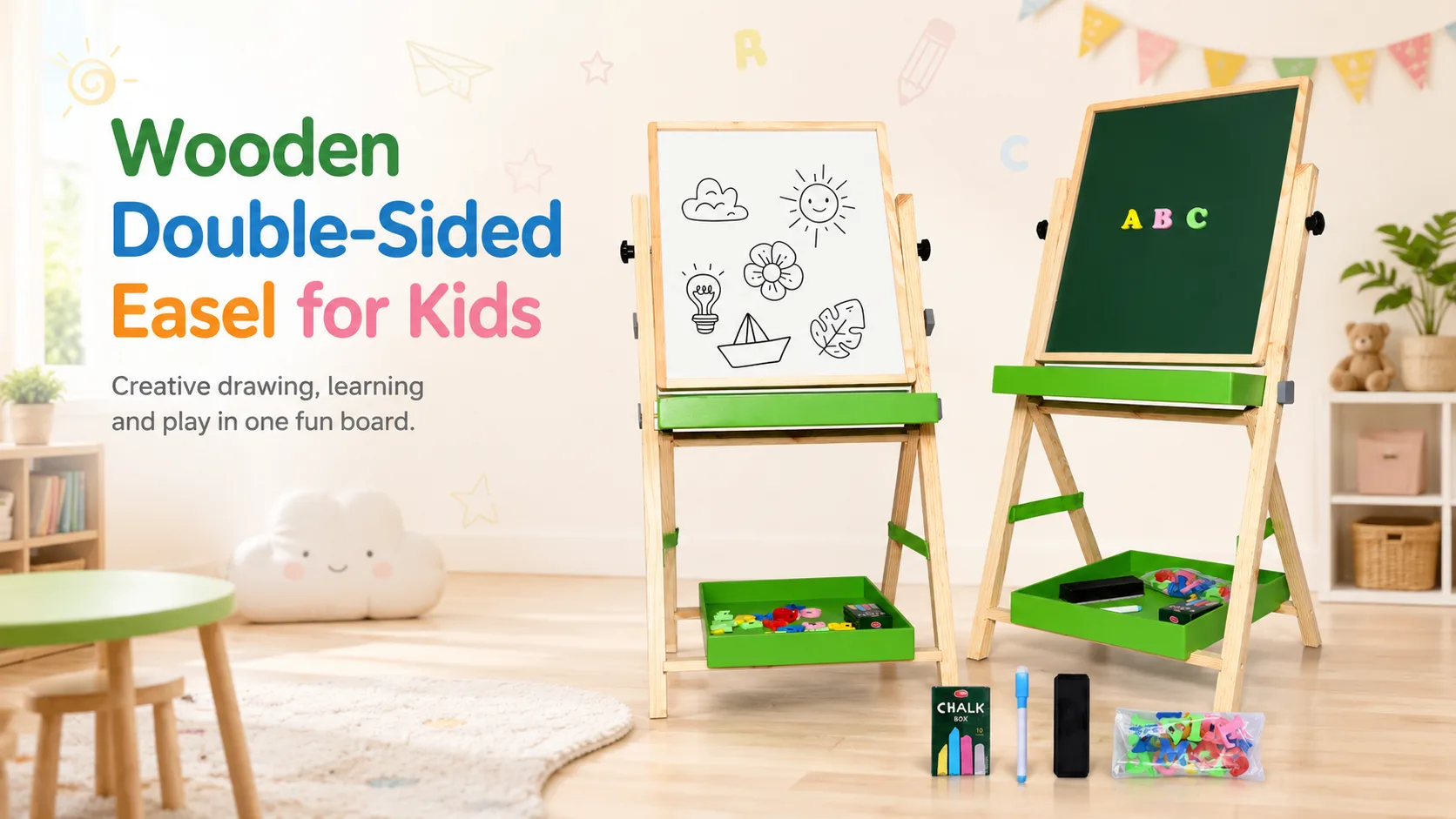
What caught my eye wasn't just the design, though it was undeniably appealing — bright, compact, clearly built with a toddler's hands in mind. It was the size and simplicity. No chair required. No fixed corner of the room permanently claimed. Just a board for kids that could sit on the floor, on a low table, or be propped up wherever my son happened to be playing that day. The listing was from a brand called Chanak, one I hadn't come across before, but the product itself did the convincing long before the name did.
What Made It Practical Instead of Just Cute
The more I looked into it, the more I realized this wasn't just a pretty toy — it solved the exact problem I was trying to solve with a study table, just from a completely different angle. It had a drawing surface, a writing surface, and small storage for chalk and markers. It gave my son a dedicated space to create and learn without demanding that he behave like a student twice his age. That's when it clicked: a board for kids can do everything a table promises, without asking a toddler to be someone he isn't yet.
I also noticed how naturally it invited interaction. There was no instruction manual needed, no explaining "this is where you sit and do your work." He simply walked up, picked up a piece of chalk, and started drawing — no prompting required. That kind of instant, unforced engagement is exactly what a study table had never managed to offer in any of the setups I'd seen friends try.
Why a Board Works Better Than a Table for a 3-Year-Old
Developmental Fit
Toddlers learn through movement, repetition, and play — not through sitting at a desk. A board matches that rhythm naturally. My son could stand, kneel, or sit cross-legged in front of it, switching positions as often as he wanted. The board supported the kind of fine motor practice — scribbling, tracing shapes, stacking magnetic pieces — that actually matters at this age, without forcing a "desk posture" he wasn't ready for.
Space and Flexibility at Home
We live in a fairly modest apartment, and a full study table setup would have eaten into space we genuinely can't spare. A board for kids, by comparison, is light, foldable, and easy to tuck away. Some mornings it lives in the living room; other days it moves to his bedroom. That flexibility alone made it feel far more realistic for our home than a bulky, fixed piece of furniture.
Cost and Longevity
There was also a practical, less romantic reason this made sense: cost. A decent study table and chair set isn't cheap, and toddlers outgrow furniture sized for their age within a year or two. A board for kids, on the other hand, cost a fraction of that price and, based on how other parents described it, tends to stay useful for years — evolving from a scribble board at three to a drawing and practice board well into early school age.
When I actually broke down the math, it made even more sense. A table and chair set often needs replacing as a child grows taller, while a board simply adjusts to however the child chooses to use it that day — sitting, kneeling, or standing. Over a few years, that single purchase quietly outlasts furniture that costs two or three times as much.
Features to Look for in a Good Board for Kids
If you're considering something similar, a few features are worth checking carefully before you buy. Ours happened to be a Chanak board, and comparing it with a few others online, these are the qualities that consistently stood out as worth prioritizing.
Safety Features
Rounded edges are non-negotiable at this age. Look for non-toxic materials, and check that the board is stable enough that it won't tip over easily when a toddler leans on it or grabs an edge.
Learning-Friendly Design
The best boards for kids offer dual-purpose surfaces — one side for chalk, one for markers or magnetic letters, for example. This variety keeps a short attention span engaged far longer than a single flat surface would.
Durability and Ease of Cleaning
Toddlers are messy by nature, so a washable, easy-to-wipe surface matters more than it sounds. Spills, scribbles, and sticky fingers are part of daily life, and the board needs to handle that without wearing down quickly.
Adjustability
Some boards come with adjustable stands or multiple positions, allowing the same board to be used lying flat on the floor for younger toddlers, or slightly propped up as they get a bit older and start sitting more upright.
How This Changed Our Daily Routine
Before vs. After
Before the Chanak board, our "learning time" was scattered and unstructured — a coloring book here, a stray marker there, usually ending with crayon marks on the wall. After introducing the board, there was suddenly a clear, consistent spot he associated with drawing and practicing letters. It wasn't rigid or scheduled; it simply gave his scattered energy a place to land.
Unexpected Benefits Noticed Over Time
What surprised me most was how much longer he'd stay engaged in short bursts of independent play. He wasn't forced to sit through a "lesson," but he'd return to the board on his own, several times a day, without being asked. That kind of self-directed interest is hard to manufacture with a traditional desk setup at this age.
Tips for Parents Considering the Same Switch
If you're weighing the same decision I was, a few thoughts worth keeping in mind:
- Don't introduce a board for kids as a "study" tool with rigid expectations — let it stay playful.
- Keep expectations age-appropriate; this stage is about exploration, not academics.
- Choose based on your actual living space and budget, not an idealized version of what a "learning corner" should look like.
- Watch what naturally holds your child's attention before committing to a specific style or size.
Conclusion — Why the Board Won Over the Table
I didn't walk into this looking for a board for kids — I was fully prepared to buy a study table, because that's what felt like the expected next step. But the more I compared the two, the clearer it became that a board fit our son's actual stage of development, our space, and our budget far better than a table ever could have. In our case, that board happened to be from Chanak, though the bigger lesson here is really about the type of product, not just the brand.
Sometimes the best purchase isn't the one you planned for — it's the one that actually matches the child in front of you, right now, not the one you imagine they'll become.
FAQs
1. Is a board for kids really better than a study table for a 3-year-old?
For toddlers, yes — a board for kids matches how they naturally learn (through movement and play) far better than a fixed desk setup does.
2. What age is ideal for switching from toys to a learning board?
Most parents find that a board for kids works well starting around 2–3 years old, once a child begins showing interest in drawing, scribbling, or tracing shapes.
3. What should I look for when buying a board for kids?
Prioritize rounded edges, non-toxic materials, a washable surface, and dual-purpose design (like chalk on one side and markers on the other).
4. Can a board for kids replace a study table completely?
For toddlers and preschoolers, yes — a board covers the same learning goals without requiring a chair, fixed space, or the "sit and study" behavior a table assumes. As they grow older and need to write more formally, a table may become useful alongside it.
5. Is a board for kids a good long-term investment?
Generally yes — unlike toddler-sized furniture that gets outgrown quickly, a good board for kids can be used for years, adapting as a child's activities become more advanced.