For the past few months, I have been looking closely at the Software Developer job market in India.
Like many job seekers, I assumed that opportunities would be spread fairly evenly across the country’s major cities. Bangalore, Hyderabad, Pune, Chennai, Gurugram, Noida and Mumbai all have strong technology ecosystems, so I expected the difference between them to be noticeable.
Once I started analysing active job listings, the picture looked very different.
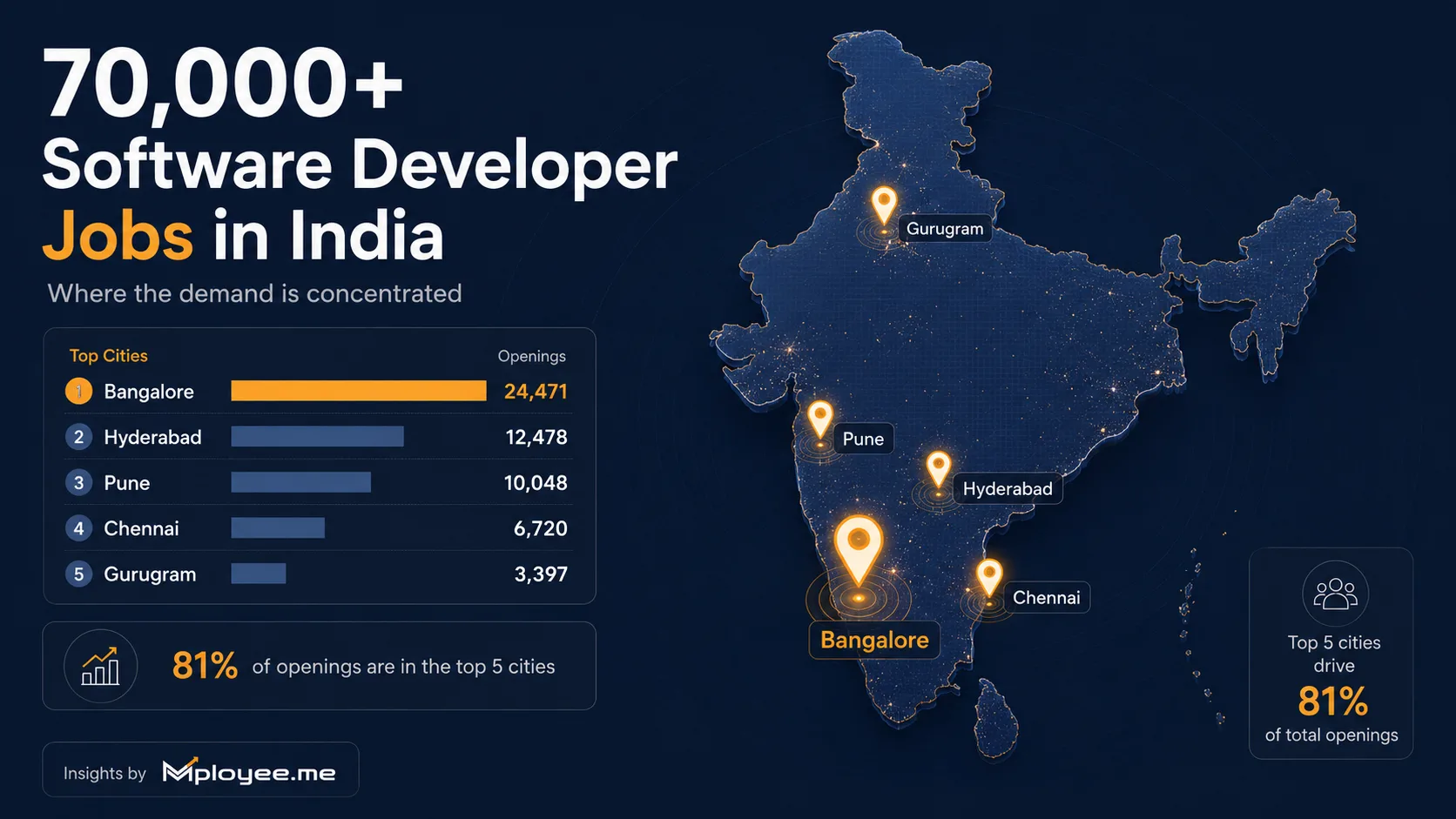
At the time of the analysis, there were 70,621 active Software Developer openings across India. The total number was impressive, but the location wise distribution was what really caught my attention.
Nearly 81% of these openings were concentrated in just five cities.
Bangalore was far ahead with 24,471 active jobs. Hyderabad came next with 12,478 openings, followed by Pune with 10,048. Chennai had 6,720 active roles, while Gurugram had 3,397.
To put this into perspective, Bangalore had almost twice as many openings as Hyderabad. It also had more than seven times the number of opportunities available in Gurugram.
These numbers made me think differently about how people search for jobs.
Most candidates begin with a very narrow search. They select their current city, enter a job title and repeatedly check the same two or three job portals. However, restricting the search to one location may also mean overlooking thousands of relevant opportunities elsewhere.
That does not mean every candidate should immediately move to Bangalore or Hyderabad. Location is only one part of the decision. Remote and hybrid roles, living costs, family responsibilities and long-term career goals also matter.
There was another important point in the data.
A large number of listings does not automatically mean a large number of suitable opportunities.
Two jobs may have the same title but require completely different skills. One Software Developer role may need Java and Spring Boot, while another may focus on React, Node.js or cloud technologies.
Candidates still need to check the technology stack, required experience, work model, location, posting date and whether their skills genuinely match the job description.
Job data can also contain duplicate, outdated or expired listings. Because of this, simply looking at the total number of openings can create a misleading impression of the market.
I noticed these patterns while analysing active listings for Mployee Me, where jobs are compared with a candidate’s resume, experience and skills. Looking at the data this way made one thing clear: finding more jobs is not always the real challenge.
The bigger challenge is finding the right jobs while they are still active.
Job-market numbers will keep changing as companies add new roles and older listings expire. However, the approach should remain practical: search across locations, check how recently the job was posted, understand the requirements and apply where your profile genuinely fits.
A wider search may show you more opportunities, but a smarter search helps you decide which ones are actually worth applying to.