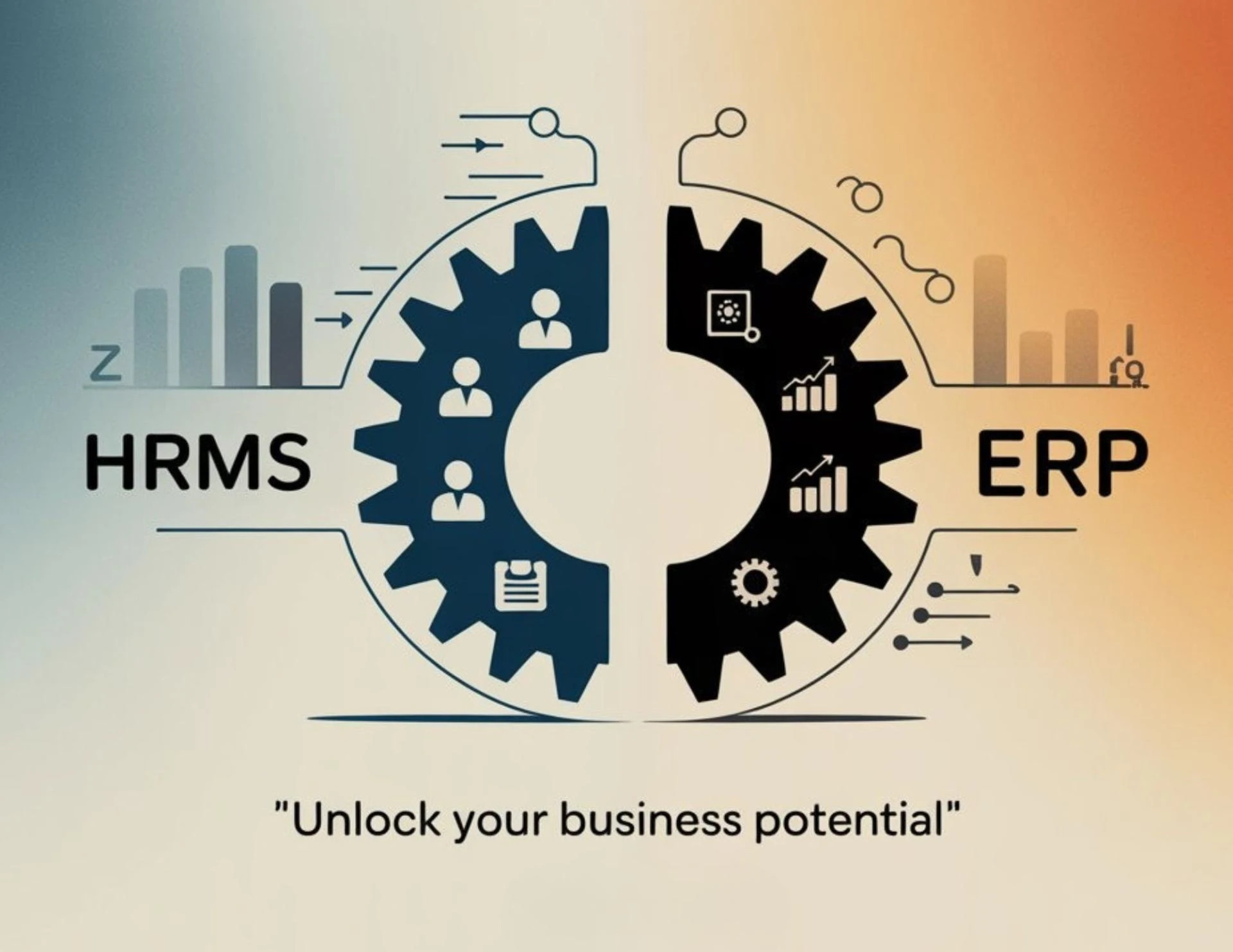
The scaling up of businesses in India, coupled with the digital transformation, has greatly pushed the need for efficient and integrated software solutions. At the very commonly talked-about areas are HRMS and ERP systems. Both have powerful features but serve different needs.
One question that we at an HRMS Software in India often receive from growing businesses is: "Should we invest in an HRMS or an ERP?"
Let's break this down simply, so you have the right understanding to pick that right for your organization.
What is HRMS?
Human Resource Management System-related software thus is a specialized software build path to streamline and automate all core HR functions, such as:
- Payroll and compliance
- Employee records
- Attendance and leave
- Performance appraisal
- Recruitment and onboarding
- Employee self-service
An HRMS is working with people management - making sure that your workforce continues to be productive, compliant, and engaged.
What is ERP?
An enterprise resource planning is in short meant to be a wider software that integrates multiple core functions of a business under one platform. Typical ERP modules include:
- Finance and accounting
- Inventory and supply chain
- Sales and CRM
- Procurement
- Human Resources (or else they would just call HRMS)
An ERP system is designed to manage an entire business process rather than processes just for Human Resources. It may contain an HR module, but usually, it's not as deep or customizable as a full-fledged HRMS.
Which One Does Your Business Really Need?
Let me help you decide based on your present business scenario.
✅ Select HRMS if:
You are a small- to medium-sized business working on workforce expansion.
You need not have all the financial bells and whistles EPR offers; you want a robust HR platform.
HR processes are manual or semi-automated.
If you are now maintaining records through manuals and spreadsheets, an efficient HRMS application like Doinsights will improve your workflow.
If you want rich HR features such as performance monitoring, payroll compliance, or self-servicing.
ERP HR modules in general lack these functionalities.
You want an improved employee experience.
Full HRMS will focus on employee-centric workflows, but an ERP platform may not be so focused.
✅ Choose ERP if:
You work as a large enterprise managing multiple departments with one roof.
ERP is well-equipped to merge data from all departments in finance, logistics, procurement, and HR.
You already have existing software systems to integrate.
An ERP will come in handy where you want your single system to connect your business end-to-end.
You have a dedicated IT team.
ERP systems are resource-heavy, often requiring technical support for customization and maintenance.
Real-World Example:
A manufacturing company in Ahmedabad approached Doinsights unsure of investing either in ERP or HRMS. While inventory and supply chain support were needed on the one side, on the other immediate pain was HR: complex shift scheduling, inconsistent payroll, and employee disengagement.
We advised them to go ahead with Doinsights HRMS to first tackle these critical issues. Over the course of six months, the organization slowly scaled into ERP and ecosystem integration, working towards a solution with higher workforce efficiency: Hence, the modular growth saved money and led to faster results.
Final Thoughts
The choice between HRMS and ERP is not about which is better - it is about which is right for your business objectives and size and current pains.
If your area of concern is people, productivity, and performance, you should consider starting with an HRMS like Doinsights.
If you are dealing with multi-departmental data that needs integration on an operational level, an ERP would perhaps be where you want to go — though with more complexity and price.
Many businesses in India today are taking the phased approach: starting with HRMS for immediate workforce management, then paving their way toward ERP as they grow.