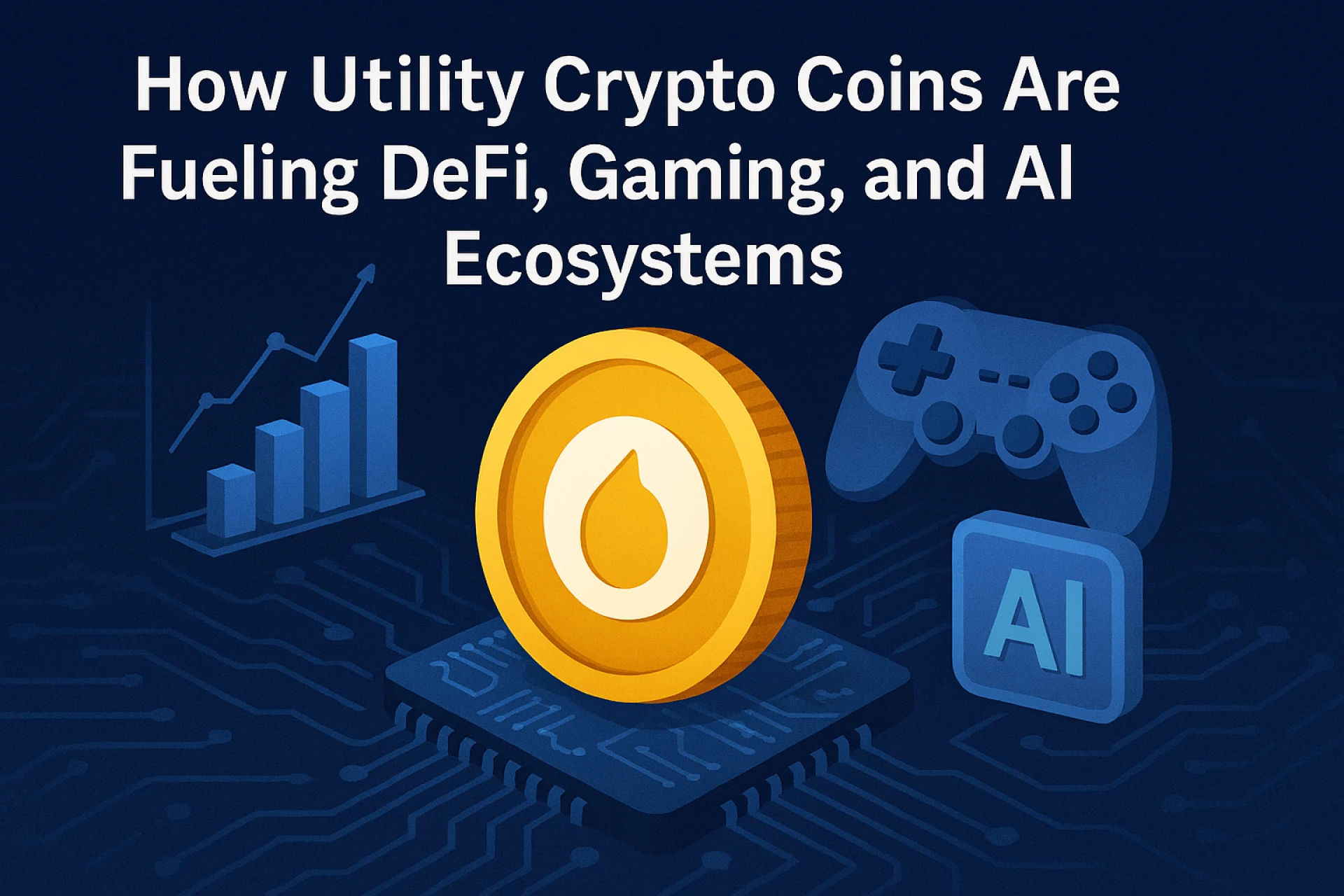
In the evolving landscape of digital finance and distributed systems, utility crypto coins have enabled new paradigms across decentralized finance (DeFi), interactive gaming economies, and emerging artificial intelligence (AI) infrastructures. Unlike store-of-value tokens or speculative assets, utility coins embody functional roles within decentralized applications, acting as essential instruments that facilitate network participation, governance, fee settlement, access rights, and incentive alignment. At the heart of this trend is the concept of Cryptocurrency Coin Utility — the pragmatic application of tokens as embedded value carriers that operationalize protocols rather than merely represent speculative value.
This article explores how utility coins serve as structural fuel in three fast-growing domains, unpacking their technological implications, economic mechanics, and ecosystem effects.
1. Defining Utility Coins: Beyond Speculation
Utility coins are digital tokens designed with explicit functional intent within a protocol or application. They differ from cryptocurrencies that primarily serve as stores of value or mediums of exchange in markets:
- Protocol Integration: Utility coins are often native to blockchain networks, encoded to interact with decentralized applications (dApps) through smart contracts.
- Economic Incentives: They align user behavior through reward mechanisms, staking, or participation rights.
- Governance Participation: Many utility tokens confer voting privileges on protocol upgrades, parameter changes, or treasury allocations.
- Service Access: Users may redeem tokens for access to premium features, compute resources, or specialized services.
While utility tokens can accrue market value, their inherent design focuses on enabling or enhancing functionality rather than price appreciation.
2. How Utility Coins Empower DeFi Infrastructures
Decentralized finance (DeFi) reconstructs traditional financial services using trustless protocols, often engineered on public blockchains like Ethereum, Solana, and Avalanche. Utility tokens are integral to DeFi mechanics because they encode economic incentives and governance parameters that maintain network cohesion.
Key Functional Roles of Utility Tokens in DeFi
- Liquidity Provision and Market Making
- Users deposit assets into automated market maker (AMM) pools and receive utility tokens as reward tokens or pool shares.
- These tokens represent ownership stakes or fee entitlements within the liquidity pool.
- Staking and Security
- Some DeFi systems use utility tokens to secure protocol operations through staking, aligning validator incentives with network integrity.
- Stakers are compensated in utility tokens proportional to their weighted contribution.
- Governance Participation
- Utility coins enable decentralized governance by granting holders voting rights on proposals related to fee models, risk parameters, or protocol forks.
- Fee Settlement
- Transactions within DeFi smart contracts often require fees paid in native utility tokens, which can then be burned, redistributed, or allocated to protocol reserves.
By embedding economic functions into token design, DeFi platforms can create self-sustaining ecosystems where participation is directly rewarded and transparent.
3. Utility Coins and the Rise of Tokenized Gaming Economies
The video gaming industry is undergoing a fundamental shift with the integration of blockchain technologies. Utility coins play a central role in enabling tokenized in-game assets, interoperable item schemas, and player-centric economic models.
Utility tokens are often used for:
- Asset Ownership and Transferability
- Players can truly own digital assets (skins, avatars, items) represented as non-fungible tokens (NFTs) or fungible utility tokens.
- Ownership rights are verifiable on decentralized ledgers, reducing dependence on centralized servers.
- Play-to-Earn (P2E) Models
- Titles are introducing reward systems where users earn utility tokens by completing tasks, contributing to ecosystems, or participating in community events.
- These tokens can be reinvested in game economies, traded, or utilized to unlock advanced experiences.
- Game Governance and Content Creation
- Certain games leverage utility coins to empower players to vote on game rule changes, content updates, or economic parameters.
- Facilitating a decentralized creative economy fosters community engagement and mod development.
Benefits Enabled by Utility Tokens in Gaming
- Player Incentive Alignment: Participants are rewarded for time and skill investment through token distributions.
- Interoperability: With shared token standards, assets can migrate across different game worlds or platforms.
- Monetary Transparency: On-chain transactions and token flows ensure clearer audit trails for in-game economies.
Through these mechanisms, utility coins are reshaping how value is created, shared, and monetized in interactive digital worlds.
4. AI and Utility Tokens: Incentivizing Decentralized Compute
Artificial intelligence applications increasingly rely on distributed compute, data markets, and collaborative model training. Utility tokens are emerging as coordination layers that incentivize contributions to AI ecosystems without central authority.
Utility tokens can enable the following:
- Compute Resource Markets
- Nodes offering GPU cycles or specialized hardware can be rewarded with tokens for participating in decentralized compute networks.
- Token-based compensation aligns supply and demand in resource-constrained environments.
- Data Contribution and Curation
- AI models require vast datasets. Contributors who provide high-quality, labeled data can be rewarded in utility tokens, promoting data availability and diversity.
- Model Sharing and Licensing
- Decentralized marketplaces can use utility tokens to govern access rights, licensing fees, and revenue sharing for AI models and APIs.
- Access to premium model endpoints can be token-gated.
By embedding economic incentives directly into AI infrastructure, utility tokens reduce friction in collaborative development, enhancing openness while preserving participants’ economic agency.
5. Risks, Challenges, and Future Directions
Although utility coins offer transformative potential, several challenges accompany their adoption:
- Regulatory Ambiguity
- Jurisdictions differ in how they classify utility tokens, leading to compliance complexities.
- Tokenomics Design
- Poorly constructed utility token models can result in inflationary pressure, misaligned incentives, or unsustainable reward structures.
- Security and Protocol Risks
- Smart contract vulnerabilities or oracle failures can compromise token utility, undermining ecosystem functions.
To address these concerns, ongoing research focuses on formal tokenomic frameworks, governance protocols with robust checks and balances, and cross-chain standards that enhance composability.
Conclusion
Utility crypto coins are foundational to the next wave of digital innovation in decentralized finance, immersive gaming, and AI infrastructure. By encoding functional roles directly into token architectures, these coins enable permissionless participation, transparent economic incentives, and decentralized governance. As real-world adoption expands, the careful design and integration of utility tokens will determine their resilience, scalability, and impact on the broader web3 ecosystem.