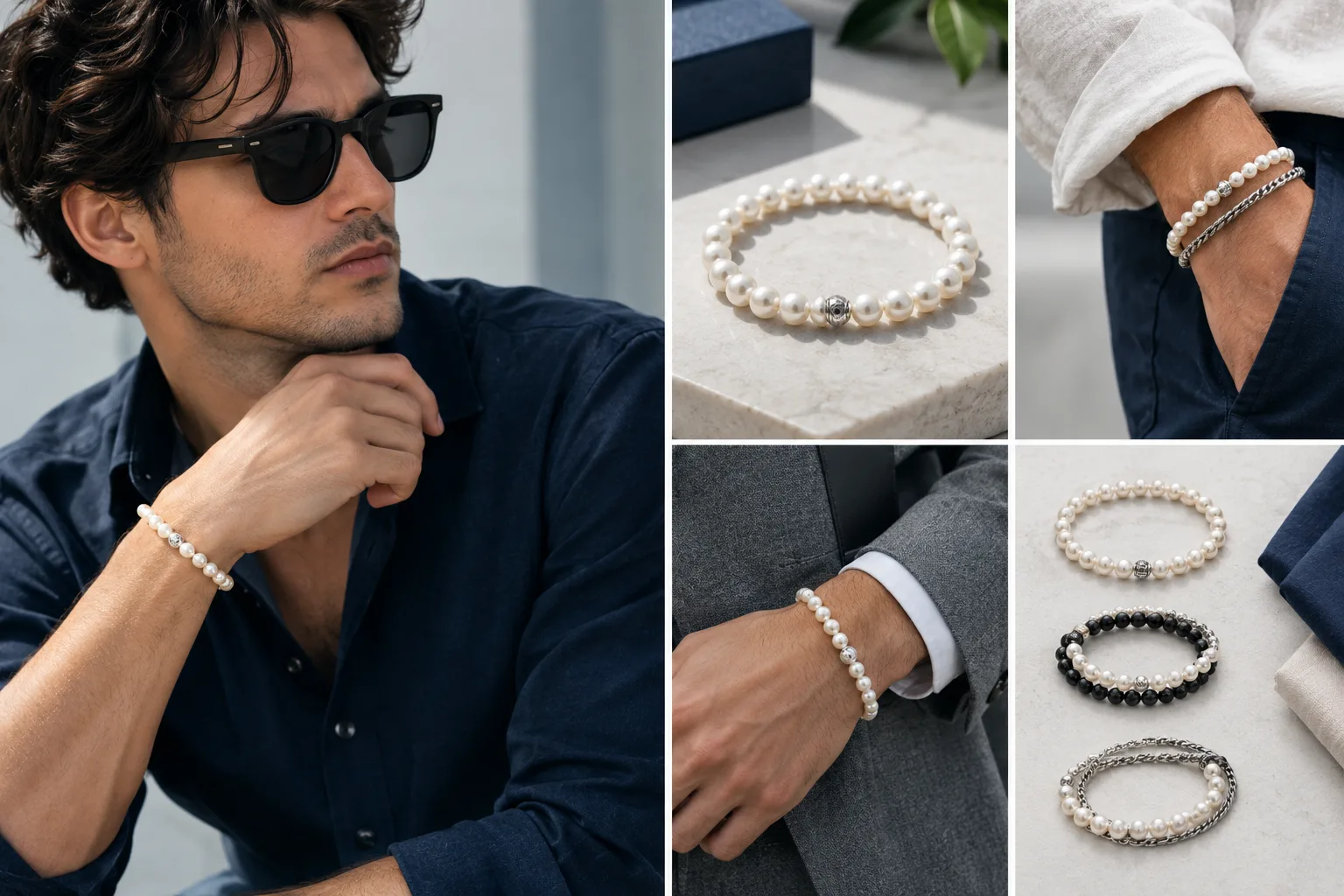
Pearl bracelets for men have become one of the fastest-growing jewelry categories of 2026. The reasons are straightforward: a bracelet is the lowest-commitment entry point into pearl jewelry for a man who is not yet sure how the material works with his style, it layers naturally with watches and other bracelets, and it does not require the same level of confidence to wear as a pearl necklace does.
The question most men ask is not whether they can wear a pearl bracelet. It is how. Which wrist. What to stack with it. Whether it works with a watch. How to match it to the rest of the look. These are the practical questions this article answers.
Why Start With a Bracelet
A pearl necklace is immediately visible. It sits at the collarbone, it is the first thing someone notices when they look at you, and it requires a clear decision about whether you are committed to wearing pearl jewelry. That commitment is worth making, but it is a bigger ask for a first piece.
A bracelet works differently. It sits on the wrist, partially obscured by a sleeve in colder weather, visible when the sleeve rolls up. It integrates into a wrist stack that might already include a watch or a beaded bracelet. The pearl element is present without being the only thing in the look. This is why most men who eventually build a full pearl jewelry collection start with a bracelet, not a necklace.
The other practical advantage is price point. The entry-level pearl bracelet in the Player collection at Aequa & Co. starts at $320 for the Player Lasso Bracelet in solid 925 sterling silver — a meaningful piece at a considered but not prohibitive price. This compares to pearl necklaces which start higher and require more commitment to the aesthetic.
The Four Pearl Bracelet Styles Worth Knowing
Not all pearl bracelets are the same. Understanding the four main design approaches helps you choose the right one for how you dress.
The mixed chain and pearl bracelet alternates pearl stations with metal links. The Player Lasso Bracelet is the clearest example — freshwater pearls spaced along a sterling silver chain, with the chain providing visual grounding and the pearls adding the organic element. This is the most versatile design because the metal proportion keeps it reading as a bracelet first and pearl jewelry second. It stacks naturally with watches and other chain bracelets, and it works across casual, smart casual, and business casual contexts.
The beaded pearl bracelet is multiple pearls strung together as the primary element, similar to a traditional beaded bracelet in construction but with pearls as the bead material. The Player Oou Bracelet uses this approach. It reads bolder than a mixed chain design because the pearl is the dominant material rather than an accent. Best worn as a single piece or stacked with one contrasting texture — a thin leather bracelet or a matte beaded bracelet — rather than with other pearl pieces.
The cluster or station pearl bracelet groups pearls at intervals rather than distributing them evenly. The Player Tri Locke Bracelet places three freshwater pearl clusters at set points along a chain. This creates focal points rather than a continuous pearl surface, which reads as more architectural and less traditional. It is the most modern aesthetic of the three and works particularly well with minimalist or streetwear-influenced outfits.
The pearl and metal combination bracelet mixes pearls with other materials — sterling silver cube links, chain links, or geometric metal elements. The Player Cube Bracelet, which combines freshwater pearls with solid sterling silver cube links, is a good example of a mixed material approach that reads clean and deliberate without the pearl being the only story.
Which Wrist and How to Size It
Most men wear bracelets on the non-dominant wrist — the left wrist for right-handed men, the right wrist for left-handed men. This is convention rather than rule, and it exists because the non-dominant wrist sees less impact during daily activities. If you wear a watch, it typically sits on the non-dominant wrist, which brings up the stacking question covered below.
On sizing: a pearl bracelet should sit comfortably on the wrist with a small amount of movement — enough that it shifts slightly when your arm moves, not so much that it slides down to your palm. Most pearl bracelets are sized for a standard men's wrist circumference of 6.5 to 7.5 inches. Measure your wrist with a flexible tape measure or a strip of paper and add half an inch to an inch for the fit allowance.
The Player collection bracelets at Aequa & Co. are sized for men's wrists specifically. This matters because pearl jewelry designed for women's wrists — smaller diameter, shorter chain lengths, lighter weight — looks and sits differently on a man's wrist, and the proportion is immediately visible.
Wearing a Pearl Bracelet With a Watch
Yes, a pearl bracelet and a watch on the same wrist works. The combination that works best is a pearl bracelet that contrasts the watch in weight and texture. A heavy steel or gold sports watch paired with a lighter pearl and chain bracelet on the same wrist reads as a deliberate, layered look. A thin dress watch paired with a pearl bracelet of similar visual weight also works.
What does not work as well is two pieces of the same visual weight and similar texture competing on the same wrist. A heavy chunky chain bracelet plus a pearl bracelet plus a large watch together reads as too much without enough contrast.
The practical approach: if you wear a watch and want to add a pearl bracelet, start with a single pearl bracelet on the same wrist. The mixed chain and pearl style works best here because the chain element ties it to the watch's metal without matching it exactly. Wear it for a week and see how it sits with your specific watch before adding anything else.
If you want to keep the watch wrist clean, wear the pearl bracelet on the opposite wrist. One piece, one wrist, no competition.
Stacking Pearl Bracelets With Other Bracelets
Pearl bracelet with a beaded bracelet. The contrast between the pearl's organic luster and the matte texture of a stone bead bracelet — onyx, lapis, malachite, meteorite — is the most effective pearl stack combination. The textures read as distinctly different, so the pieces complement rather than compete. The Outlaws collection at Aequa & Co. covers beaded bracelets in exactly these materials, and the combination of an Outlaws beaded bracelet with a Player pearl bracelet is the most cohesive mixed-collection stack available.
Pearl bracelet with a thin chain bracelet. A thin sterling silver or gold curb chain bracelet adds a third element without adding visual weight. It connects the pearl bracelet to a metal element and creates a layered look that reads intentional. Keep the chain bracelet lighter than the pearl bracelet so the pearl remains the focal piece.
Pearl bracelet alone. This is underrated. A single well-chosen pearl bracelet on a wrist with nothing else — no watch, no other bracelets — makes a clearer statement than a stack of three pieces. If you are new to pearl jewelry, start here. The piece does its job when it has space to be seen.
What to avoid. Two pearl bracelets on the same wrist at the same time. The effect is redundant rather than layered. If you own multiple pearl bracelets, alternate them rather than stacking them together. Also avoid stacking a pearl bracelet with a very heavy statement piece — a wide bangle or a thick chain bracelet — as the pearl reads too delicate next to heavy metal and the proportions do not balance.
Matching a Pearl Bracelet to Your Outfit
Pearl bracelets work across more outfit contexts than most men expect. The key is matching the weight and material of the piece to the register of the look.
Casual wear. A pearl and chain bracelet like the Player Lasso works with a plain tee, jeans, and clean trainers without any adjustment to the rest of the look. The bracelet adds refinement without overdressing the outfit. Keep the rest of the jewelry minimal — one ring at most, nothing else on the wrist besides the bracelet.
Smart casual. An open collar shirt, chinos or tailored trousers, leather sneakers or loafers. A pearl bracelet in solid sterling silver or solid gold sits naturally in this context. The Player Tri Locke Bracelet with its pearl clusters at intervals is particularly well-suited here — the design is considered and the solid sterling silver reads as fine jewelry rather than fashion jewelry.
Business casual. A collar, structured trousers, dress shoes. A pearl bracelet under a shirt sleeve, visible when the sleeve moves, is a quiet detail that adds personality without demanding attention. The mixed chain and pearl design works best here — it reads more discreet under a cuff than a fully beaded pearl design.
Formal. If you are in a suit or black tie, a pearl bracelet is generally the wrong piece for the wrist. Pearl cufflinks are the correct application of pearl jewelry in formal contexts. The Player collection includes pearl cufflinks for exactly this.
A Note on the Setting
For a pearl bracelet specifically, the setting material determines how the piece holds up over time and how it looks in six months, two years, and five years.
Pearl bracelets built in plated metal show wear at the clasp and the links before the pearl shows any deterioration. The plating wears at the points of most contact and movement. Once the base metal is exposed, the piece changes character significantly.
Pearl bracelets built in solid 925 sterling silver or solid gold do not have this limitation. The metal develops a natural patina over time but does not degrade. The Player collection at Aequa & Co. is built exclusively in solid 925 sterling silver, solid 14K and 18K gold, and 18K gold vermeil over sterling silver for this reason.
Where to Start
If you are buying your first pearl bracelet and want the most versatile starting point, the Player Lasso Bracelet in solid 925 sterling silver at $320 is the correct choice. It works with a watch or without, stacks naturally with a beaded bracelet, and suits casual and smart casual contexts equally well. For more on daily wear and care, the full guide covers what to expect over time.
If you want something bolder as a single statement piece, the Player Tri Locke Bracelet at $490 has the presence to wear alone without needing a stack around it. And if you are still deciding between pearl types before committing to a piece, there is a full breakdown of the differences worth reading first.
Browse the complete men's pearl bracelet range at Aequa & Co. and find the piece that fits how you actually dress.